
Real-time gym announcements are live messages, such as a class delay, room change, or busy-floor alert, pushed to members the moment conditions change through TV displays, in-gym audio, push notifications, or SMS. The fastest way to start sending them is to pick one unified dashboard and publish a short templated message to your main screens and your members' phones at the same time.
TL;DR:
- Screens and in gym audio update almost instantly, while push notifications and SMS usually arrive within seconds; email and social are not truly live.
- Track attendance stability, push notification opens, and front desk interruptions for two weeks before launch, then compare the same measures two weeks afterward.
- A direct API connection is generally the most dependable scheduling link; webhooks suit events such as cancellations, while prebuilt connectors depend on ongoing maintenance.
- Start with screens near the busiest room, confirm the workflow works, then add audio and mobile alerts; launching all channels at once risks abandonment.
Table of Contents
- Where Members See Real-Time Announcements
- Why Real-Time Announcements Matter for Members and Operators
- Tools and Technology Categories Worth Evaluating
- Setting Up Real-Time Announcements Step by Step
- Keeping Multi-Room Announcements in Sync
- Making Live Announcements Sustainable, Not Just Flashy
- How Kingdom Signage Brings It All Together
- FAQ
- Sources
Where Members See Real-Time Announcements
Members encounter live updates through whichever channel they happen to be near, so operators need a consistent message across all of them. Each channel has its own strengths, its own limits, and its own expected delay.
Digital signage on gym TVs works well for anyone currently on the floor. A screen near the free weights or at the front desk can rotate a class-starting notice, a room change, or a "floor is busy" alert within seconds of being published.
In-gym audio, paired with automatic music ducking, is the fastest way to reach people mid-workout without making them look up. A short spoken announcement over the PA, with the music volume dropped for a few seconds, gets noticed even with headphones on.

Mobile push, SMS, email, and a website or app-based live-status widget cover members who are not on-site yet, whether they are driving over or deciding whether to come at all. Social posts work for broader, less time-sensitive updates, like a holiday hours change announced a day ahead.
Short templates make this manageable across channels:
- Class starting: "Spin with Dana starts in 5 in Studio B."
- Delayed: "6pm HIIT pushed to 6:15. Grab water and stretch."
- Canceled: "7am yoga is canceled today. Sorry for the short notice."
- Room change: "Strength class moved from Studio A to the main floor."
- Busy alert: "Free weights area is at capacity. Try the turf space or check back in 15."
On-screen and audio messages land almost instantly. Push and SMS typically arrive within seconds, while email and social posts are better treated as near-instant rather than truly live. Our front desk signage essentials guide covers how to use the arrival point specifically to cut confusion before members even reach the floor.
Why Real-Time Announcements Matter for Members and Operators
Members benefit from clarity they did not have before: knowing a class moved rooms, that the floor is crowded, or that a trainer is running late saves a wasted trip or an awkward wait at a locked studio door. That clarity shows up in attendance and in fewer members who leave annoyed after a mixup.
Operators get a quieter front desk. Instead of fielding the same question five times during a schedule change, staff can point to a screen or let a push notification do the explaining. Class transitions run smoother when the outgoing group sees a "wrapping up in 2 minutes" cue and the incoming group sees "Starting now in Studio B" before they even open the door.
A few metrics are worth tracking as you roll this out:
- Attendance stability: compare no-show rates before and after live delay or cancellation alerts.
- Push engagement: track open rates on time-sensitive messages versus general promotions.
- Front-desk interruptions: log how often staff get asked about schedule changes in a given week.
One practical approach to measuring results: set a two-week baseline on these three metrics before turning on live announcements, then compare the same metrics two weeks after launch to see whether the gap closes.
Industry coverage of shifting gym floor layouts, with more resistance-training zones and fewer cardio machines, points to a growing need for crowd-flow technology in concentrated training areas, which is exactly where busy-floor alerts earn their place.
Tools and Technology Categories Worth Evaluating
Before picking a tool, it helps to know the categories you are actually choosing between, since vendors mix and match these capabilities differently.
- Unified signage and audio platforms that control TVs, room audio, and class displays from one dashboard, which matters most once a gym has more than one room or screen.
- Scheduling systems that expose webhooks or an API, so a class change in your booking software can trigger a screen or audio update automatically instead of needing a manual re-entry.
- Mobile engagement platforms covering app push notifications and SMS, aimed at members who are off-site or between visits.
- Web and app widgets showing live class status or current floor occupancy, useful for members deciding whether to drive over right now.
Whatever category you lean toward, a short list of features separates a system that works under pressure from one that looks good in a demo:
- Live publish, meaning a message goes out the moment someone sends it, not on a delayed refresh cycle.
- Multi-room sync, so the same update appears correctly across every screen and speaker zone at once.
- Scheduling overrides, letting staff interrupt a pre-set rotation for an urgent message without breaking the rest of the schedule.
- Offline fallback content, so a screen with a dropped connection still shows something useful instead of a blank or frozen frame.
- Basic analytics, to see which messages got seen or opened.
- Role-based permissions, so only the right staff can publish to all locations versus just their own room.
Integration method matters for reliability as much as feature count. A direct API connection to your scheduling software tends to be the most dependable, webhooks work well for event-triggered updates like a last-minute cancellation, and prebuilt connectors save setup time but are only as good as how often they are maintained. Promotional and event-driven content, like a new class launch displayed on gym TVs, is often the first use case operators test before expanding into live operational alerts.
Setting Up Real-Time Announcements Step by Step
Getting from "we should do this" to a reliable live-announcement system takes a short sequence of steps, not a long project plan.
- Audit your spaces. Walk the gym and map every TV, speaker zone, and Wi-Fi dead spot. Note which rooms share a network segment and which run on separate hardware.
- Connect your scheduling system. Link class bookings to your signage platform so room changes and cancellations populate automatically instead of needing manual re-typing.
- Set staff roles. Decide who can publish to every screen gym-wide versus who can only update their own studio, and lock that down before launch.
- Build your templates. Draft the five or six message types you will reuse constantly: delay, cancellation, room change, busy alert, and closing-soon notice. Keep each under 15 words.
- Design for quick reading and hearing. Use plain language, repeat the key detail once, and give audio announcements a clear volume floor so they cut through music without startling anyone.
- Write a publishing playbook. Name who approves urgent messages, who can override without approval during an emergency, and how escalations get handled if a system goes down mid-class.
- Run a dry test. Send a test message to every screen and phone type before go-live, and check actual delay time from publish to display.
- Set a check cadence. Review message logs weekly for the first month, then monthly after that, adjusting templates based on which ones get ignored.
Pro Tip: Keep a single "closing early" and "system down" fallback message saved and ready to publish with one click, since those are the two situations where staff have the least time to compose something on the fly.
Our digital signage setup guide walks through the initial hardware and network configuration in more depth, and the studio schedule display examples page is a useful reference when building your own template layouts.
Keeping Multi-Room Announcements in Sync
Running live announcements across several rooms exposes problems a single-screen setup never hits. Clock drift between devices can make a "starting now" message appear a few seconds early on one screen and late on another. A stalled device that missed its last check-in will keep showing yesterday's schedule. Network packet loss on a crowded gym Wi-Fi network can drop part of a push to mobile while the TV update goes through fine.
The fixes are mostly about discipline, not complexity:
- Sync device clocks to a network time source so every screen and speaker agrees on "now."
- Run automated health checks on each display and audio zone so a stalled device gets flagged before a member notices a stale message.
- Use staggered retries for failed pushes instead of one single attempt, so a brief network hiccup does not mean a missed alert.
A reliable pattern we recommend is orchestrating the publish action itself: one button press updates the screen visuals, triggers audio ducking for a spoken version, and fires the mobile push, all from the same event instead of three separate manual steps. That keeps the wording and timing consistent across channels, which matters more than any single channel being perfect on its own.
Pro Tip: Test your full multi-room publish flow at least once a week during a real class transition, not just during a quiet maintenance window, since that's when network load and clock drift actually show up.
We cover this in more detail in our guide to real-time content updates and in our breakdown of how gym networks support multiple displays, including the network segmentation choices that make staggered retries actually work.
Making Live Announcements Sustainable, Not Just Flashy
The mistake we see most often is treating real-time announcements as a launch event instead of an ongoing habit. A gym rolls out screens and push notifications for a grand opening, gets a burst of attention, and then the templates go stale within a month because nobody owns the publishing workflow day to day.
Unified control matters most in gyms with more than one room precisely because it removes the excuse. When updating three screens and a speaker zone takes three separate logins, staff quietly stop bothering during a busy Tuesday evening. When it takes one action, the habit actually survives contact with a real shift.
Start with a single channel, usually the screens closest to your busiest room, prove the workflow works, and then expand to audio and mobile push once staff trust the process. Gyms that try to launch every channel on day one tend to abandon half of them by week three.
— Kingdom
How Kingdom Signage Brings It All Together
We built Kingdom Signage around the exact problem this article describes: gyms running TVs, class schedules, room audio, and live updates through separate logins and separate hardware. Our dashboard lets one person publish a message and have it appear across multiple screens, speaker zones, and connected mobile channels at once, without switching tools.
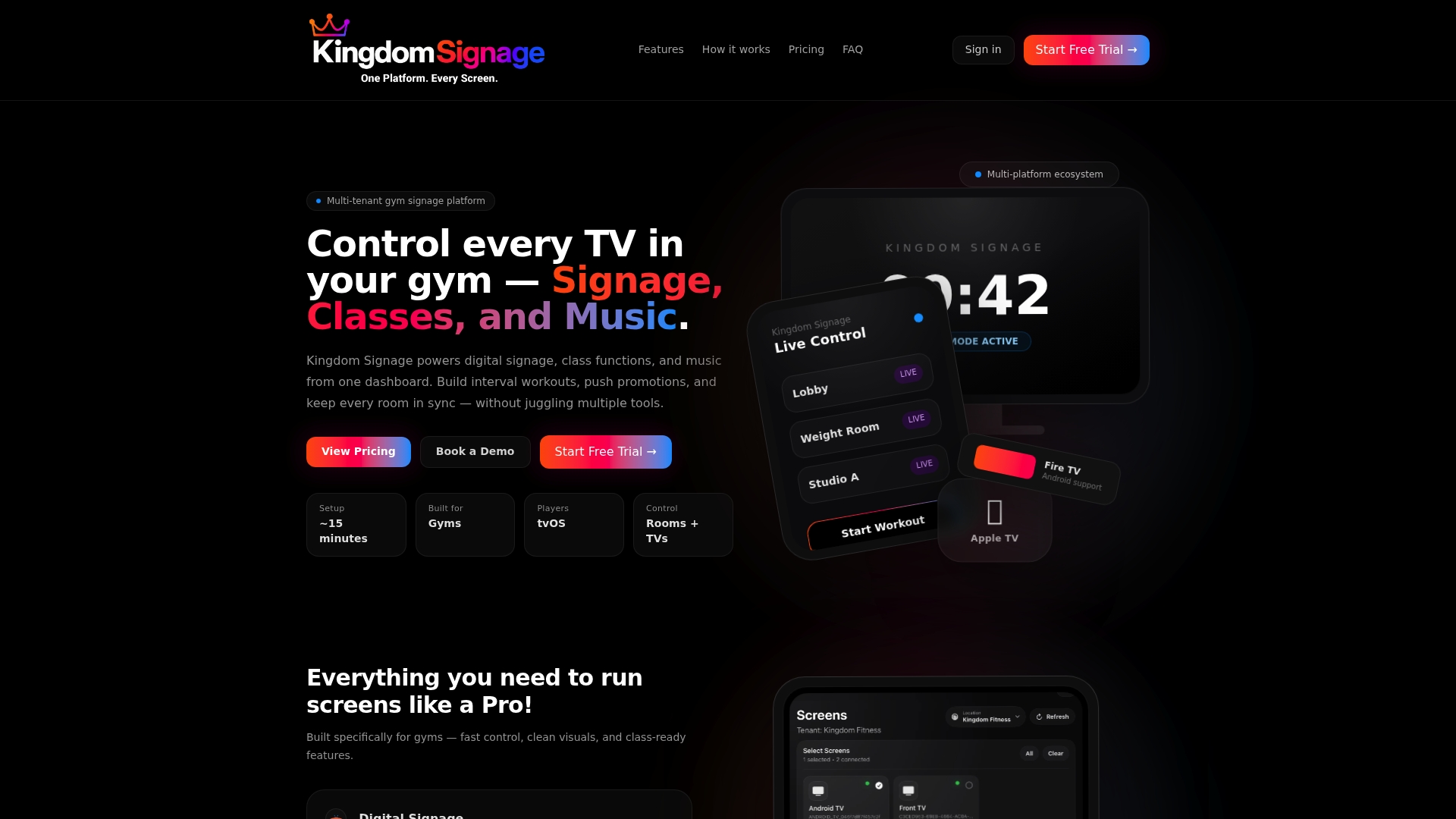
We work best for multi-room studios and gym franchises managing multiple locations, since that is where manual updates break down fastest.
- Unified dashboard for TVs, class schedules, and room-based audio.
- Multi-room sync that keeps visuals, audio ducking, and push notifications aligned from one publish action.
- Live publish and scheduling overrides for urgent or last-minute announcements.
If your front desk is still fielding the same schedule question five times a shift, start a demo at Kingdomsignage and see how one dashboard handles it instead.
FAQ
What are some recent gym news stories operators should know about?
Recent coverage includes new concept locations opening with expanded amenities, such as Amped Fitness' Amped Universe debut in Margate, Florida, and equipment brands launching premium product lines tied to athlete partnerships. These openings and launches are common reasons gyms lean on live screens and push notifications to spread the word quickly.
What is the 3-3-3 rule in gym routines?
The 3-3-3 rule is a trending workout split with three days of strength training, three days of cardio, and three days of rest each week. Operators can build recurring class or announcement templates around this pattern to reduce the amount of manual scheduling work each week.
Is there a way to check how busy a gym is in real time?
Many gyms now offer a live-status widget on their website or app showing current floor occupancy, alongside in-gym screens posting a "busy" or "open" alert for specific zones. Checking your gym's app or website before heading over is usually the fastest way to see current conditions.
What are some recent fitness news headlines worth watching?
New studio openings, amenity expansions, and equipment partnerships have been steady themes, including reports on recovery-focused amenities at newly opened locations and brand ambassador deals tied to new equipment lines. These stories generally point to gyms competing more on experience, which is pushing more operators toward faster, more consistent member communication.
How quickly do real-time gym announcements actually reach members?
On-screen displays and in-gym audio update almost instantly once a message is published, while mobile push and SMS typically arrive within seconds. Email and social media posts are better treated as near-instant updates rather than truly live ones.
Sources
- What is the 3-3-3 gym rule, and does it work? | Tom's Guide
- How the 3-3-3 rule helped me stick to an exercise routine | Lifehacker
- Amped Fitness' Much-Anticipated Amped Universe Will Officially Debut October 12 in Margate, Florida