
Cue-based video playback is scheduled or trigger-driven media delivery that times class videos, promotions, and timers to specific moments, synced with music and timers across multiple room displays. For gym operators, the payoff is a consistent class experience: fewer instructor interruptions, no scrambling to hit play on time, and promotions that run exactly when they should. Accessibility guidance from Section508 and platforms built for fitness shape how this works in practice.
TL;DR:
- Live booking integrations update displays within 30 to 60 seconds, while polling can lag 5 to 15 minutes and leave class names or times stale.
- Distributed players cache content locally and follow shared NTP or PTP clocks, so brief network outages do not blank screens or desynchronize rooms.
- Section 508 and WCAG require captions for prerecorded synchronized media, and controls belong beside volume; human reviewed captions catch counts and music cues.
- Pilot in one or two rooms after rehearsing manual triggers and network failure, then verify proof of play logs, heartbeats, and timing across cue cycles.
Table of Contents
- How cue-based playback systems are built
- Scheduling patterns and triggers that work for class operations
- Keeping audio and video synchronized across rooms
- Accessibility requirements for prerecorded class video
- A short checklist for testing and verifying cue timing
- We built our platform around the idea that gyms shouldn't need separate tools for signage, class scheduling, and room audio. Pulling scheduling, audio zoning, and screen control into one dashboard removes the handoffs between systems that usually cause missed cues or mismatched audio in multi-room setups.
- Ready to pilot cue-based playback in your gym?
- FAQ
- Sources
How cue-based playback systems are built
A cue-based system has a few moving parts that work together instead of relying on one box doing everything.
- Cloud CMS: the central dashboard where you build schedules, upload content, and manage every room from one login.
- Distributed edge players: small devices at each screen that store content locally and execute cues on their own clock.
- Scheduling engine: the logic that decides what plays, where, and when, based on calendar entries or live triggers.
- Audio integration: ties video playback to room-specific sound zones so music and class audio stay matched to what is on screen.
- Instructor remote controls and APIs/GPIO: let a trainer or an external system fire a cue manually or programmatically.
Cues generally fall into five categories: scheduled time-of-day cues, calendar or API-driven cues tied to booking changes, manual cues an instructor triggers from a phone or button, sensor or IO-based cues tied to physical equipment, and timecode-based cues that keep multiple screens frame-aligned. A manager's guide to multi-room gym displays breaks down how these categories map to typical studio layouts.
Streaming everything from a single central server sounds simpler, but it creates one point of failure and adds latency as rooms multiply. Distributed players that cache content locally and sync to a shared clock handle network hiccups far better, which matters once you are running more than one or two rooms at once.
Scheduling patterns and triggers that work for class operations
Most studios build cue sequences around recurring class templates rather than one-off events.
- Chain a warm-up, interval set, and cooldown into a single template so the player advances automatically without instructor input.
- Give instructors a manual override, usually a mobile app button or a wall-mounted hardware trigger, for when a class runs long or short.
- Connect scheduling to live booking data rather than a static calendar export; live API integrations update displays within 30 to 60 seconds of a booking change, while polling-based refreshes lag 5 to 15 minutes and often show stale class names or times.
- Map each trigger to a bundle of actions, not just a video. A single cue might start playback, duck the room's zone audio, enable captions, and start the class timer in one step.
An instructor remote control guide covers mobile UX patterns for trainers who need a trigger they can hit mid-set without breaking stride. For promotions, pairing live API data with scheduled cues keeps front-desk and lobby screens accurate; a front desk signage guide and a class promotions display guide walk through placement and timing choices.
Pro Tip: Build a five-second buffer into chained cues so a slightly late trigger never cuts off the end of the previous segment.
Keeping audio and video synchronized across rooms
Drift between rooms, where one screen is a beat ahead of another, is the most common complaint in multi-room setups, and it is almost always a clock problem rather than a content problem.
- Use distributed players with NTP or PTP timecode triggers. This approach is the preferred method for syncing large facilities because local timecode keeps each player accurate even when the network has a momentary hiccup, rather than depending on a continuous single-server stream.
- Segment AV traffic onto a dedicated VLAN and apply QoS rules that prioritize media traffic over general gym Wi-Fi, which prevents member device congestion from disrupting playback.
- Run wired Cat6 connections as the primary transport for each player, with Wi-Fi reserved as a fallback rather than the default.
- Confirm your platform offers heartbeat monitoring, remote reboot, and diagnostics. Remote device management with offline fallback is now considered baseline functionality, not a premium add-on, and it should let cached content keep playing during an outage instead of leaving screens blank.
A kiosk mode checklist and a remote gym display management guide go deeper on locking down devices and configuring offline behavior.
Accessibility requirements for prerecorded class video
Captioning is not optional for prerecorded synchronized media. Section 508 and WCAG guidance require captions on this content and call for closed caption and audio description controls to sit at the same menu level as volume or program selection, not buried in a submenu.
- Use human-reviewed captions rather than relying on auto-generated text alone; auto-generated captions frequently fail accuracy checks for fitness-specific terms, rep counts, and music cues.
- Label speakers when more than one voice appears in a video, especially for team-taught classes.
- Describe on-screen timers and rep counts in captions when they carry information not spoken aloud.
- Produce a separate audio-description track for any video where visual demonstration matters more than narration, and label files clearly before upload.
Caption accuracy matters because automatic captioning struggles with branded terms, counts, and music, which raises both member confusion and accessibility risk if left unchecked. An ADA signage audit guide covers the legal side in more detail for facility managers.
A short checklist for testing and verifying cue timing
Before trusting a cue schedule with a full class roster, run it through a short verification process.
- Pull proof-of-play logs to confirm each scheduled asset actually played at the intended time, not just that it was queued.
- Check timestamped heartbeats from every player to catch devices that silently dropped offline.
- Validate content checksums so you know the file that played matches the file you uploaded, not a corrupted or outdated version.
- Run a rehearsal schedule a day before a launch, including manual trigger tests and a simulated network outage to confirm offline fallback works.
- Measure timing drift across rooms during the rehearsal, not just once but across several cue cycles.
- Set alert thresholds for missed cues or offline devices, and keep logs retained long enough to troubleshoot recurring issues.
Roll out in stages rather than all at once: pilot in one or two rooms, expand location by location once the pilot holds steady, then shift into ongoing monitoring with iterative fixes as new content types get added. A guide to gym screen uptime covers how these checks tie back to member experience and retention.
We built our platform around the idea that gyms shouldn't need separate tools for signage, class scheduling, and room audio. Pulling scheduling, audio zoning, and screen control into one dashboard removes the handoffs between systems that usually cause missed cues or mismatched audio in multi-room setups.

In practice, this looks like multi-room audio ducking during announcements, music visuals that stay matched to the room they're playing in, and instructor remote control that doesn't require a separate app for every function. Centralizing scheduling also simplifies caption delivery, since caption files live with the same asset an instructor triggers rather than in a separate media library.
The result for operators is fewer interruptions during class and less time spent reconciling what played where.
— Kingdom
Ready to pilot cue-based playback in your gym?
A good next step is small: audit your current screens, confirm your caption files meet accessibility requirements, and pilot a cue sequence in one or two rooms before rolling it out facility-wide.
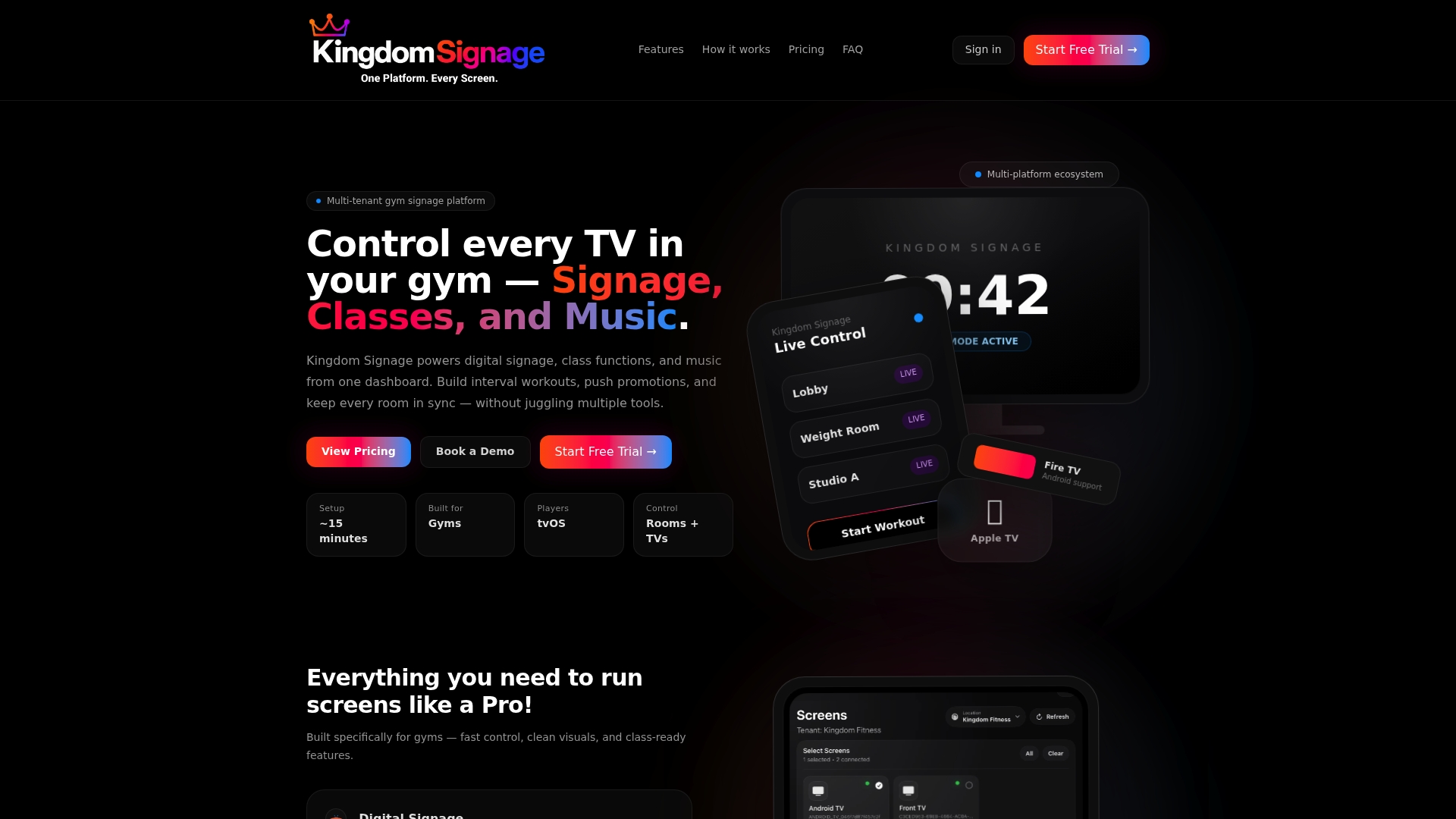
If you're weighing whether to build this with separate tools or consolidate it, our team can walk you through what a unified setup looks like for your room count and class schedule. For studios experimenting with audio-reactive content for classes or events, this primer on building audio-reactive visuals is a useful reference for pairing music and visuals in real time. When you're ready to see cue-based scheduling and multi-room audio control in action, book a demo with Kingdom Signage.
FAQ
What triggers a cue in a gym video playback system?
A cue can be triggered by a scheduled time, a calendar or API update from your booking system, a manual button an instructor presses, a sensor or IO signal from equipment, or a timecode match used to keep multiple rooms aligned. Most gyms combine scheduled cues for regular classes with manual overrides for flexibility.
How do I stop video and audio from drifting out of sync across rooms?
Use distributed players with NTP or PTP timecode triggers rather than streaming from one central server, since local timecode keeps each player accurate even during brief network issues. Pairing this with a dedicated AV network reduces most drift problems reported in multi-room setups.
Are captions required for prerecorded gym class videos?
Yes. Section 508 and WCAG guidance require captions for prerecorded synchronized media, and caption or audio-description controls need to be accessible at the same level as volume controls. Human-reviewed captions are recommended over auto-generated ones for fitness content with counts and music cues.
What happens to cue-based playback if the network goes down?
Systems with remote device management and offline fallback keep playing cached content locally on each player until connectivity returns. This is why distributed players that store content on-device, rather than streaming continuously, are the more reliable choice for gyms.
How do I verify that a scheduled cue actually played correctly?
Check proof-of-play logs and timestamped heartbeats from each player, which confirm both that the asset played and that the device was online at the scheduled time. Running a rehearsal schedule with manual trigger tests before a live rollout catches most timing issues early.
Sources
- Section508
- The USB Paradox: Why Digital Signage Without Remote Management is a Relic of the Past | AVIXA Xchange
- Open-source time synchronization services for data center operators | NVIDIA Developer Blog
- Glofox blog: API integrations