
A gym content management system (CMS) is a centralized platform that controls and automates digital content delivery across every screen, portal, and app in your facility. Most gym owners think of CMS as a back-office tool, but the industry now classifies it as a member experience engine that drives retention, fills classes, and delivers promotional messages without manual effort. This guide explains what a gym CMS actually does, how it differs from generic gym management software, and what separates a well-run implementation from a stale, underperforming one.
What is a gym content management system, and what does it do?
A gym CMS is defined as software that gives operators a single dashboard to schedule, publish, and update digital content across all facility touchpoints. Those touchpoints include lobby screens, workout floor TVs, member portals, and mobile apps. The system automates content delivery so the right message appears at the right time without a staff member manually switching slides or updating a playlist.
The standard industry term for this category is "digital content management system," but the fitness-specific version adds layers that generic platforms lack. A gym CMS connects directly to membership databases, class schedules, and operational modules. That connection means a screen in the spin room can automatically display the next class time pulled from the live schedule, not a static image someone updated last Tuesday.

Gym CMS platforms differ from general gym management software in one critical way. General gym management software handles billing, check-ins, and member records. A gym CMS handles what members see and hear while they are inside your facility. The two categories overlap in data sharing, but their core functions are distinct. Treating them as interchangeable is the most common mistake gym operators make when evaluating fitness content platforms.
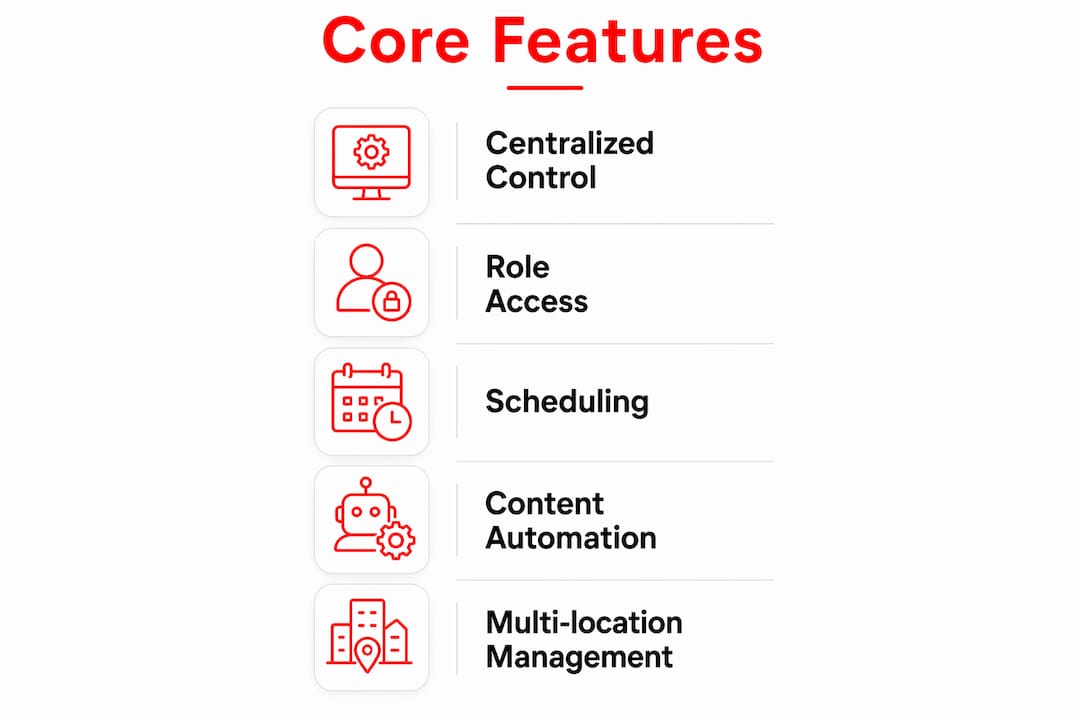
What are the core features of a gym CMS?
The features that define a capable gym CMS fall into four functional categories.
- Content scheduling and automated playback. Operators set content to run on specific screens at specific times. A morning playlist of motivational content switches automatically to class promotion content at midday without any manual input.
- Centralized playlist and media management. All workout videos, promotional graphics, schedule boards, and challenge announcements live in one library. Staff pull from that library to build screen playlists rather than hunting through shared drives.
- Membership database integration. The CMS reads member data to trigger personalized communications. A member who has not visited in two weeks can receive a targeted re-engagement message on the app or member portal.
- Role-based access controls. Role-based permissions let managers control which staff members can edit content and on which screens. A front desk employee can update the lobby announcement without touching the workout floor display settings.
Pro Tip: Separate your content creation workflow from your CMS scheduling workflow. Build and approve all creative assets in a dedicated folder or tool first, then upload finished files to the CMS for scheduling. This prevents half-finished graphics from going live and keeps your brand consistent across every screen.
The role-based access feature matters most in multi-location gyms. Brand consistency across locations depends on controlling who can publish what and where. Without permissions, a single staff member at one location can override the brand standard for the entire network.
How does a gym CMS improve member engagement and retention?
Content strategies delivered through an effective gym CMS improve 90-day member retention by 25–35%. That figure matters because 50% of new members quit within six months. A CMS gives operators a direct tool to close that gap through consistent, relevant content that keeps members connected to the facility between visits.
The content types that produce the strongest engagement results are:
- Weekly programming updates displayed on screens and pushed to the member portal, so members always know what classes and challenges are coming.
- Motivational tips and member spotlights that create a sense of community and belonging.
- Progress challenges with clear milestones, displayed on lobby screens to encourage participation.
- Promotional messages for membership upgrades, personal training packages, and retail offers.
Industry experts now classify CMS platforms as "member experience engines" that connect facility management with human-level communication through data-driven personalization. That shift in classification reflects a real change in how operators use these tools. The CMS is no longer just a scheduling board. It is the primary channel through which a gym communicates its culture and value to members every day.
Personalized communications triggered by CMS data integration produce the highest conversion rates. When a member's attendance data triggers a targeted "we miss you" message or a class recommendation based on past bookings, the response rate climbs significantly compared to generic broadcast messages. Effective gym CMS content must also include explicit calls-to-action to convert engagement into business growth. Attention without direction produces no revenue.
What are the common pitfalls when implementing a gym CMS?
Gym CMS platforms typically cost $150 to several hundred dollars monthly, with 2–4 weeks required for initial setup including station configuration and content playlist building. That timeline assumes the operator has content ready to load. Operators who underestimate content preparation consistently run over the setup timeline.
The most damaging mistake in gym CMS implementation is treating the system as a set-it-and-forget-it tool. A gym CMS requires integration into weekly operational workflows to avoid content staleness. Screens showing a January challenge promotion in March signal to members that nobody is paying attention. That signal erodes trust faster than no screen at all.
Common implementation pitfalls include:
- Stale content. No update schedule means screens fall out of sync with current promotions and programming.
- Fragmented tech stacks. Running separate tools for scheduling, lead management, and content delivery creates data gaps and administrative overhead. Unified CMS systems that integrate all three functions reduce that burden significantly.
- Ignoring role-based permissions. Giving all staff full edit access leads to inconsistent branding and accidental content errors.
- No content approval process. Publishing content directly from creation to screen without a review step produces errors that reach every member in the facility.
Pro Tip: Build a weekly content review into your operations calendar. Assign one team member to audit every active playlist every Monday morning. A 15-minute weekly check prevents months of outdated content from running unchecked.
Multi-location gym operators face an additional layer of complexity. Each location may have different promotional priorities, but the brand standard must remain consistent. Role-based access solves this by letting location managers customize within approved templates while headquarters retains control over brand-level content.
How do gym CMS platforms integrate with digital signage and promotions?
A gym CMS is the operational backbone of every gym digital signage strategy. The system controls which content plays on which screen in which room at which time. That level of control turns a collection of TVs into a coordinated communication network.
The table below shows the most common content types managed through a gym CMS and the promotional function each one serves.
| Content Type | Promotional Function |
|---|---|
| Class schedule boards | Drive class enrollment and reduce front desk inquiries |
| Membership offer graphics | Promote upgrades and referral programs at peak traffic times |
| Challenge countdowns | Build community engagement and increase visit frequency |
| Workout tip videos | Demonstrate facility expertise and increase perceived value |
| Retail and supplement ads | Generate on-site upsell revenue from existing members |
| Event announcements | Fill capacity for workshops, open days, and special classes |
Multi-room gym displays require synchronized content management to avoid contradictory messages appearing in different zones. A CMS handles this by letting operators assign content zones to specific screens and schedule zone-level playlists independently. The spin room sees cycling content and class times. The free weights area sees strength programming and supplement promotions. The lobby sees membership offers and community challenges.
Gym CMS platforms also support class enrollment drives by displaying real-time availability and booking prompts directly on facility screens. Members who see "3 spots left in tonight's HIIT class" on a screen near the exit are far more likely to book on the spot than members who receive an email hours later. That immediacy is a direct revenue driver that generic email marketing cannot replicate.
Upselling through gym screens works because the content reaches members at the moment of highest engagement, during their workout. A CMS makes that timing precise and repeatable without requiring staff to deliver the message manually every time.
Key Takeaways
A gym CMS is the most direct tool available to gym operators for connecting content delivery with member retention and revenue growth.
| Point | Details |
|---|---|
| Core definition | A gym CMS centralizes control of all digital content across screens, portals, and apps from one dashboard. |
| Retention impact | CMS-driven content strategies improve 90-day member retention by 25–35%, addressing the 50% six-month dropout rate. |
| Implementation cost | Expect $150 to several hundred dollars monthly and a 2–4 week setup period including content preparation. |
| Biggest pitfall | Stale content from a set-it-and-forget-it approach destroys member trust faster than having no screens at all. |
| Digital signage link | A gym CMS turns individual screens into a synchronized, zone-specific communication network that drives enrollment and upsells. |
Why gym operators underestimate what a CMS actually is
Most gym owners I speak with think of their CMS as a digital bulletin board. They set it up, load some graphics, and move on. That framing costs them real retention and real revenue every month.
The shift I have watched happen across the fitness industry is significant. Operators who treat their CMS as a live communication channel, one that gets updated weekly, responds to member behavior, and drives specific actions, consistently outperform those who treat it as static infrastructure. The retention data backs this up. A 25–35% improvement in 90-day retention is not a minor operational gain. It is the difference between a gym that grows and one that churns through members indefinitely.
The future of gym CMS platforms points toward tighter AI integration and real-time personalization. Imagine a screen that changes its promotional message based on which member just checked in, pulling from their membership tier and class history. That capability is closer than most operators realize. The operators who have already built clean CMS workflows and data integrations will adopt those tools first. The ones still running static playlists will be two years behind before they notice the gap.
My honest advice: stop treating your CMS as a technical expense and start treating it as your primary member communication channel. Update it weekly. Assign ownership. Measure what it drives. The operational discipline required is modest. The return is not.
— Kingdom
Kingdomsignage: gym content and signage control in one place
Gym operators who want a single platform for content management and digital signage control have a direct option in Kingdomsignage.
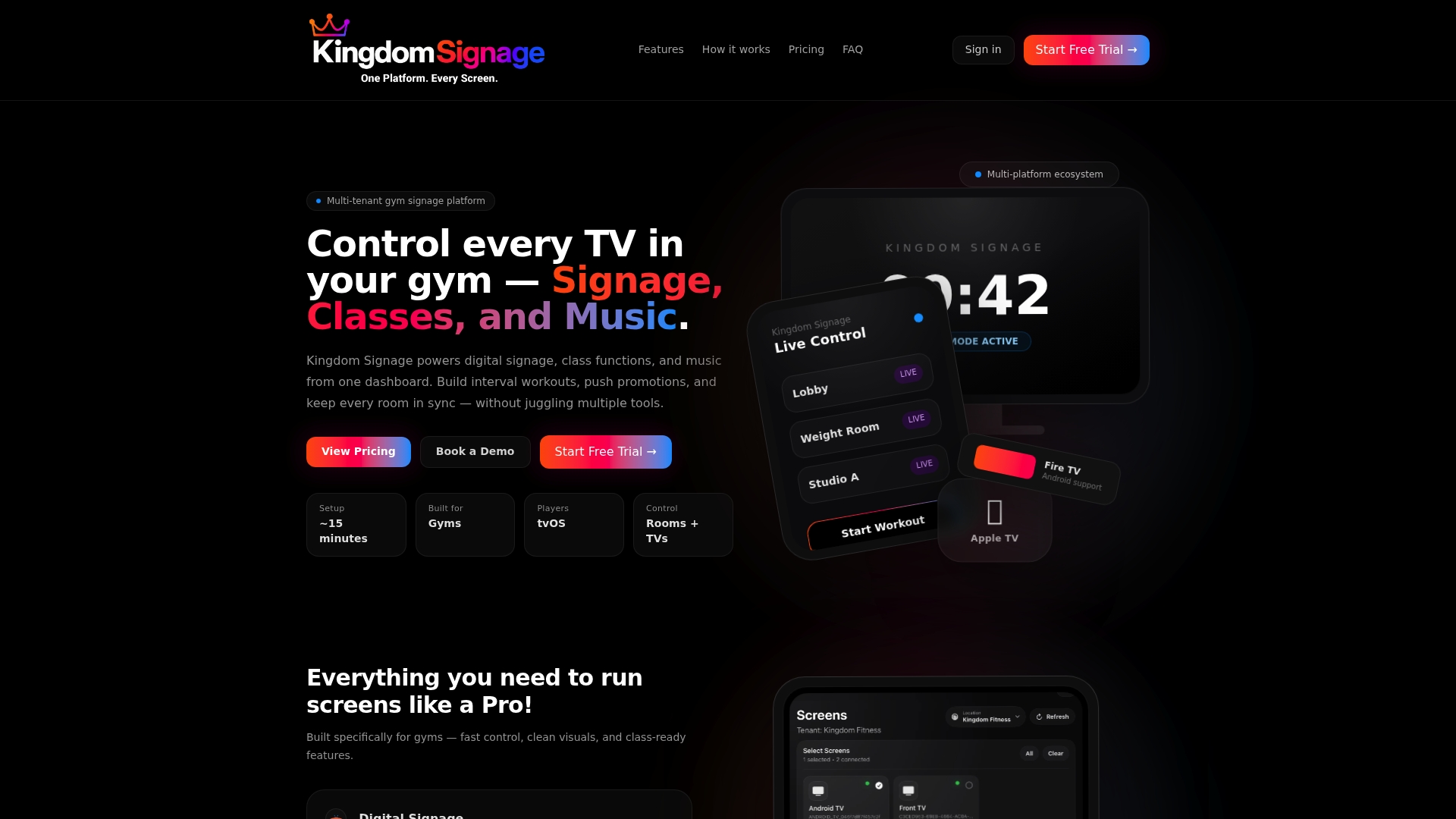
Kingdomsignage unifies TV control, workout class content, and audio management across every room in your facility through one dashboard. Operators sync visuals and sound across zones, schedule promotional content, and push real-time updates without switching between tools or devices. The platform is built specifically for gym environments, which means the integration with class schedules, membership promotions, and multi-room display management works without custom configuration. Gym owners looking to connect their content management and signage into one controlled system can explore Kingdomsignage's full platform at kingdomsignage.com.
FAQ
What is a gym content management system?
A gym content management system is a centralized platform that controls and automates digital content delivery across gym screens, member portals, and apps from a single dashboard. It differs from general gym management software by focusing on what members see and experience inside the facility.
How does a gym CMS improve member retention?
CMS-driven content strategies improve 90-day member retention by 25–35% by keeping members engaged through consistent programming updates, personalized communications, and targeted promotional messages.
What does a gym CMS typically cost?
Gym CMS platforms typically cost $150 to several hundred dollars monthly, with an initial setup period of 2–4 weeks for station configuration and content playlist preparation.
What is the biggest mistake when implementing a gym CMS?
Treating the CMS as a set-it-and-forget-it tool is the most damaging mistake. Content must be reviewed and updated weekly to stay relevant and maintain member trust.
How does a gym CMS connect to digital signage?
A gym CMS assigns specific content to specific screens by zone and schedule, turning individual displays into a synchronized network that delivers class promotions, membership offers, and community challenges at precisely the right time and location.