
Gym screen content template types are predefined digital layouts that organize class schedules, workout timers, motivational messages, and promotional content into structured displays for fitness facility screens. The right templates do more than fill wall space. They communicate with members at the exact moment those members need information, whether that is a countdown clock during a HIIT set or a class schedule in the lobby. Platforms like PosterBooking, CastHub, and ScreenCloud have built entire content libraries around these templates because the format works. Kingdomsignage takes this further by unifying screen content, audio, and multi-room control into a single dashboard built specifically for gym environments.
1. What are the main gym screen content template types?
Core content categories for gym digital signage include timers, class schedules, workout demos, motivational posts, promotions, and community recognition. Each serves a distinct function and belongs in a specific part of your facility. Treating all templates as interchangeable is the fastest way to produce screens that members ignore.
The six primary template categories are:
- Workout timers and interval clocks. These count down rounds, rest periods, and total session time. They are most effective on the cardio floor and in group fitness studios where pacing is critical.
- Class schedules and announcements. These display the day's timetable, instructor names, and room assignments. Members check these in the lobby and near studio entrances before every visit.
- Exercise demos and workout instructions. Short video loops or animated graphics show proper form for movements. They reduce injury risk and reduce the number of questions staff field during peak hours.
- Motivational content. Quotes, athlete imagery, and progress-themed graphics keep energy high. Structuring motivational content into playlists ensures members receive the right message during workout peaks rather than during check-in.
- Promotions and event advertising. Personal training packages, membership upgrades, merchandise, and upcoming events all convert better when displayed at the right moment in the right zone.
- Community and member recognition. Member spotlights, challenge leaderboards, and milestone callouts build loyalty and social proof. These templates work especially well near the entrance and in recovery areas.
Pro Tip: Rotate your motivational and community templates on a weekly schedule. Content that never changes becomes invisible to regular members within two weeks.
2. How zone-based templates improve content relevance

Zone-based screen templates tailored to specific gym areas improve content relevance and member engagement more than any single design choice. The logic is simple: a member on the treadmill needs a timer, not a retail promotion. A member walking through the front door needs the class schedule, not a squat tutorial.
A practical zone breakdown looks like this:
- Lobby and reception. Class schedules, membership offers, event announcements, and member spotlights. This is your highest-traffic zone and your best opportunity for promotional content.
- Cardio floor. Workout timers, motivational quotes, and TV entertainment feeds. Keep text minimal because members are moving and cannot stop to read.
- Free weights and functional training area. Exercise demos, form tips, and challenge boards. Members here are self-directed and respond well to instructional content.
- Group fitness studio entrance. Class-specific schedules, instructor bios, and countdown timers to the next session start. This reduces hallway congestion and late arrivals.
- Recovery and stretching zone. Cool-down guidance, nutrition tips, and community content. The pace is slower here, so members will actually read longer content.
- Retail or supplement area. Product promotions, pricing boards, and limited-time offers. Scheduling class schedules, member spotlights, and retail menus across multiple zones improves both member experience and non-dues revenue.
Pro Tip: Map your zones before you build a single template. A zone map forces you to think about what each member needs at each physical location, which produces better content decisions than starting with design.
3. Hardware and design considerations for gym screen templates
Template design must go beyond aesthetics to match gym operational realities, including lighting conditions and display durability. A beautifully designed template on an underpowered consumer TV in a bright gym is a wasted investment.
Commercial gym screens must offer 500–700 nits brightness and a 24/7 operation rating to remain visible in glare-heavy environments. Consumer televisions are rated for four to six hours of daily use and will fail quickly under gym conditions. The brightness gap between a consumer TV and a commercial display is immediately visible in a well-lit weight room.
| Factor | Consumer TV | Commercial Display |
|---|---|---|
| Brightness | 200–350 nits | 500–700 nits |
| Daily runtime rating | 4–6 hours | 24 hours |
| Remote management | Limited | Full remote reboot and monitoring |
| Warranty for commercial use | Voided | Included |
| Template orientation support | Landscape only | Landscape and portrait |
Screen orientation affects template layout directly. Landscape screens suit class schedules, video content for gym screens, and motivational imagery. Portrait screens work better for vertical workout instruction cards and single-metric timer displays near equipment. Matching templates to hardware realities also means choosing high-contrast typography, large font sizes, and color palettes that read clearly from 10 to 15 feet away.
Remote management and network reliability are critical to maintaining uninterrupted displays. A screen that goes black during a busy Saturday morning class is a member experience failure, not just a technical one.
4. How digital signage platforms support template management
Cloud-based content management systems give gym owners the ability to build, schedule, and update templates from any device without being physically present at the facility. Local-only solutions require onsite access for every content change, which creates delays and increases labor costs.
Key features to look for in a gym digital signage platform:
- Playlist creation and scheduling. Gym digital signage software supports playlist creation to display motivational content at peak hours. A platform without scheduling forces you to manually swap content, which means your 6 a.m. rush sees the same screen as your 2 p.m. slow period.
- Fitness software integration. Successful gym digital signage integrates live class data from platforms like Mindbody, ABC Fitness, and Mariana Tek for real-time schedule accuracy. Manual schedule updates create errors that frustrate members and staff.
- Multi-screen and multi-zone management. A single dashboard that controls every screen in the facility saves time and prevents content mismatches between zones.
- Template libraries. Pre-built workout screen design options reduce the time needed to launch new content. Starting from a blank canvas for every campaign is inefficient.
- Remote device monitoring. The ability to reboot a screen, check its status, and push content updates without visiting the location is not optional for multi-location operators.
Kingdomsignage addresses all of these needs through a unified platform that controls TVs, workout class displays, and audio from one dashboard. That integration matters because audio and visual content that are out of sync create a disjointed member experience, particularly during class transitions.
5. Choosing templates by gym size, type, and budget
Template strategy scales with facility size, and the right starting point depends on how many screens you operate and what your members expect. A boutique studio with two screens needs a different approach than a multi-location gym chain managing 50 displays.
- Small boutique studios (1–5 screens). Prioritize class schedules, motivational content, and a single promotional template. Keep the content library small and update it weekly. Gym membership offers displayed digitally convert well even on minimal screen setups when placed at the point of decision, which is the front desk.
- Mid-size gyms (6–20 screens). Zone-based templates become necessary at this scale. Invest in a cloud-based CMS with scheduling and at least one fitness software integration. Multi-room gym display management at this level requires centralized control to prevent content inconsistencies.
- Large and multi-location gyms (20+ screens). Full zone mapping, automated scheduling, and real-time data integrations are non-negotiable. Content must update automatically across locations without manual intervention.
- Hotel and hospitality gyms. These facilities benefit most from clean, low-maintenance templates that display hours, equipment guides, and safety instructions. Interactive fitness templates with QR codes linking to workout programs work well for guests who are unfamiliar with the space.
Typical gym digital signage costs range from $35–$300 monthly plus $400–$4,000 in hardware setup costs depending on scale. That range is wide because a single-screen boutique and a 30-screen multi-location gym have fundamentally different needs. Budget planning should start with screen count and zone count, not with software features.
| Gym Type | Recommended Templates | Estimated Monthly Software Cost |
|---|---|---|
| Boutique studio | Schedule, motivation, 1 promo | $35–$75 |
| Mid-size gym | Zone-based, scheduling, demos | $75–$150 |
| Large multi-location | Full zone map, integrations, automation | $150–$300 |
| Hotel gym | Hours, equipment guide, QR workouts | $35–$75 |
6. Interactive and video content for gym screens
Video content for gym screens outperforms static images in engagement, particularly for exercise demos and promotional content. A looping video of a trainer demonstrating a kettlebell swing communicates form more clearly than any static graphic. The key is keeping video clips short, typically 15 to 30 seconds, so they complete a full loop before a member moves on.
Interactive fitness templates add another layer of engagement. QR codes embedded in templates let members pull up workout plans, class booking links, or supplement menus on their phones without staff involvement. This is particularly effective for boosting class enrollment through screen-based calls to action placed near studio entrances.
Touchscreen templates work in lobbies and reception areas where members have time to interact. They are less practical on the cardio floor where members are mid-workout. Match the level of interactivity to the zone and the member's likely state of attention.
Key takeaways
The most effective gym screen content template types are those matched to specific zones, member behaviors, and hardware capabilities rather than chosen for visual appeal alone.
| Point | Details |
|---|---|
| Zone-based deployment | Assign templates to specific areas like lobby, cardio floor, and studio entrance for maximum relevance. |
| Six core template types | Timers, schedules, demos, motivation, promotions, and community content each serve a distinct purpose. |
| Hardware matters | Commercial displays rated at 500–700 nits and 24/7 operation are required for gym environments. |
| Software integration | Connect your signage platform to Mindbody or similar systems for automated, accurate schedule updates. |
| Budget by screen count | Monthly software costs range from $35–$300 depending on facility size and feature requirements. |
What I've learned about gym screen templates after working with hundreds of facilities
Most gym owners start with the wrong question. They ask "What should our screens look like?" when the right question is "What does a member need to see at this exact spot in our gym?" That shift in thinking changes everything about how you build and manage templates.
The facilities I see struggle most with digital signage are the ones that treat every screen as a billboard. They load up promotional content across every zone and wonder why members stop looking at the screens after two weeks. Members tune out screens that do not serve them. A timer on the cardio floor serves them. A membership upsell on the cardio floor does not.
The other mistake I see constantly is underinvesting in hardware and overinvesting in design. A beautifully crafted template on a consumer TV that washes out under gym lighting is invisible. Spend the money on commercial-grade displays first, then build templates around what those screens can actually render.
Workflow is the hidden factor that separates good gym signage from great gym signage. The gyms with the best screens are not the ones with the most creative templates. They are the ones with a weekly content review process, a clear person responsible for updates, and a platform that makes those updates take five minutes instead of fifty. Kingdomsignage was built around that operational reality, which is why it combines screen control, audio management, and scheduling in one place rather than forcing gym operators to juggle multiple tools.
— Kingdom
Kingdomsignage for gym screen template management
Managing gym screen content across multiple zones and locations gets complicated fast when you are using separate tools for scheduling, audio, and display control.
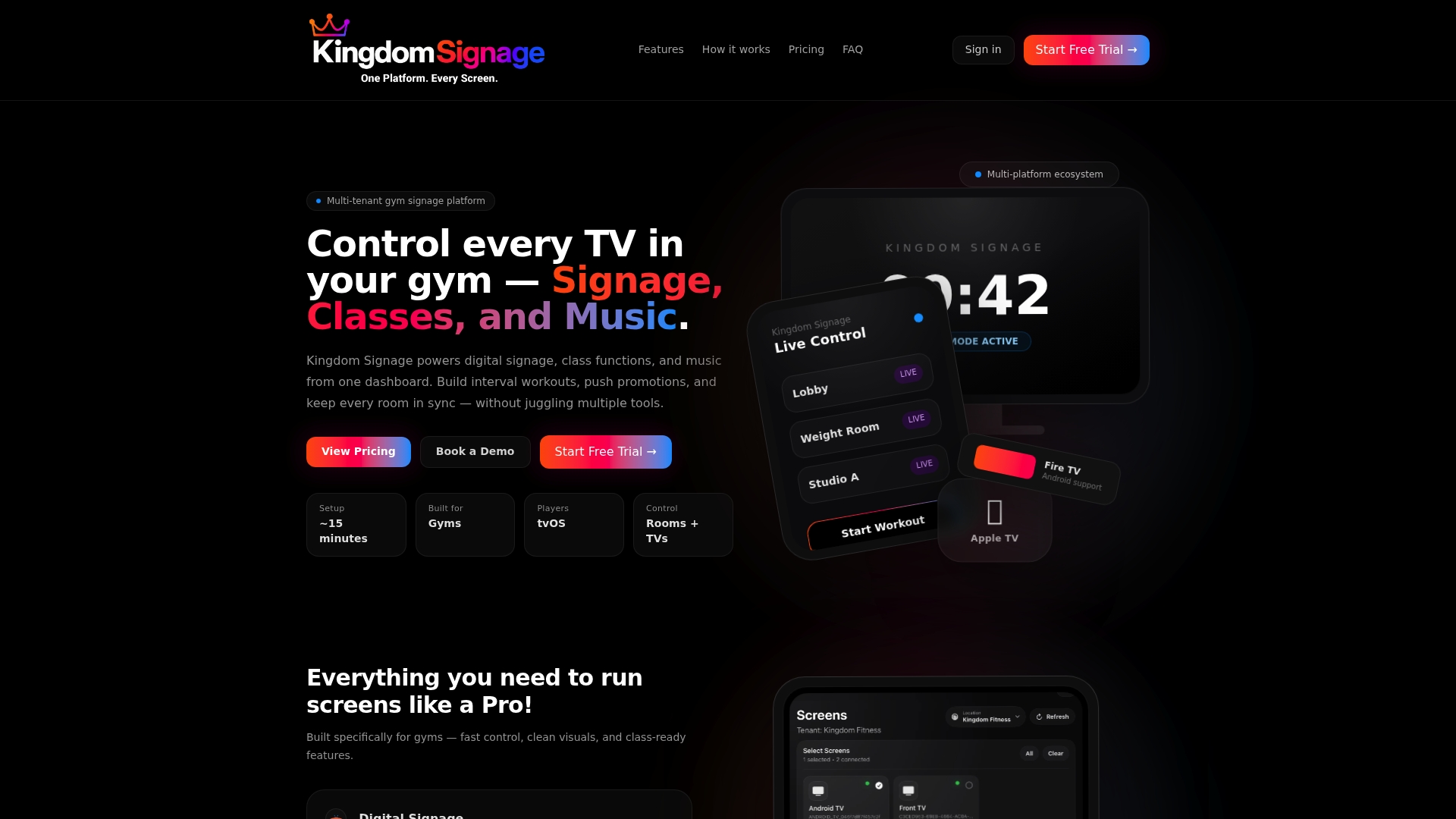
Kingdomsignage solves that by putting every screen, every playlist, and every zone under one dashboard. You can schedule zone-specific templates, sync audio to class transitions, and push real-time updates to every display in your facility without leaving your desk. The platform supports multi-screen and multi-zone scheduling, integrates with fitness management software, and eliminates the manual content updates that eat into staff time. For gym owners who want a single platform built for fitness environments, Kingdomsignage is the place to start.
FAQ
What are the most common gym screen content template types?
The six most common types are workout timers, class schedules, exercise demos, motivational content, promotional templates, and member recognition displays. Each type serves a specific zone and member need within the facility.
How do I choose the right template for each gym zone?
Match the template to what a member needs at that physical location. Lobbies need schedules and promotions, cardio floors need timers and motivation, and studio entrances need class-specific countdowns and instructor information.
What software integrations should a gym signage platform support?
Look for integration with fitness management platforms like Mindbody, ABC Fitness, or Mariana Tek. These connections allow class schedules to update automatically on your screens without manual data entry.
How much does gym digital signage software cost?
Monthly software costs typically range from $35–$300 depending on screen count and features, with hardware setup adding $400–$4,000 depending on the number and type of commercial displays required.
Do gym screens need special hardware?
Yes. Commercial displays rated for 24/7 operation and 500–700 nits brightness are required for gym environments. Consumer televisions are not built for continuous use and will fail under typical gym lighting and runtime conditions.