
Digital gym membership offer display is defined as the use of integrated screen networks inside fitness facilities to show live, personalized, and strategically timed promotional content to members and prospects. Gyms that deploy this approach correctly see a 1–5% lift in total revenue, with targeted upsell categories like personal training climbing 15–25%. That kind of return makes digital signage one of the highest-ROI marketing investments a gym operator can make. The industry term for this technology is digital signage, and understanding how gym membership offers display digitally through it is the difference between screens that sell and screens that just sit there.
How gym membership offers display digitally through software integration
The foundation of any effective digital gym offer display is the connection between your signage software and your gym management system. Platforms like Mindbody, ABC Fitness, and Mariana Tek hold the live data that makes your screens relevant. Without that connection, you are manually updating slides, which means outdated pricing, wrong class times, and missed promotional windows.
Here is how the integration workflow operates in practice:
- Connect your gym management platform. Mindbody and ABC Fitness integrations pull live class schedules, membership tier data, and booking availability directly into your signage CMS. The moment a class fills up, the screen reflects it automatically.
- Set up condition-based content triggers. Your CMS fires specific content based on real-time member data. A member in their trial phase sees a conversion offer. A member who has completed 20 or more classes but has no personal training history sees a PT consultation prompt.
- Configure AI targeting rules. Modern signage platforms support audience segmentation. PT consultation promotions target members who are active 90-plus days, have no prior PT history, and have completed 20 or more classes. This is not guesswork. It is automated precision.
- Deploy a cloud-based CMS for multi-location control. A cloud CMS lets your marketing manager push a new membership promotion to every screen across every location from a single dashboard. No on-site visits, no USB drives, no delays.
- Schedule content by member lifecycle stage. New members see onboarding tips and upgrade prompts. At-risk members see retention offers. Active members see upsell content for premium tiers or add-on services.
Pro Tip: If your gym management software supports webhooks or an open API, ask your signage vendor whether they can build a direct data feed. This removes the need for manual CSV exports and keeps your screens accurate in real time.
The success of digital signage depends far more on integration depth than on screen size or resolution. A 4K display showing stale content converts nobody.
What hardware and software do you need for gym digital displays?
Choosing the wrong hardware is the most common and most expensive mistake gym operators make. Consumer televisions are not built for continuous commercial use. They dim, overheat, and fail within months in a gym environment.
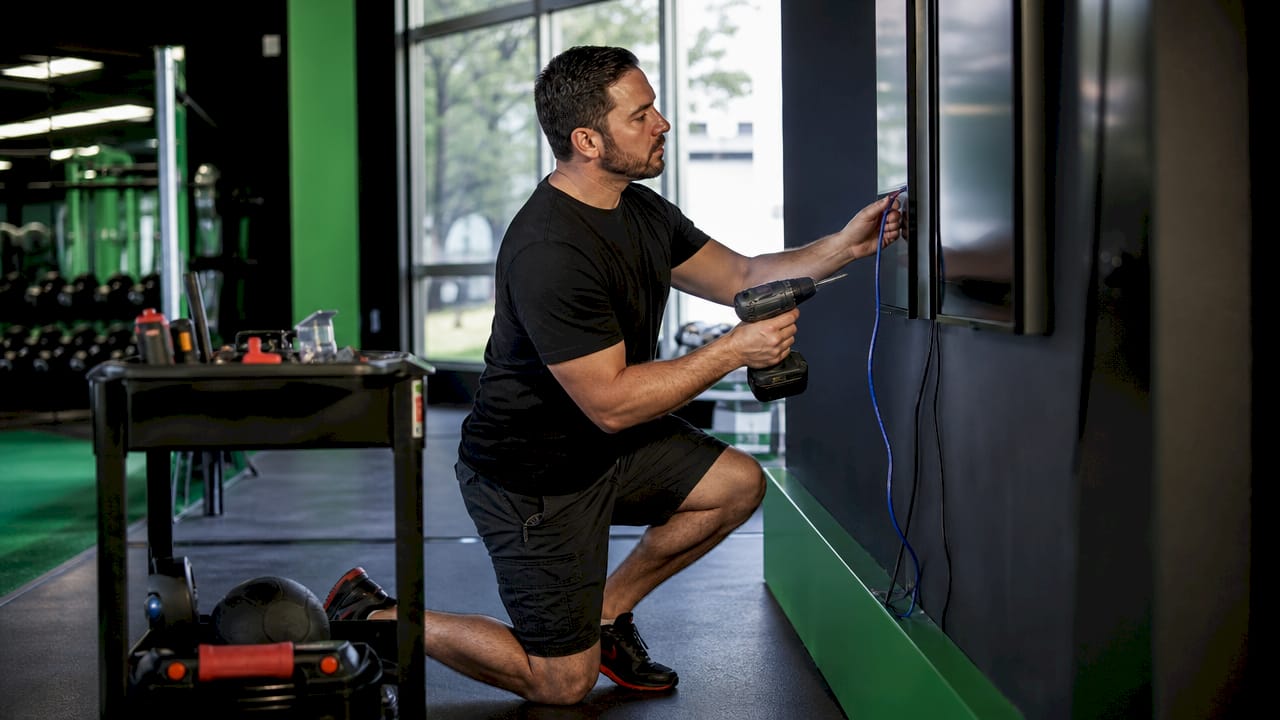
Commercial-grade screens rated for 24/7 use with 500 to 700 nits of brightness are the minimum specification for gym environments. Higher brightness matters in spaces with large windows or strong overhead lighting, where a dim screen simply disappears. Portrait orientation works well in corridors and near reception desks. Landscape orientation suits class schedule boards and lobby feature walls.
For connectivity, hardwired Cat6 Ethernet is the correct choice for any screen carrying promotional or schedule content. Shared gym Wi-Fi is congested, inconsistent, and a liability when a screen goes blank during peak hours. Run the cable properly during installation and you eliminate 90% of connectivity-related downtime.
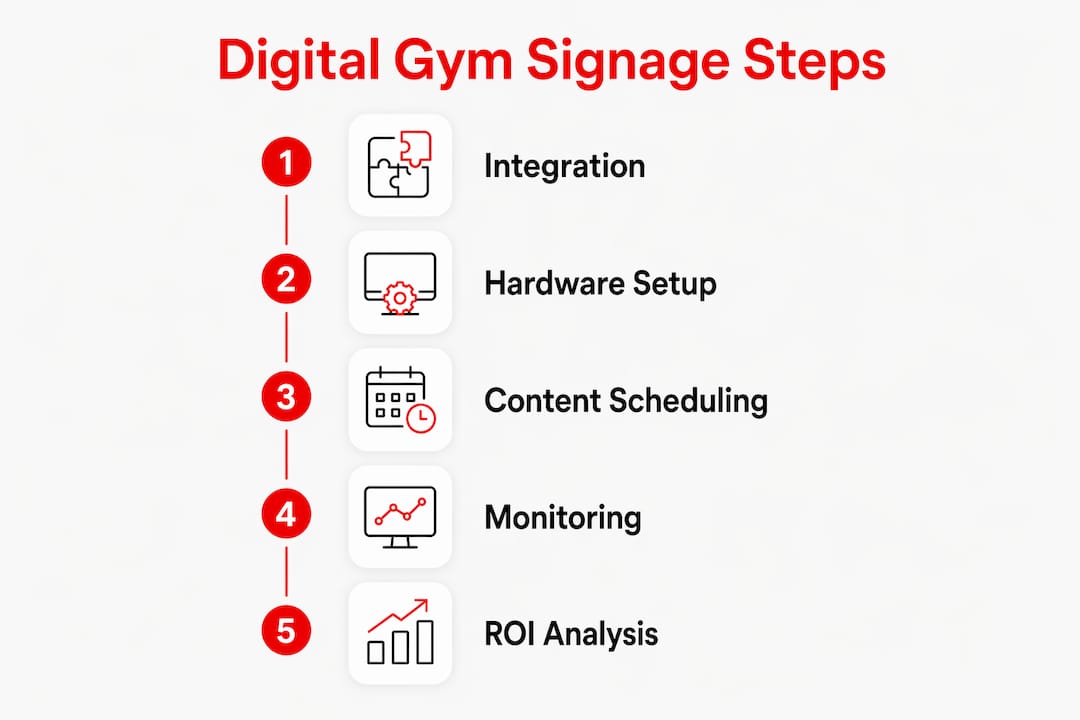
On the software side, the right CMS depends on your gym's scale and complexity:
| Platform | Best for | Key strength |
|---|---|---|
| ScreenCloud | Mid-size to large gyms | Deep app integrations and analytics |
| Raydiant | Multi-location operators | Enterprise content management |
| PosterBooking | Budget-conscious single sites | Free tier with basic scheduling |
| Spectrio | Full-service gym chains | Managed content creation included |
ScreenCloud, Raydiant, PosterBooking, and Spectrio each serve different gym sizes and budgets, so matching the platform to your operational complexity matters as much as the hardware choice.
One more hardware decision worth understanding is SoC screens versus external media players. SoC (System on Chip) screens have the playback hardware built in, which simplifies installation and reduces cable clutter. External players like BrightSign or a dedicated Android box give you more processing power for complex, data-driven content. For most gyms displaying membership offers and class schedules, a quality SoC screen is sufficient.
Pro Tip: Request "Proof of Play" reporting from your CMS vendor before signing any contract. Proof of Play reporting logs the exact time and location every piece of content runs, which lets you prove ROI to stakeholders and opens the door to third-party advertising revenue from supplement brands or local businesses.
What are the best practices for scheduling gym membership promotions?
Content placement and timing determine whether your digital gym offer displays convert or get ignored. The physical location of a screen inside your gym tells you exactly what message belongs on it.
Effective zone-based content strategy works as follows:
- Lobby and reception screens carry your highest-priority membership offers. This is where prospects and new members form their first impression. Display current pricing, trial offers, and social proof like member count or Google review scores.
- Gym floor screens are not the place for hard-sell membership content. Motivational content, class countdowns, and member spotlights perform better here because members are mid-workout and not in a buying mindset.
- Corridor and transition zone screens are prime real estate for PT upsell offers and premium tier upgrades. Members moving between areas are mentally transitioning too, which makes them more receptive to a well-timed offer.
- Locker room screens call for soft-sell content. Context-aware scheduling avoids hard-sell messages in relaxed areas like locker rooms. Post-workout recovery tips, class recommendations for tomorrow, and loyalty program reminders fit this zone perfectly.
- Trial member targeting deserves its own content track. Screens showing finite trial reminders and upgrade offers during the first 7 to 14 days of a trial membership measurably improve conversion to paid plans.
Frequency matters as much as placement. Rotating through three to five content pieces per zone prevents viewer fatigue without sacrificing message frequency. A member who visits four times per week will see your content repeatedly, so variation keeps it from becoming invisible.
For gym owners managing multiple locations, a centralized content calendar synchronized through your cloud CMS is the operational backbone. You can run a national promotion on every screen simultaneously while still allowing individual locations to override with local offers.
How much does digital signage cost, and what is the ROI?
Digital signage for gyms carries a range of costs depending on scale, hardware quality, and software choice. Understanding the full picture prevents budget surprises.
Software costs start at $7.99 to $10 per screen per month for entry-level platforms. Enterprise flat-rate plans, which cover unlimited screens across multiple locations, typically run around $95 per month. For a 10-screen gym on a per-screen plan, that is roughly $80 to $100 per month in software alone.
Hardware costs for a single commercial-grade display, including mounting hardware and a media player where needed, typically fall between $400 and $900 per screen. Installation by a qualified AV technician adds $100 to $300 per screen depending on cable routing complexity. A five-screen lobby and reception setup therefore carries a realistic one-time hardware cost of $2,500 to $6,000.
| Cost category | Typical range | Notes |
|---|---|---|
| CMS software | $7.99–$95/month | Per-screen or flat-rate enterprise |
| Commercial display | $300–$700/screen | 24/7 rated, 500+ nits |
| Installation | $100–$300/screen | Includes cabling and mounting |
| Content creation | $0–$500/month | In-house or managed service |
The return side of this equation is where the numbers become compelling. Well-executed digital signage drives a 1–5% lift in total revenue, with personal training and retail upsells climbing 15–25%. For a gym generating $50,000 per month in revenue, even a 2% lift covers the entire annual signage investment in under two months.
Soft ROI compounds the financial case. Screens that answer common questions about class times, pricing, and membership tiers reduce front desk inquiries. That frees your staff to focus on member relationships rather than repetitive information delivery. Member satisfaction scores improve when information is accurate, visible, and current. You can track these outcomes directly through gym screen performance metrics tied to your CMS analytics.
Key Takeaways
Effective digital gym membership offer display requires integration, zone-aware content strategy, and commercial-grade hardware working together to convert screen time into membership revenue.
| Point | Details |
|---|---|
| Integration drives accuracy | Connect Mindbody or ABC Fitness to your CMS to eliminate manual updates and enable real-time offer display. |
| Hardware quality is non-negotiable | Use commercial-grade 24/7 screens with 500+ nits brightness and hardwired Cat6 connections for reliability. |
| Zone your content by location | Match message type to screen location: hard sells in lobbies, soft content in locker rooms, upsells in corridors. |
| ROI is measurable and fast | A 1–5% total revenue lift means most gym signage investments pay back within two to three months. |
| Proof of Play closes the loop | Logging content display times lets you prove ROI, optimize scheduling, and attract third-party advertisers. |
What I have learned from watching gyms get digital signage wrong
Most gyms that underperform with digital signage make the same mistake. They treat it as a decoration project rather than a marketing system. They buy consumer TVs, connect them to a free slideshow tool, and wonder why nothing changes. The screens look busy but the content is static, generic, and disconnected from what the gym management software already knows about each member.
The gyms that get real results treat their signage network the way a good retailer treats a point-of-sale system. Every screen has a defined role. Every piece of content has a target audience and a measurable goal. The integration with gym management systems is not optional. It is the entire point.
What surprises most operators is how much the content strategy matters relative to the technology. I have seen gyms with mid-range hardware and a well-configured CMS outperform competitors running expensive screens with no content logic behind them. The screen is just the delivery mechanism. The intelligence lives in the integration, the scheduling rules, and the willingness to measure and adjust.
The other underrated factor is audio. Gyms that sync their visual promotions with audio cues during class transitions create a far more cohesive member experience than those running screens in silence or with mismatched background music. When the visual and audio environment reinforce the same brand message, retention improves in ways that are hard to attribute to any single tactic but are consistently observable.
My honest recommendation: start with two or three screens in your highest-traffic zones, connect them properly to your gym management platform, and measure the results for 90 days before scaling. The data will tell you exactly where to expand next.
— Kingdom
See how Kingdomsignage powers gym membership displays
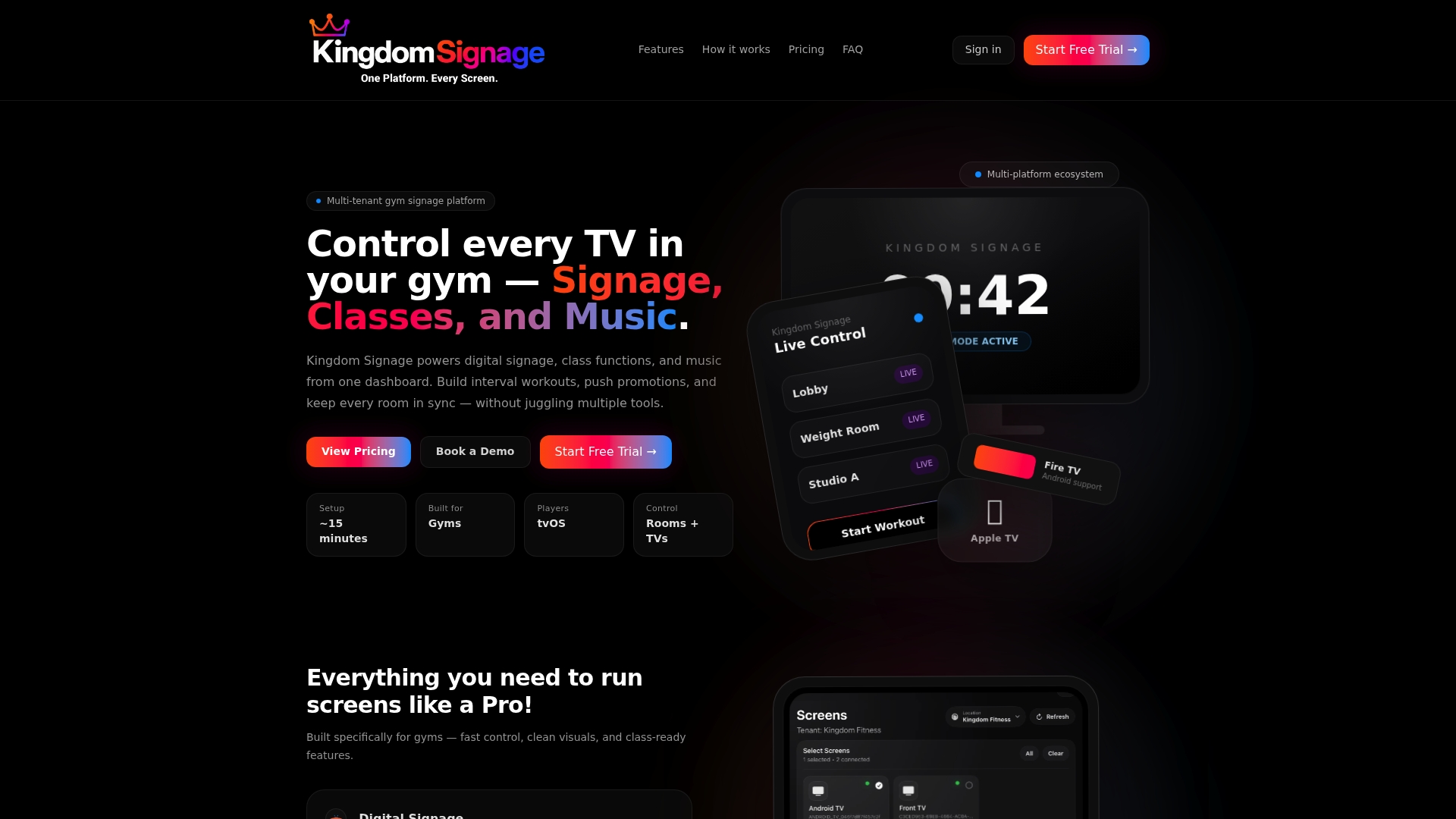
Kingdomsignage is built specifically for gym operators who need more than a generic slideshow tool. The platform unifies control of your displays, workout class screens, and audio across every room through a single dashboard, connecting directly with Mindbody and ABC Fitness to keep your membership offers, class schedules, and promotional content accurate and current without manual intervention. Whether you are running one location or twenty, Kingdomsignage lets your marketing manager push real-time updates, target content by member segment, and sync visuals with audio for a consistent member experience. Explore how Kingdomsignage for gyms can turn your screen network into a membership conversion engine.
FAQ
How do gym membership offers display digitally on screens?
Gym membership offers display digitally through a CMS connected to gym management software like Mindbody or ABC Fitness, which pushes live pricing, tier options, and promotional content to screens automatically based on member data and scheduling rules.
What software is best for displaying fitness offers on gym screens?
ScreenCloud, Raydiant, PosterBooking, and Spectrio are the leading CMS platforms for gym digital signage, each suited to different gym sizes and budgets, with cloud-based management for multi-location operators.
How much does gym digital signage cost per month?
Software costs start at $7.99 to $10 per screen per month, with enterprise flat-rate plans around $95 per month for unlimited screens. Hardware and installation add a one-time cost of $400 to $900 per screen.
Can digital signage improve gym membership conversion rates?
Yes. Screens showing trial reminders and upgrade offers during the first 7 to 14 days of a trial membership measurably improve conversion to paid plans, and targeted PT upsell content can lift that category's revenue by 15 to 25%.
What is Proof of Play in gym digital signage?
Proof of Play is a CMS reporting feature that logs the exact time and location every content piece runs on your screens, giving gym operators verifiable data to measure ROI and optimize content scheduling.