
Music is a direct performance enhancer in fitness classes, not a background amenity. The role of music in fitness class energy operates through two parallel channels: physiological regulation of the autonomic nervous system and psychological shifts in motivation, mood, and perceived effort. Recent research from 2025 and 2026 confirms that preferred music lowers how hard exercise feels while simultaneously pushing participants to work longer and harder. For instructors and participants alike, understanding how music tempo and exercise intensity interact, and how playlist personalization shapes engagement, is the difference between a class that drains people and one that drives them back every week.
How does music influence physical and psychological responses during fitness workouts?
Music's influence on exercise performance is best understood through the concept of psychoacoustic regulation, the process by which sound directly shapes both brain chemistry and bodily function during physical effort. Dopamine release triggered by preferred music elevates mood and reduces the subjective difficulty of exertion. At the same time, music modulates the autonomic nervous system, shifting heart rate variability toward patterns associated with better physiological regulation.
A 2026 meta-analysis found that music improves HF HRV power and decreases LF HRV power during exercise, a pattern indicating reduced stress load on the cardiovascular system. This means participants working out with music are not just feeling better subjectively. Their bodies are operating more efficiently under load.
On the psychological side, preferred music reduces perceived exertion with a standardized mean difference of 0.23 across meta-analytic studies, while also increasing motivation, positive affect, and physical outcomes like strength endurance and power output. That SMD of 0.23 is meaningful in practice: it represents the difference between a participant who stops at 80% effort and one who pushes through to completion.

| Effect type | What the research shows |
|---|---|
| Physiological | Improved heart rate variability, better autonomic regulation during exercise |
| Psychological | Lower perceived exertion, higher motivation, elevated positive affect |
| Performance | Greater strength endurance, increased power output, longer time to exhaustion |
| Emotional | More enjoyment, stronger identity connection, reduced fatigue over time |
Pro Tip: Play higher-tempo tracks during the transition into peak intensity intervals. That 30-second window before maximum effort is when music's arousal effect is most potent, priming the nervous system before the body fully commits.
What is the impact of music tempo and self-selection on workout energy?
Tempo is the most controllable variable in music selection for fitness classes, and its effects are more nuanced than simply "faster equals better." Research on swimming found that fast tempo at 120 BPM significantly increased positive engagement and enjoyment (p=0.013) without altering perceived exertion or actual performance metrics. This tells instructors something counterintuitive: tempo shapes how much participants enjoy the workout more reliably than it changes how hard they work.
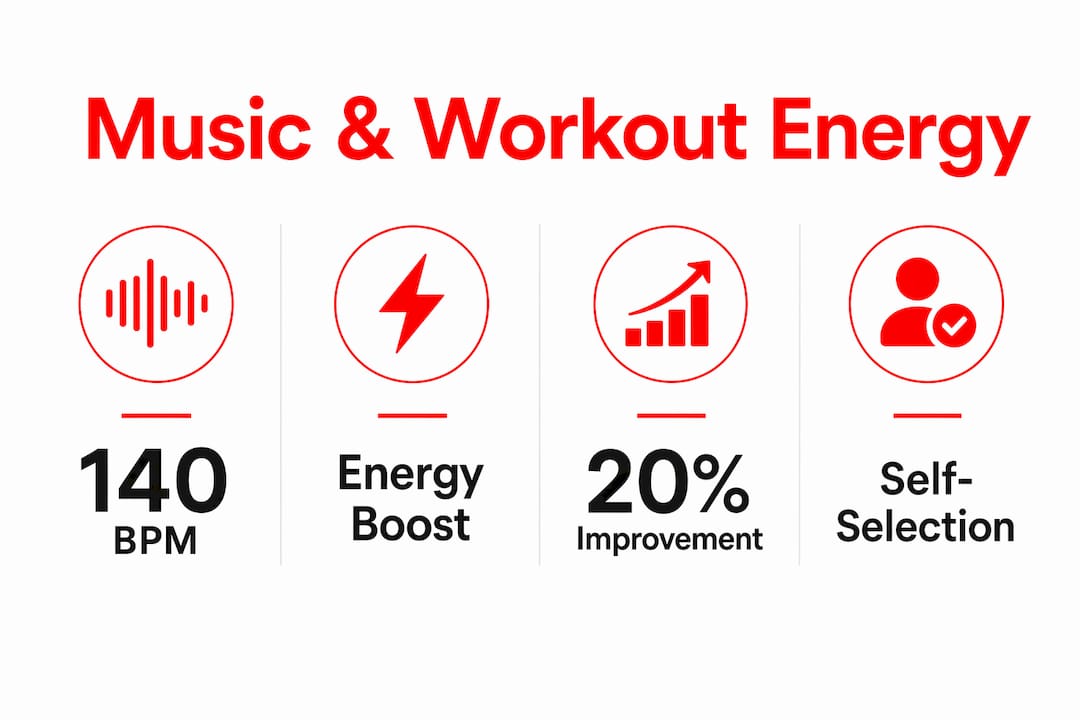
Self-selection takes this further. When participants choose their own music, the motivational effect compounds. Self-selected playlists improved cycling endurance from approximately 30 minutes to 36 minutes at 120 to 140 BPM, a nearly 20% gain in time to exhaustion without any increase in exhaustion markers. That is not a marginal improvement. It represents a fundamentally different training dose achieved purely through music personalization.
Student-curated playlists in physical education settings produced higher steps, calories burned, and heart rate over four weeks compared to instructor-selected music. The mechanism is identity connection: when music reflects a participant's cultural background, personal taste, and tempo preferences, it generates a sense of ownership that translates directly into effort.
Here are the tempo and selection principles that the research supports most clearly:
- Use 120 to 140 BPM tracks for high-intensity intervals and cardio peaks, where sustained effort is the goal
- Reserve 80 to 100 BPM music for warm-up phases to gradually raise arousal without spiking heart rate prematurely
- Collect participant playlist input at least once per month to keep selections current and personally relevant
- In modalities like swimming or cycling, prioritize tempo for enjoyment rather than expecting it to directly reduce perceived effort
- Avoid repeating the same playlist more than two weeks in a row, since novelty is part of what sustains the motivational effect
How can instructors integrate music to maximize fitness class energy?
Effective music integration is a structured practice, not a matter of hitting shuffle on a generic playlist. The most productive approach treats a fitness class like a narrative arc, with music serving as the emotional score that guides participants through activation, peak effort, and recovery.
Phase-aligned playlist design is the foundation. Warm-up segments benefit from tracks in the 80 to 100 BPM range that feel familiar and accessible, reducing anxiety and building readiness. As intensity climbs, dynamically aligning music with workout phases means switching to 120 to 140 BPM tracks with strong rhythmic drive. Cool-down music should drop below 90 BPM and shift toward lower energy, signaling the nervous system that recovery has begun.
- Survey participants before building a new playlist. A simple three-question form asking about genre preferences, tempo preferences, and any tracks they find demotivating takes five minutes and pays dividends for weeks.
- Build separate playlists for each class phase rather than relying on a single continuous mix. This gives you precise control over energy shifts.
- Update at least one third of your playlist every two to three weeks. Familiarity breeds comfort, but repetition breeds boredom.
- Test new tracks during lower-stakes class moments, not at peak intensity. If a track lands poorly, you want to find out during a rest interval, not during a sprint.
- Note which tracks generate visible behavioral responses: participants singing along, increasing pace, or showing more effort. These are your anchors. Build future playlists around them.
Common pitfalls include playing music at volumes that prevent verbal cueing, selecting tracks based on personal instructor preference rather than participant demographics, and ignoring the cool-down phase entirely. A class that ends on a high-tempo track leaves participants physiologically activated when they should be recovering, which affects how they feel about returning.
Pro Tip: Time your most energizing track to hit exactly when participants typically hit their mental wall, usually around 60 to 70% of the way through peak intensity. That moment of doubt is where music's motivational effect delivers the highest return.
Music vs. no music in fitness classes: what does the evidence show?
The empirical case for music in fitness classes is now strong enough to treat silence as a measurable disadvantage. A study of 180 university students over eight weeks found that music-accompanied classes produced significantly higher psychological resilience, physical strength, and motivation scores compared to no-music classes (p < 0.001). That significance level means the result is not a statistical artifact. It reflects a real, reproducible difference in outcomes.
A separate randomized trial on home-based exercise found that music-supported programs reduced fatigue significantly (p=0.001) and increased intrinsic motivation (p<0.001) after just four weeks. The fact that these effects appear even in solo, home-based settings underscores that the mechanism is not social or group-dependent. Music works on the individual nervous system regardless of context.
| Outcome | Music classes | No-music classes |
|---|---|---|
| Psychological resilience | Significantly higher | Baseline |
| Physical strength gains | Significantly higher | Baseline |
| Intrinsic motivation | Higher, sustained over weeks | Lower, declines over time |
| Perceived fatigue | Reduced after 4 weeks | No significant change |
| Endurance (cycling) | Up to 20% longer time to exhaustion | Baseline |
The pattern across these studies is consistent: music does not merely make workouts more pleasant. It changes what participants are capable of and willing to do. That is the core argument for treating music selection as a professional skill rather than an afterthought.
Key takeaways
Music directly increases fitness class endurance, motivation, and physical output, with preferred and tempo-matched selections producing the largest and most consistent gains.
| Point | Details |
|---|---|
| Music lowers perceived exertion | Preferred music reduces RPE with an SMD of 0.23, helping participants sustain effort longer. |
| Self-selected playlists outperform generic ones | Participant-curated music improved cycling endurance by nearly 20% without increasing exhaustion. |
| Tempo shapes enjoyment more than effort | Fast tempo (120 BPM) significantly boosts engagement and positive affect, especially in modalities like swimming. |
| Phase-aligned music maximizes energy regulation | Matching tempo and energy to warm-up, peak, and cool-down phases optimizes both performance and recovery. |
| Music classes produce measurable outcome differences | Eight-week studies show significantly higher strength, resilience, and motivation in music-accompanied classes versus no-music classes. |
What I've learned about music and fitness class energy
After working with gym operators and fitness instructors across many environments, the pattern I keep seeing is the same: instructors treat music as decoration and then wonder why their classes feel flat. The research is clear, but the application gap is wide.
The insight that changed how I think about this is the distinction between music as masking and music as regulation. Most people assume music works by distracting participants from discomfort. The actual mechanism is more interesting. Preferred music acts as a psychoregulatory aid, genuinely shifting how the nervous system processes effort. That is not distraction. That is a real change in physiological state.
What I find underused is participant input. Instructors often resist it because they feel it undermines their authority or creates logistical complexity. But incorporating participant input into playlist curation is one of the highest-leverage moves available. It builds ownership, increases identity connection, and produces measurable engagement gains. The logistics are simple. A monthly survey or a shared playlist link costs almost nothing.
The other thing I'd push back on is the assumption that louder and faster always means more energy. Recovery music matters. The cool-down is where participants form their lasting impression of the class. A well-chosen track at the end of a session can do more for retention than anything that happened during peak intensity. Experiment with that, gather feedback, and let the data guide your selections.
— Kingdom
How Kingdomsignage helps you control class energy through music and visuals
Managing music across multiple fitness class rooms while keeping visuals, promotions, and scheduling aligned is a real operational challenge. Kingdomsignage solves it by unifying gym audio and digital signage control through a single dashboard, so instructors can switch playlists, update on-screen content, and manage transitions across rooms without juggling multiple devices or apps.
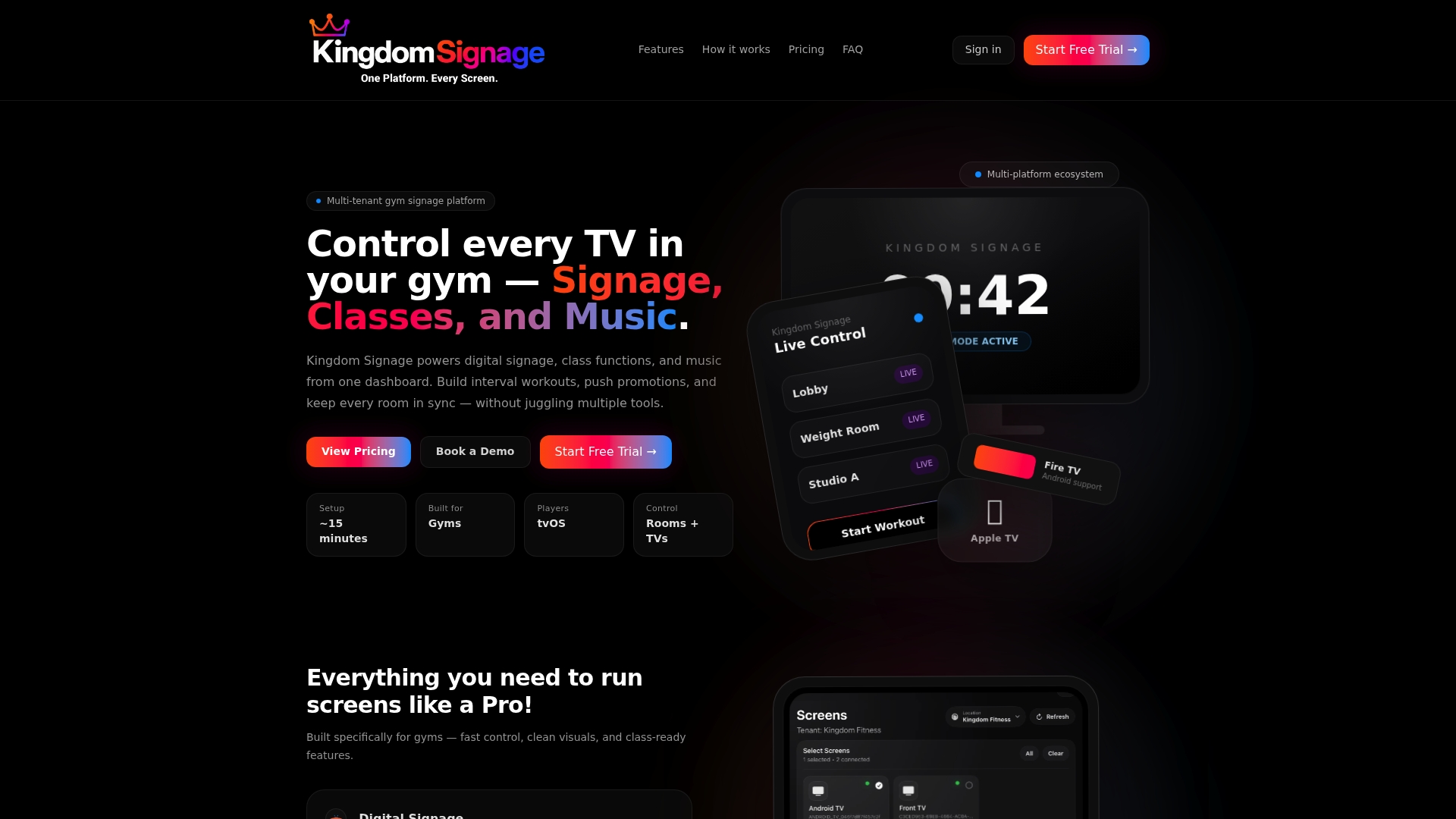
For fitness centers running back-to-back classes with different energy profiles, Kingdomsignage allows real-time updates to both music and screen content, keeping the environment matched to each class's intensity. Instructors can pre-load phase-aligned playlists, schedule promotional content between sessions, and sync audio across zones without interrupting class flow. If you want to deliver the kind of environment where music and visuals work together to drive member engagement and retention, Kingdomsignage is built for exactly that.
FAQ
How does music affect workout energy in fitness classes?
Music regulates arousal and mood through dopamine release and autonomic nervous system modulation, lowering perceived exertion while increasing motivation and positive affect. Studies show preferred music reduces RPE with an SMD of 0.23 and can extend endurance by up to 20%.
What tempo is best for high-intensity fitness classes?
Tracks in the 120 to 140 BPM range are optimal for high-intensity intervals, where sustained cardiovascular effort is the goal. Research confirms that fast tempo at 120 BPM significantly increases positive engagement, though its effect on perceived exertion varies by exercise modality.
Does letting participants choose music actually improve performance?
Yes. Self-selected playlists improved cycling time to exhaustion by nearly 20% compared to baseline, and student-curated playlists in physical education produced higher steps, calories burned, and heart rate than instructor-selected music over four weeks.
How often should fitness instructors update their playlists?
Instructors should refresh at least one third of their playlist every two to three weeks. Novelty sustains the motivational effect of music, and repeated exposure to the same tracks reduces their psychological impact over time.
Is music beneficial in all types of fitness classes?
Music benefits most fitness modalities, but its specific effects vary. In swimming, tempo primarily shifts enjoyment rather than exertion or performance metrics. In strength and cycling contexts, preferred music directly improves endurance and output, making music selection strategy modality-dependent.