
Gym brand consistency digital screens are the physical and software layer that determines whether your members see a unified, professional brand or a patchwork of mismatched content every time they walk through your doors. The standard industry term for this discipline is digital signage, and it covers everything from lobby promotions to in-class workout timers. Gyms that get this right use a centralized content management system (CMS) paired with dedicated workout display software, all running on a reliable wired network. Platforms like Esprit Digital and Fit Viz represent the two functional categories every gym operator needs to understand before deploying a single screen.
1. what gym brand consistency digital screens actually require
The foundation of fitness brand digital signage is a clear separation of two distinct functions. Communication signage and workout displays serve different purposes and should be managed by dedicated software layers, not a single screen running mixed content. Blending promotional slides with workout timers on the same display creates confusion for members and dilutes both messages.
A centralized digital signage CMS handles your brand communication layer. It controls lobby screens, hallway displays, and locker room monitors. A workout display platform like Fit Viz manages class timers, heart rate zones, and coaching cues. Together, they form a complete gym visual branding system.

Pro Tip: Map every screen in your facility before choosing software. Label each one as either a communication display or a workout display. That single step prevents the most common deployment mistake gym operators make.
2. centralized CMS: the control hub for brand messaging
Enterprise-grade digital signage CMS platforms give you centralized control, scheduling, and remote management across every screen in your facility. That means you update a promotion once and it pushes to every lobby screen instantly, with no USB drives and no manual screen visits.
The practical brand benefit is significant. Every display shows the same color palette, the same fonts, and the same messaging hierarchy. Members at your front desk see the same visual identity as members near the free weights. That repetition builds brand recognition faster than any single marketing campaign.
Esprit Digital's CMS, for example, supports unified media uploads, real-time playlist updates, and proof of play verification. Real-time monitoring and campaign flexibility also reduce printing costs and eliminate the lag between a marketing decision and its appearance on screen. For multi-location gyms, this capability is non-negotiable.
3. workout display software: consistency inside the studio
Workout display platforms do something a standard CMS cannot. They deliver synchronized coaching cues, interval timers, and heart rate zone data that keep every class running to the same standard regardless of which instructor is teaching. Uniform coaching cues and timing improve brand perception and workout quality simultaneously.
This matters for brand consistency in a way gym owners often overlook. When a member attends a Tuesday HIIT class and a Friday cycling session, the visual experience of the workout itself is part of your brand. Inconsistent timers, handwritten whiteboards, or verbal-only instructions signal a lack of professionalism.
Fit Viz is purpose-built for this function. It manages workout timing, displays heart rate zones, and provides standardized templates that instructors use across every class. Synchronized signage and instruction screens also reduce the need for staff to repeat instructions verbally, which improves class flow and member experience.
4. network infrastructure: the hidden driver of brand reliability
Wired Ethernet and VLAN segmentation are the recommended infrastructure choices for gym digital signage. Wired connections deliver stable throughput, easier troubleshooting, and better security than Wi-Fi. A screen that drops its connection mid-class or displays a loading error is a direct hit to your brand's credibility.
Here is a practical setup sequence for gym operators:
- Run Cat6 Ethernet to every display location before mounting screens.
- Create a dedicated VLAN for signage traffic to isolate it from guest Wi-Fi and corporate network loads.
- Configure your firewall to prioritize signage traffic bandwidth.
- Enable offline-first caching on every media player so screens continue playing content during brief network interruptions.
- Schedule a monthly network audit to check throughput and identify bottlenecks before they cause outages.
Offline-first caching means players locally store all media files, so a temporary internet outage does not blank your screens. That single feature preserves brand messaging integrity during the moments when a visible failure would be most damaging, such as peak morning hours.
Pro Tip: Never share your signage network with guest Wi-Fi. A crowded Saturday morning with 200 members streaming music will degrade screen performance on a shared network. A dedicated VLAN costs nothing extra to configure and prevents this entirely.
5. content strategy: what to show and where to show it
Consistent gym marketing through digital screens requires a content plan, not just a content library. The most effective gyms organize their screen content into four categories:
- Promotional content: membership offers, class package deals, and referral programs displayed in lobbies and near the front desk.
- Community highlights: member spotlights, transformation stories, and event recaps that build emotional connection to the brand.
- Operational information: class schedules, facility rules, and staff introductions that reduce front desk questions.
- Workout content: timers, rep counts, and coaching cues displayed exclusively on studio screens during active classes.
Each category belongs on specific screens. Mixing operational information into a studio workout display, or running workout timers in the lobby, weakens both messages. A content map that assigns categories to screen zones is the simplest way to maintain visual discipline across your facility.
6. CMS and workout display platforms: a side-by-side look
Choosing the right software combination is one of the most consequential decisions in your digital screen deployment. The table below compares the two primary platform types on the criteria that matter most for gym brand consistency.
| Criteria | Digital Signage CMS (e.g., Esprit Digital) | Workout Display Platform (e.g., Fit Viz) |
|---|---|---|
| Primary function | Brand communication and promotions | Class timing, coaching cues, heart rate zones |
| Content scheduling | Yes, playlist-based with real-time updates | Limited; class-driven triggers |
| Multi-site scalability | Strong; built for distributed networks | Moderate; studio-focused |
| Branded templates | Yes; full design control | Yes; standardized workout layouts |
| Offline playback | Yes; local media caching | Yes; class data stored locally |
| Integration with other tools | CRM, social media, data feeds | Heart rate monitors, class management software |
| Best for | Lobbies, hallways, locker rooms | Studios, group fitness rooms |
The most effective gyms use both platform types rather than forcing one tool to do both jobs. A combined approach, where each platform handles its designated function, produces cleaner content and simpler management. The operational cost of running two specialized tools is lower than the brand cost of running one tool poorly.
7. scaling digital screens by gym size and location
How you deploy screens depends directly on your facility's size and structure. A single-location boutique gym and a 10-location franchise face fundamentally different challenges.
For single-location gyms:
- Start with two to three lobby screens on a basic CMS plan.
- Add one studio workout display per class room.
- Use a single VLAN for all signage traffic.
- Review content monthly and update promotions weekly.
For multi-location franchises, the approach changes significantly. Keeping brand messaging consistent across multiple rooms and locations requires centralized content control with location-level override capability. Corporate sets the brand templates and promotional calendar. Individual locations can swap in local event announcements without breaking the visual system.
A phased rollout works best for franchises. Deploy the CMS infrastructure at your highest-traffic location first, refine the content strategy over 60–90 days, then replicate that system across remaining locations. Trying to launch everywhere simultaneously creates inconsistency and makes troubleshooting harder.
8. common pitfalls that undermine gym visual branding
Most gym digital screen failures trace back to three avoidable mistakes. Recognizing them before you deploy saves significant time and money.
Mixing screen functions. Running workout timers and promotional content on the same display is the most common error. Members cannot focus on a workout interval while a membership promotion scrolls across the same screen. Separate the functions physically and in software.
Neglecting network infrastructure. Gyms that deploy screens on shared Wi-Fi report the most content delivery failures. Infrastructure reliability directly impacts brand consistency. A screen showing a buffering spinner during peak hours signals technical incompetence to every member who sees it.
Siloed content management. Branding fails when workout timers and communication content are managed by separate teams without coordination. The result is mismatched messaging, outdated promotions running alongside current class schedules, and a fragmented member experience. A single dashboard that unifies both content streams solves this problem at the operational level.
Key takeaways
Gym brand consistency through digital screens requires a unified system that separates communication signage from workout instruction, supported by centralized CMS control and a dedicated wired network infrastructure.
| Point | Details |
|---|---|
| Separate screen functions | Assign communication displays and workout displays to dedicated software platforms, never mix them. |
| Use a centralized CMS | Platforms like Esprit Digital enable real-time updates and brand-consistent templates across all locations. |
| Prioritize wired networks | Cat6 Ethernet with VLAN segmentation prevents the connectivity failures that damage brand credibility. |
| Enable offline caching | Local media storage on players keeps screens running during network interruptions at peak hours. |
| Scale with a phased rollout | Deploy at one location first, refine the content strategy, then replicate across additional sites. |
What i've learned running screens in real gym environments
The gyms that struggle most with digital screen consistency are not the ones with the smallest budgets. They are the ones that treat screens as a technology purchase rather than a brand infrastructure decision. They buy the hardware, install a free CMS trial, and assume the content will manage itself. It never does.
The insight that changed how I think about this: integrating workout and signage content management reduces operational silos and produces a consistent brand voice across every member touchpoint. That is not a software feature. It is an organizational commitment. Someone on your team needs to own the screen content calendar the same way someone owns your social media calendar.
The second thing I have seen consistently: gyms that invest in proper network infrastructure before buying screens have far fewer problems than gyms that retrofit the network after deployment. Pulling Cat6 cable after screens are mounted is expensive and disruptive. Doing it before costs the same and saves weeks of troubleshooting.
Start with the infrastructure. Then choose your platforms. Then build your content strategy. That sequence produces results. Reversing it produces frustration.
— Kingdom
How Kingdomsignage unifies your gym's screen management
Managing digital signage and workout displays through separate tools creates the exact operational silos that break brand consistency. Kingdomsignage solves this by unifying control of TVs, workout class displays, and audio through a single dashboard built specifically for gym environments.
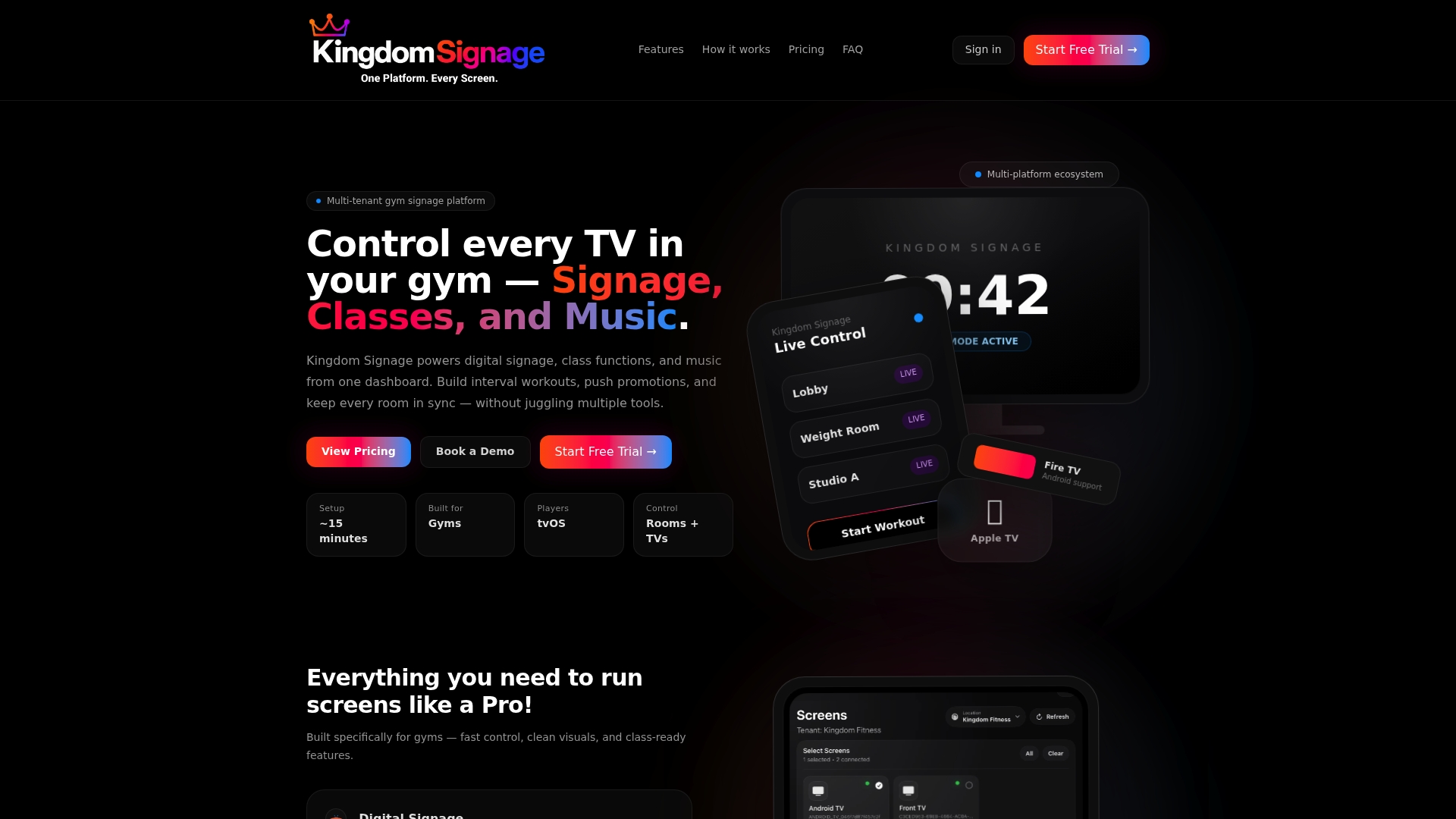
With Kingdomsignage, you schedule promotional content, sync workout instructions across studio screens, and push real-time updates without switching between platforms or devices. The system supports multi-room and multi-location deployments, making it practical for both boutique gyms and growing franchises. If you want to see how a unified gym signage platform handles brand consistency from lobby to studio, visit Kingdomsignage to request a demo or start a trial.
FAQ
What is gym brand consistency through digital screens?
Gym brand consistency through digital screens means every display in your facility shows coordinated visual content, from lobby promotions to in-class workout timers, managed through a centralized system that enforces your brand standards across all locations.
Do gyms need separate software for signage and workout displays?
Yes. A digital signage CMS handles promotional and operational content, while a workout display platform like Fit Viz manages class timers and coaching cues. Running both functions through one tool typically compromises the performance of each.
Why is wired ethernet better than wi-fi for gym digital signage?
Wired Ethernet delivers stable throughput and is not affected by the heavy Wi-Fi loads that peak gym hours generate. Dedicated VLAN setup also improves security and simplifies troubleshooting compared to shared wireless networks.
How do multi-location gyms maintain consistent screen content?
Multi-location gyms use a centralized CMS that allows corporate teams to set brand templates and promotional schedules while giving individual locations the ability to add local content without overriding the master brand framework.
What happens to gym screens when the network goes down?
Players with offline-first caching store all media locally and continue playing scheduled content during network outages, preventing blank screens and preserving brand messaging during connectivity failures.