
Digital displays are one of the most direct tools you have for shaping how your gym feels the moment a member walks in. Research shows that members form impressions within the first 90 seconds of entering a facility, and those impressions drive whether they push hard, come back, or quietly cancel their membership. The role of displays in gym atmosphere goes well beyond showing a class schedule. Done right, screens control energy, communicate community, and turn a generic workout space into somewhere people genuinely want to be.
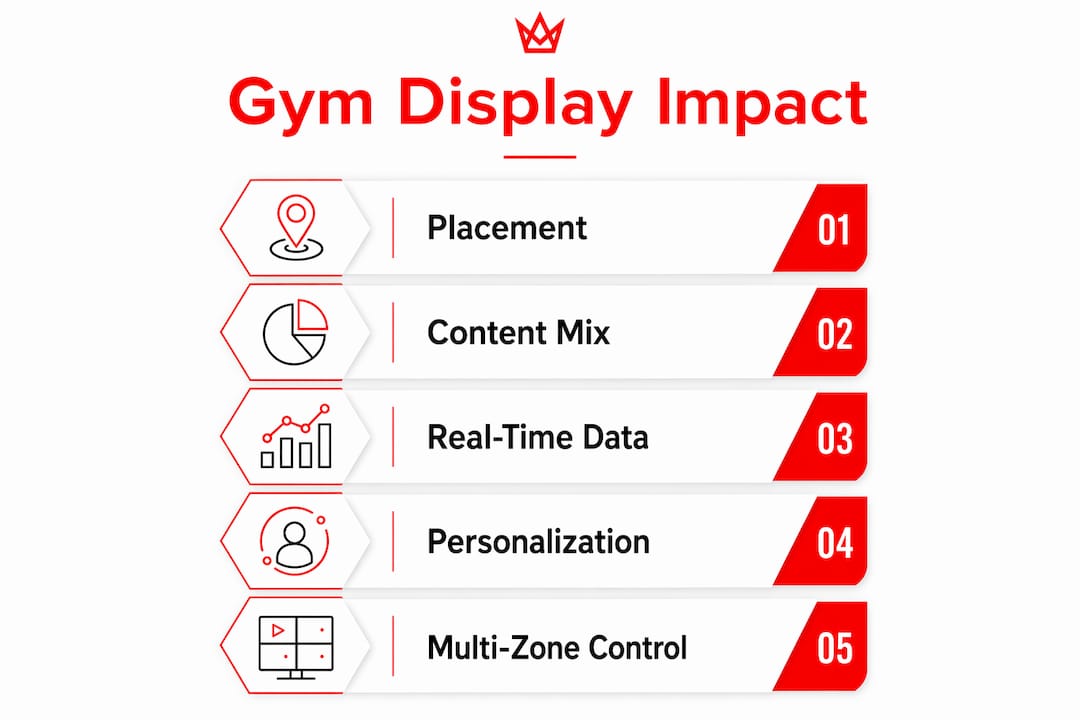
Here is what well-deployed digital signage actually does for your facility:
- Sets the mood by controlling visual energy across zones, from high-intensity cardio floors to recovery areas
- Drives motivation through real-time performance metrics, workout challenges, and visual cues tied to member goals
- Builds community via member spotlights, social feeds, and leaderboard competitions
- Communicates efficiently by replacing printed schedules and posters with live, updatable content
- Personalizes the experience through attendance streaks, personal records, and biometric feedback integration
- Supports operations by syncing promotions, class availability, and policy updates across every screen instantly
Kingdomsignage unifies all of these functions through a single dashboard, giving gym operators control over displays, audio, and class content across every room without juggling multiple tools.
How digital displays enhance member engagement in your gym
Engagement is not just about keeping members entertained. It is about making them feel connected to the facility and to each other. Screens that show only promotional ads create the opposite effect: members tune them out fast, and the gym starts to feel like a shopping mall.

The content mix matters enormously. Leaderboard displays and cooperative competition increase motivation even among members who do not consider themselves competitive, because seeing peers' progress triggers a social accountability response. Member spotlights work on a similar principle: when someone sees their own name or photo on a screen, their emotional investment in the facility spikes. Pair that with a live social media feed showing real member activity, and you have a community loop that no amount of email marketing can replicate.

Real-time class updates are another high-value use. A screen near the entrance showing today's schedule, current class capacity, and upcoming openings reduces front-desk friction and nudges members toward classes they might otherwise skip. For class enrollment drives, timely on-screen prompts outperform static posters by a wide margin.
A few principles that keep engagement high without creating ad fatigue:
- Rotate content on a schedule so no single message dominates
- Keep promotional content to roughly 20–30% of total screen time
- Use member-generated content and community milestones as the primary visual anchor
- Update class and event information in real time rather than daily batch uploads
How visual content on screens directly boosts workout motivation
The science behind visual motivation in gyms is more specific than most gym owners realize. A large screen positioned at the front of a cardio zone does not just look good. Research on exercise immersion and perceived exertion shows that overwhelming optic flow from a wide display shifts a member's cognitive attention away from internal fatigue signals, which can lower their rating of perceived exertion and improve physical output. In plain terms: the right visual environment makes hard workouts feel more manageable.
Virtual guided workouts incorporating visual cues show higher motivation and adherence among younger adults compared to traditional methods, which points to a clear opportunity for gyms running group fitness or on-demand class content. The display is not decoration. It is part of the workout.
Content strategy by zone matters here:
- Cardio areas: high-energy visuals, countdown timers, real-time pace or heart rate data
- Weight rooms: form demonstration videos, rep counters, personal record boards
- Group fitness studios: instructor-led content, synchronized music visuals, class progress indicators
- Recovery zones: calming imagery, breathing guides, post-workout stretch sequences
Integrating devices like Myzone or Polar with your display system takes this further. Showing live heart rate data on a shared screen during a class creates a competitive but supportive dynamic that pushes members to work harder than they would alone.
Pro Tip: Place motivational content at eye level in the primary sightline of each zone, not mounted so high that members have to crane their necks. Ergonomic placement is as important as content quality for sustaining workout focus.
How displays let you personalize the gym experience for each member
Personalization is where displays shift from atmosphere tools to loyalty drivers. A screen that greets a member by name, acknowledges a 30-day attendance streak, or announces a new personal record creates an emotional moment that a generic motivational poster never could. These micro-recognitions build the kind of attachment that keeps members renewing year after year.
Member spotlight features are particularly effective. Rotating profiles that highlight a member's progress, a milestone, or a personal story give your community a face and a narrative. The member featured feels valued; everyone else sees that the gym notices effort. That dynamic is hard to manufacture through any other channel.
Wearable and biometric integration adds another layer. When a display pulls live data from a member's fitness tracker and shows personalized feedback during a session, the gym stops feeling like a shared facility and starts feeling like a personal training environment. This level of customization was once reserved for high-end personal training studios. Display technology has made it accessible at scale.
Accessibility and inclusivity deserve attention here too. Personalized content should account for members with visual impairments, hearing differences, or language preferences. Practical steps include:
- Offering closed captions on all video content
- Using high-contrast color schemes that remain readable under gym lighting
- Including multilingual content options where your membership base warrants it
- Avoiding flashing or strobing visuals that can trigger photosensitive conditions
What types of gym display systems actually work in practice
Not all screens are built for gym environments, and the wrong hardware choice is an expensive mistake. Commercial-grade displays are designed for continuous daily use, whereas typical consumer TVs have shorter operational lifespans unsuitable for gym environments. In a gym running from 5 AM to midnight, a consumer TV will fail within months. Certain commercial display models include active cooling for continuous operation and provide sufficient brightness to stay visible under high ambient light typical of fitness floors.
Beyond hardware, the system architecture determines what you can actually do with your screens. Three common configurations:
Standalone screens work well for single-zone applications like a reception desk or a locker room entrance. They are easy to set up and manage but offer no coordination across the facility.
Multi-zone synchronized systems let you control content across every area from one platform. A cardio floor can show high-energy content while a yoga studio displays calming visuals, all managed from the same dashboard. This is where multi-room display management becomes a genuine operational advantage rather than a luxury.
Video walls create a statement in entrance lobbies or group fitness studios. They require careful content design since low-resolution content looks terrible at large scale, but when done well, they set a facility apart immediately.
For setting up gym digital signage that holds up operationally, the display placement, mounting height, and content scheduling system all need to be planned together, not as separate decisions.
Digital signage benefits for communication, promotion, and daily operations
The operational case for digital signage is straightforward: central management software synchronizes messages and promotions instantly across every screen without requiring staff to print, laminate, or physically post anything. For multi-location gyms, this means a policy change or a flash promotion goes live everywhere simultaneously with a few clicks.
Class schedules, equipment maintenance notices, hygiene reminders, and emergency protocols all become faster to communicate and easier to update. Staff spend less time on administrative tasks and more time with members. That shift in staff attention has a direct effect on member experience, even if members never consciously notice the screens driving it.
Promotion through digital signage works best when it feels native to the environment rather than intrusive. A few approaches that keep members receptive:
- Show membership upgrade offers during natural pause points, like between class segments or at check-in
- Tie promotional content to member behavior, such as displaying personal training packages to members who consistently use the free weights area
- Use upselling through gym screens as a soft touchpoint rather than a hard sell, keeping the tone consistent with the rest of your content
Real-time integration with gym management software is what separates a functional signage setup from a genuinely useful one. When your display system pulls live data from your booking platform, members see accurate class availability rather than outdated information, which reduces front-desk questions and member frustration simultaneously.
How synchronized multi-zone displays take gym atmosphere to the next level
Fitness centers that treat displays as architectural elements creating emotional energy consistently outperform those that view screens purely as content devices. That distinction shapes everything from how you mount hardware to how you schedule content across zones.
A unified display ecosystem controlling both audio and visuals across gym zones creates a coherent experience that members feel even when they cannot articulate why. The transition from the cardio floor to the stretching area feels intentional rather than accidental. Music, lighting cues, and on-screen content shift together. Kingdomsignage is built specifically for this: its platform syncs audio and visuals across multiple rooms through a single dashboard, reducing the operational complexity that comes with managing separate systems for each zone.
The visual design of multi-zone environments requires specific attention to prevent sensory overload. Research on media-convergent fitness spaces identifies cybersickness as a real risk when large screens produce optic flow that conflicts with a member's actual physical movement. The solution is architectural: using screen bezels, equipment consoles, or wall elements as static rest frames gives the brain a stable visual anchor, preventing the vestibulo-ocular conflict that causes disorientation. This is not a minor technical detail. It is the difference between a display environment that energizes members and one that subtly makes them feel unwell.
Content scheduling in a multi-zone setup should follow the energy arc of your facility throughout the day:
- Early morning: moderate-energy content that eases members into their session
- Peak hours in the morning and evening benefit from high-intensity visuals, live class feeds, and leaderboards
- Midday: instructional content, form guides, community spotlights
- Evening wind-down: recovery-focused visuals, upcoming event previews, motivational messages
Real-time adaptation adds another dimension. When a display system integrates with your gym management platform, it can automatically shift content based on which classes are running, how many members are on the floor, or even time of day without manual intervention. That level of responsiveness is what turns a collection of screens into a genuine atmosphere management tool.
Pro Tip: When designing your multi-zone content schedule, build in at least 10–15% of screen time for static or low-motion content. This gives members' visual systems a rest and prevents the fatigue that comes from constant motion on every screen.
Key Takeaways
Digital displays shape gym atmosphere most effectively when they function as integrated environment tools rather than standalone screens, combining real-time data, personalized content, and synchronized audio-visual control across every zone.
| Point | Details |
|---|---|
| First impressions are fast | Members form their impression of a gym within 90 seconds, making entrance and lobby displays critical. |
| Hardware must match the environment | Commercial-grade displays rated for 18–24 hours of daily use and 500–700 nits brightness are required for gym reliability. |
| Zone-specific content drives performance | Cardio, weight, and recovery areas each need tailored visual content to support the right member mindset. |
| Personalization builds loyalty | Member spotlights, attendance streaks, and biometric feedback create emotional connections that generic content cannot. |
| Synchronized control reduces complexity | Managing audio and visuals from one platform, as Kingdomsignage enables, keeps the member experience consistent across every room. |