
Gym signage costs range from a few hundred dollars for a simple installed sign to $20,000 or more for large exterior structures, and the number that surprises owners most is the one that repeats: every printed sign inside the gym has to be paid for again each time a promotion, class time or price changes. Budget the permanent signs once, and treat the signs that change as a monthly cost, not a project. That is the reason we build Kingdom Signage around the screens a gym already owns: one dashboard replaces the reprint cycle for schedules, offers and announcements.
This guide gives you real US price ranges for the signs that stay up for years, shows what pushes a quote up, and then walks through the cost of the signs that keep changing.
TL;DR
- A typical installed commercial sign averages $464 nationally, with most jobs between $181 and $804, before wiring and permits.
- Permits can add $400 to $2,500, and electrical work for a lit sign is a separate line on the quote.
- Large exterior signs such as channel letters and monument signs run into the thousands, so buy them once and keep the design stable.
- Anything that changes (class schedules, offers, announcements, workout timers) is cheaper to run on screens you already own than to reprint every time.
Table of Contents
- What gym signage actually includes
- Exterior and storefront signs: the big one-time costs
- Fixed interior signs
- What pushes a gym sign quote up
- How to estimate your total and compare quotes
- The cost most gyms underestimate: signs that change
- A sample budget structure
- Our perspective
- Try it on your own screens
- FAQ
- Sources
What gym signage actually includes
When owners ask what signage costs, they usually mean three different budgets that get mixed together in one quote:
- Exterior and storefront signs. Channel letters, monument signs, blade signs and window graphics. These are permanent, regulated by your city and priced like construction.
- Fixed interior signs. Room identification, restroom and exit signs, wayfinding arrows, and brand walls. These rarely change and some are required by accessibility rules.
- Changing content. Class schedules, membership offers, event posters, rules, announcements and the timers and demo videos used in classes. This is the category that quietly costs the most over a year, because it is repeated.
Keeping the three apart makes every quote easier to read, and it tells you where a one-time purchase makes sense and where a subscription does.
Exterior and storefront signs: the big one-time costs
Exterior signs carry the widest price spread because size, lighting and local rules all change the number.
According to Angi's 2026 cost data, channel letters run $3,000 to $20,000, monument signs $5,000 to $20,000, and pylon signs from $10,000 to over $200,000. Channel letters are individual three-dimensional letters mounted on the facade, often lit from inside. Monument signs are low, freestanding signs at the entrance of a lot, and pylons are tall poles for visibility from the road.

For most gyms in a strip center or a leased unit, the realistic choices are channel letters or a lit cabinet on the facade, plus window graphics. Gyms in a standalone building with a parking lot may add a monument sign.
What the national average really covers
HomeAdvisor's June 2026 figures put the average commercial sign installation at $464, with most owners paying between $181 and $804. That number is for the installation labor and basic mounting, not for a fabricated, lit storefront sign. Treat it as the floor for the install line, not as the price of the sign.
The same source lists two lines that owners often forget:
- Electrical wiring: $560 to $2,300 when a sign needs power run to it.
- Building permits: $400 to $2,500, depending on city, sign type and size.
So a lit sign quoted at a few thousand dollars can finish well above that once wiring and permits are added. Ask every vendor whether the quote includes electrical, permit filing and the permit fee itself, or only the sign and a truck roll.
Leased space: ask the landlord first
If you rent, the landlord or property manager often controls sign size, placement and style through the lease or a shared sign criteria document. Get approval in writing before you pay a deposit. A sign built to the wrong dimensions is a cost you cannot recover. Also ask who is responsible for removing the sign and repairing the facade at the end of the lease, and price that in.
Fixed interior signs
Interior signs are the cheapest permanent category per piece, but they add up across a large floor plan. Room names, restroom signs, exit markers and wayfinding arrows are bought in quantity, and some are tied to accessibility rules. The ADA (the Americans with Disabilities Act) sets requirements for certain permanent room signs in public accommodations, and fitness facilities are covered. Confirm the requirements for your building with your local building department or an accessibility consultant before you order a batch, so you do not pay twice.
A few practical points keep this category from running over budget:
- Order all fixed interior signs in one batch with one finish, so you do not pay setup costs repeatedly.
- Choose materials for the room. Locker rooms, showers and pool corridors are humid and are cleaned with strong disinfectants, so a sign that looks fine in the lobby may degrade there.
- Leave room names and numbers generic where you can. If a room is renamed from "Studio B" to "Cycle Room," every printed sign for it is wasted.
That last point leads to the real cost issue: what you put on printed signs that will change.
What pushes a gym sign quote up
When two quotes for the same sign differ by thousands of dollars, the difference is almost always in one of these:
| Cost driver | Why it matters | What to ask |
|---|---|---|
| Size and letter height | Material and labor rise quickly with height | What is the cost at one size smaller? |
| Illumination | Lit signs need power, wiring and often an electrician | Is wiring included? |
| Materials | Metal, acrylic and vinyl differ in price and lifespan | How long is the finish warrantied in a humid space? |
| Installation | Height, access and mounting style change labor | Is a lift or crew size added? |
| Permits and approvals | Fees and review times vary by city | Who files, and who pays the fee? |
| Design changes | Revisions after approval can restart production | How many revisions are included? |
For a gym, the material question deserves extra attention indoors. Sweat, humidity and daily disinfectant use are harder on signs than a retail floor is, so a cheaper sign that has to be replaced in a couple of years is not cheaper over the life of your lease.
How to estimate your total and compare quotes
A quote comparison only works when every vendor prices the same scope. Use this process.
Step 1: Write one scope document
List every sign you want by location: exterior, fixed interior, and changing content. Give approximate dimensions and whether each is lit. Send the identical document to each vendor so you are not comparing a basic sign against a fully installed one.
Step 2: Ask for line items
Require separate lines for design, fabrication, shipping, installation, electrical, permit filing and permit fees. A single lump sum hides the items that most often get added later.
Step 3: Check what is left out
The lines most often missing are electrical work and the permit fee. Using the ranges above, add a reasonable allowance for each to any quote that leaves them out, so the total you compare is the total you will pay.
Step 4: Add the cost of change
This is the step most budgets skip. For every printed sign that will be replaced, multiply the cost of one replacement by how many times a year you expect to change it. A simple illustration, using made-up round numbers: if printing and hanging a new promotional wall graphic costs you $300 and you run eight promotions a year, that one wall costs $2,400 a year in reprints. Use your own print and labor costs in the same formula, and count every wall, door and desk stand that carries changing content.
Step 5: Compare over the lease term
Multiply recurring costs by the years left on your lease and add the one-time costs. The cheapest sign on day one is not always the cheapest over three or five years.
The cost most gyms underestimate: signs that change
A gym is not a store with a stable product. Class timetables shift with the season, offers start and end, instructors change, and events come and go. Every one of those changes touches signage.
Printed media handles change badly. Each update means design time, print cost, delivery, and a staff member removing the old piece and hanging the new one. The old one is waste on the day it is replaced. If a price or class time is wrong on a printed sign, members see it until someone notices.

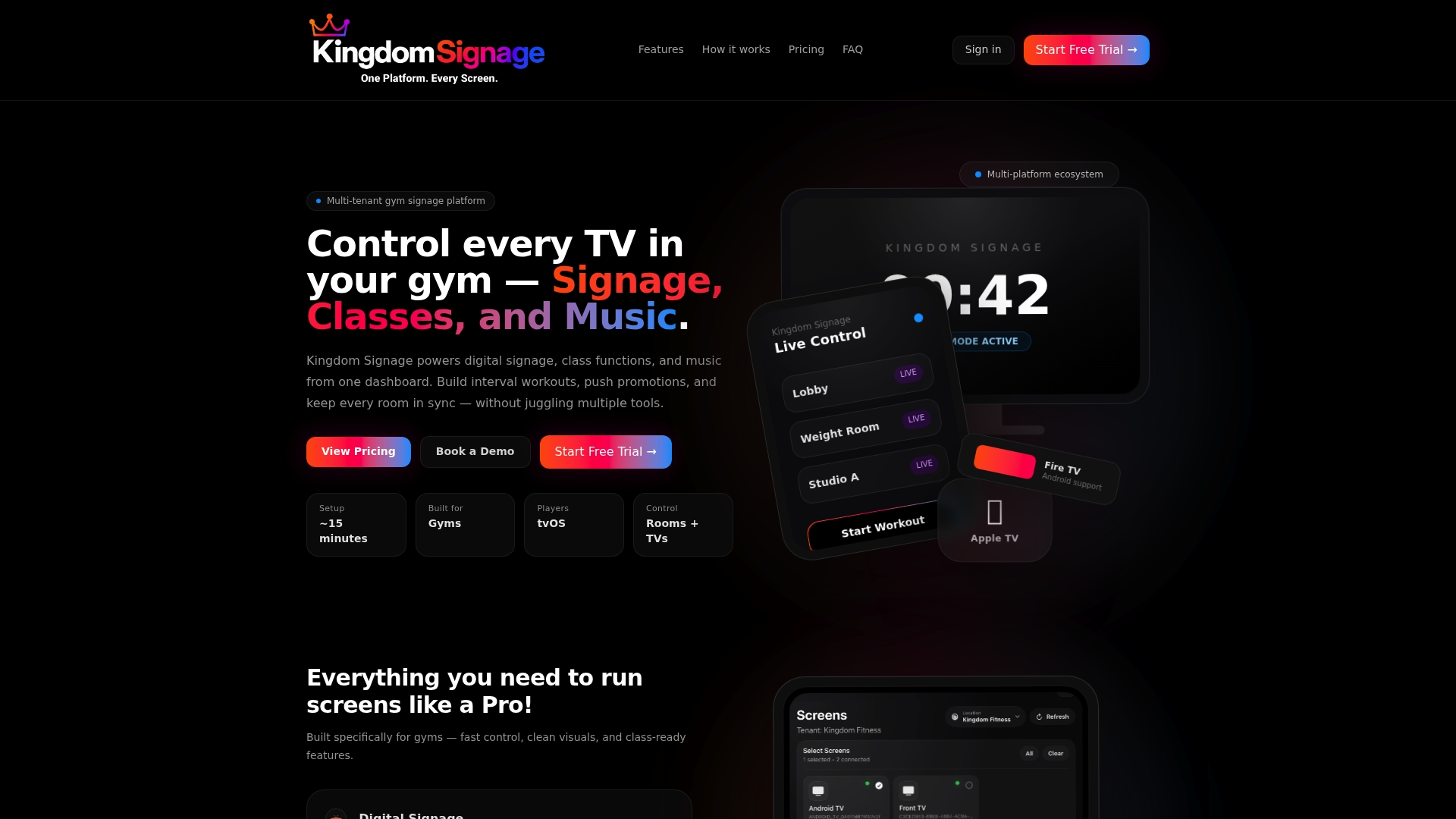
We built Kingdom Signage for exactly this layer. It manages the TV screens a gym already has, class schedules, workout timers with demo video support, room-based music, and real-time announcements from one dashboard, across rooms and across locations. A schedule change or a new membership offer is edited once and appears on the screens, with no print run. Our guide to how gym membership offers display digitally shows what that looks like on the floor.
Where digital screens replace printed signs
- Class schedules and room timetables. Change them on the dashboard instead of reprinting a laminated sheet for every door.
- Membership offers and promotions. Start and end a campaign without a print order.
- Announcements. Closures, maintenance and event reminders can go out in real time.
- Front desk information. Hours, rules and check-in instructions are easy to keep current, and our piece on front desk signage essentials covers what to show.
- Multiple languages. Showing two or three languages on a screen is an edit, not a second print job, and we explain how in our guide to multilingual gym signage.
What stays printed or fabricated is what is permanent: the exterior sign, the brand wall, the required room and exit signs. A sensible budget pairs the two, with fabricated signs for what is fixed and screens for what moves.
Why the screens you own change the math
A common worry is that digital signage means buying new hardware. Kingdom Signage integrates with existing screens, so the cost conversation is about the software subscription, not a wall of new TVs. That keeps the entry cost low for a small boutique studio with one or two displays, and the same dashboard handles multi-room and multi-location management as you grow.
If you want a fuller breakdown of what a first year looks like, read our digital signage pricing guide for gyms. To plan the rollout, see how to set up gym digital signage and the signage upgrade checklist for managers.
A sample budget structure
The figures below are the national ranges cited above, shown as a structure you can fill in with your own quotes.
| Budget line | One-time or recurring | Reference range |
|---|---|---|
| Exterior sign (channel letters) | One-time | $3,000 to $20,000 |
| Monument sign | One-time | $5,000 to $20,000 |
| Installation labor | One-time | $181 to $804 for most jobs |
| Electrical wiring for lit signs | One-time | $560 to $2,300 |
| Permits | One-time | $400 to $2,500 |
| Fixed interior signs | One-time | Your vendor quotes |
| Changing content on screens | Recurring subscription | Tiered by location |
| Reprints for anything left on paper | Recurring | Your cost per change times changes per year |
The last two rows are the ones to compare directly. If a year of reprints for schedules and offers is more than a year of a screen subscription, the printed route is the more expensive one.
Our perspective
Most gym owners come to us after pricing a storefront sign and realizing the number is the easy part. The storefront sign is bought once. The hundred small changes that follow, a new class block, a seasonal offer, a closed studio, are what quietly fill a budget.
We built Kingdom Signage so those changes stop being projects. Screens, class timers with demo videos, room music and announcements live in one dashboard, so an instructor or a marketing manager changes what members see without calling a printer or switching between several tools.
Our advice is to spend on fabrication where a sign will not change for years, and to run everything else through screens you already own. That keeps the lobby looking current, keeps rooms in sync, and gives you a predictable monthly line instead of a surprise print invoice.
Kingdom
Try it on your own screens
Kingdom Signage is a subscription priced in tiers per gym location, billed monthly or annually, and it starts with a free trial or demo. Premium features such as music integration and additional TV licenses are optional. If you are comparing a year of reprints against a screen plan, start with one room and your own schedule.
See how it works for your gym at kingdomsignage.com.
FAQ
How much does gym signage cost?
It depends on the type. A typical commercial sign installation averages $464, with most jobs between $181 and $804, while large exterior signs such as channel letters run $3,000 to $20,000. Wiring and permits are extra, so ask for them as separate lines.
Do I need a permit for a gym sign?
Usually yes for exterior signs, and fees vary by city, sign type and size. Angi reports permit fees of $400 to $2,500. Check with your local building or planning department, and with your landlord if you lease.
What is the cheapest way to keep gym signage current?
Put the content that changes on screens you already own, so updating a schedule or offer means editing it once instead of reprinting. Keep fabricated signs for permanent items such as your exterior sign and required room signs. Our cost-effective signage features guide lists what to look for.
Can digital signage work with the TVs my gym already has?
Yes. Kingdom Signage integrates with existing screens, so you can manage them from one dashboard without replacing hardware, across multiple rooms and locations.
Sources
- HomeAdvisor: How Much Does Commercial Sign Installation Cost?
- Angi: How Much Does Commercial Sign Installation Cost?