
A gym signage upgrade checklist is a structured evaluation tool that confirms every element of your facility's visual communication system, from hardware to messaging, meets current performance and safety standards. Static signs that never change, screens that crash mid-class, and inconsistent branding all signal the same problem: your signage system is working against you. The checklist format exists because gym managers who skip structured planning consistently overspend on retrofits and underdeliver on member experience. This guide walks through every critical decision point, grounded in 2026 technology standards and real budget data.
1. Your gym signage upgrade checklist starts with budget allocation
Budget planning is the first item on any gym sign improvement guide because the numbers shape every decision that follows. Signage and branding typically consume 2–10% of the total gym fit-out budget, while services like electrical and HVAC run 10–20%. That gap matters because most gym managers underestimate the service side and then discover mid-project that their electrical panel cannot support the load.
The fix is simple: plan electrical capacity before you order a single screen. A site survey that maps existing circuits, load-bearing walls, and conduit paths costs far less than drywall demolition after installation. Treat the electrical budget as a prerequisite, not an afterthought.
- Allocate 2–10% for signage and branding materials
- Reserve 10–20% for electrical, HVAC, and structural services
- Get a licensed electrician to assess panel capacity before purchasing hardware
- Budget a contingency of at least 10% for scope changes
Pro Tip: Commission your site survey and electrical assessment at the same time you request hardware quotes. Vendors who see the full picture give more accurate proposals and fewer change orders.
2. Build a stable technical infrastructure first

Network stability determines whether your digital signage runs or crashes. Hardwired Cat6 Ethernet is the industry standard for gym digital signage networks. Wi-Fi is unreliable in gym environments because dozens of member devices compete for bandwidth on the same frequency bands, causing screen freezes and dropped connections at the worst possible moments.
Every display location needs a dedicated data drop and a dedicated power circuit. Shared circuits cause voltage fluctuations that shorten screen lifespan. Early-stage site surveys must include load-bearing and power access planning to avoid expensive drywall demolition when adding circuits post-installation.
- Run Cat6 Ethernet to every planned screen location
- Install dedicated 20-amp circuits for commercial displays
- Label all data and power runs clearly for future maintenance
- Confirm router and switch placement supports full facility coverage
3. Choose commercial-grade hardware, not consumer TVs
Consumer televisions fail in gym environments within months. Commercial-grade screens support 24/7 operation with brightness ratings of 500–700 nits and active cooling systems designed for continuous use. Consumer TVs top out around 300 nits and lack the thermal management needed for a room full of body heat and humidity.
The hardware decision also involves choosing between built-in System-on-Chip (SoC) players and external media players. SoC displays reduce cable clutter and simplify installation. External players give you more processing power and easier hardware swaps without replacing the entire screen. For most gym environments, SoC displays work well in lobby and reception zones, while external players suit high-demand areas like group fitness rooms running video-heavy content.
| Zone | Recommended hardware | Key requirement |
|---|---|---|
| Lobby/reception | SoC commercial display | High brightness, portrait or landscape |
| Cardio floor | Commercial display, wall-mounted | Viewing angle, glare resistance |
| Group fitness room | Commercial display + external player | Video processing, audio sync |
| Locker room | Smaller commercial panel | Moisture resistance, low brightness |
| Hallways/wayfinding | Commercial display or static acrylic | Durability, quick readability |
Pro Tip: Verify UL-listing on all illuminated signage products before purchase. Vendor support across the full project life cycle, including documented compliance certifications, separates reliable partners from one-time suppliers.
4. Adopt a cloud-based content management system
The shift from local media players to cloud-based CMS platforms is the single biggest operational improvement available to gym managers today. A cloud CMS lets you update content across every screen in your facility from one dashboard, without physically touching each device. That matters when a class gets canceled at 6:00 AM and you need every screen updated before the first member walks in.
Cloud-based CMS platforms integrate with gym management software like Mindbody to pull live class schedules automatically. That eliminates the manual update cycle that causes stale information to linger on screens. Features like remote reboot and Proof of Play reporting give managers real-time visibility into what is running on every display.
- Confirm the CMS supports API integration with your gym management software
- Require remote reboot capability for every connected display
- Use Proof of Play logs to verify promotional content actually ran
- Choose a CMS tier that matches your screen count and content complexity
Kingdomsignage unifies TV control, class scheduling, and audio management through a single dashboard, which removes the need for separate tools across different rooms. For gym managers running multiple zones, that kind of centralized display control reduces daily management time significantly.
5. Apply a signage hierarchy for wayfinding and safety
Gym signage must follow a clear hierarchy to work. Zone signs identify areas, equipment labels confirm machines, instruction signs explain setup, and safety signs call out risks. When this hierarchy breaks down, members spend time searching instead of training, and safety hazards go unnoticed.
Wayfinding design starts with traffic flow analysis. Walk the facility during peak hours and note where members pause, backtrack, or ask staff for directions. Those friction points are exactly where signage is missing or unclear. Branding integrated from the start into architectural layout, color schemes, and materials increases member retention by improving intuitive navigation and visual cohesion.
Consistent fonts, colors, and icons across all sign types reinforce the brand and reduce cognitive load. A member who sees the same visual language from the front door to the locker room navigates faster and feels more confident in the space. That confidence translates directly to retention.
Pro Tip: Test your wayfinding signage by asking a first-time visitor to find the locker room, the water fountain, and the group fitness room without staff help. Real-world scenario testing before launch reveals gaps that a floor plan review never catches.
6. Select materials that survive the gym environment
Material selection is a fitness center signage tip that most gym managers skip until a sign warps or corrodes. Acrylic is preferred for wet areas like locker rooms and pool decks, while stainless steel suits high-traffic, high-load zones like weight rooms. Both materials balance durability with a professional appearance.
Foam board and paper-based prints have no place in a gym. Sweat, humidity, and cleaning chemicals destroy them within weeks. Every material choice should be evaluated against the specific conditions of the zone where it will be installed. A sign that looks great on day one but peels by month three damages your brand more than no sign at all.
7. Maintain brand consistency across all signage types
Fragmented procurement is the most common cause of chaotic visual identity in gyms. When different departments order digital screens, floor decals, and window graphics separately, the result is a mix of fonts, colors, and styles that confuses members and weakens the brand. A unified design system that governs every signage type prevents this.
Your brand consistency across screens should be documented in a signage standards guide before any vendor receives a purchase order. That document specifies approved colors, typefaces, logo placement rules, and tone of voice for all sign content. Vendors who receive clear standards deliver consistent output. Vendors who receive vague briefs deliver whatever they think looks good.
8. Avoid the most common pitfalls in signage upgrades
Stale static signage actively signals poor management to members. A permanent schedule board that shows last month's classes tells every member who reads it that the facility is not actively managed. Dynamic digital signage solves this by updating automatically, but only if the CMS is configured and maintained correctly.
The other major pitfall is buying signage piecemeal. Gym managers who purchase one screen at a time, from different vendors, end up with hardware that does not integrate, content that does not sync, and a maintenance burden that grows with every addition. A gym signage vendor evaluation checklist should require vendors to demonstrate full project life cycle support, from planning through post-installation troubleshooting. Vendor reliability is defined by commitment across the entire project, not just the sale.
- Avoid consumer-grade hardware regardless of price savings
- Never skip network infrastructure planning before hardware installation
- Test all signage in real conditions before the facility opens or reopens
- Require a single unified design system before ordering from any vendor
- Confirm your CMS vendor provides ongoing technical support, not just setup
Key Takeaways
A successful gym signage upgrade requires technical infrastructure planning, commercial-grade hardware, cloud CMS integration, and a unified design system applied before any vendor receives an order.
| Point | Details |
|---|---|
| Budget infrastructure first | Electrical and network costs run 10–20% of fit-out; plan them before ordering screens. |
| Use commercial hardware only | Screens rated 500–700 nits with 24/7 operation specs are required for gym environments. |
| Deploy a cloud CMS | Remote updates, schedule integrations, and Proof of Play reporting reduce daily management time. |
| Apply a signage hierarchy | Zone, equipment, instruction, and safety signs must follow a consistent visual system. |
| Unify procurement | A single design standards document prevents brand fragmentation across vendors. |
What I've learned from watching gym signage projects go wrong
Most gym signage upgrades fail in the planning phase, not the execution phase. The managers who end up with screens that crash, brands that look inconsistent, and members who still cannot find the locker room all made the same mistake: they started with the product catalog instead of the infrastructure audit.
The technical side is unglamorous but non-negotiable. I have seen facilities spend significant money on beautiful commercial displays, only to run them on shared Wi-Fi and a single overloaded circuit. The screens freeze during peak hours. Members notice. Staff get frustrated. The investment delivers the opposite of its intended result.
Cloud CMS integration changed the game for ongoing management. The ability to push a class cancellation to every screen in the building from a phone, in under 60 seconds, is not a luxury feature. It is the baseline expectation for any facility that takes member experience seriously. Gyms that still rely on someone physically updating a USB drive on each screen are one staff absence away from a facility full of wrong information.
The detail that most gym managers underestimate is real-world signage testing. A sign that reads perfectly on a design mockup can be completely unreadable at the actual viewing distance, under actual lighting conditions, during actual peak traffic. Walk the floor with a first-time visitor before you call the project complete. What they struggle to find tells you everything.
Brand consistency is not a design preference. It is a retention driver. Members who navigate your facility intuitively, who see the same visual language from the front door to the weight room, feel more at home. That feeling keeps them coming back. A fragmented visual environment creates low-level friction that members cannot always name but absolutely feel.
— Kingdom
Kingdomsignage makes the upgrade process manageable
Upgrading gym signage involves more moving parts than most managers expect. Kingdomsignage addresses the complexity directly by unifying TV control, class scheduling, and audio management through one dashboard, so you are not juggling separate tools for separate rooms.
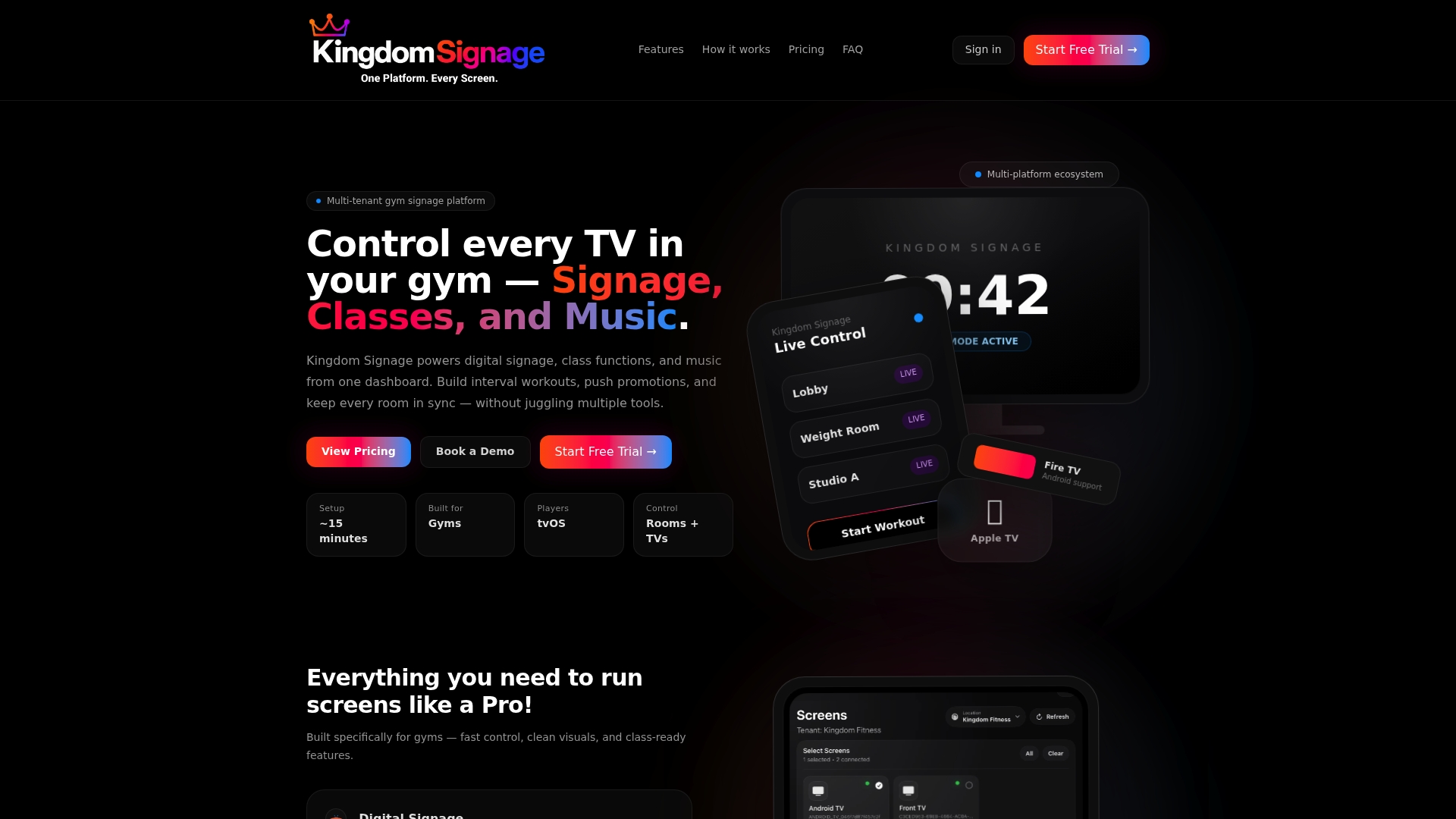
The platform integrates with gym management software to push live schedule updates automatically, supports remote reboot and content verification, and scales from single-location gyms to multi-site operations. If you are planning a signage upgrade and want a system built specifically for gym environments, explore Kingdomsignage to see how it handles the full range of display and audio management needs. The platform is designed to reduce the daily management burden while keeping every screen current and on-brand.
FAQ
What is a gym signage upgrade checklist?
A gym signage upgrade checklist is a structured list of planning, hardware, software, and design criteria that gym managers verify before and during a signage overhaul. It prevents costly oversights like inadequate electrical capacity or inconsistent branding.
Why do gyms replace static signage with digital displays?
Static signage cannot update in real time, which causes outdated class schedules and promotions to linger on walls. Dynamic digital signage reflects active facility management and keeps members informed accurately.
What network infrastructure does gym digital signage require?
Gym digital signage requires hardwired Cat6 Ethernet connections at every display location. Wi-Fi is insufficient because member device congestion causes screen crashes and dropped connections during peak hours.
How do I evaluate a gym signage vendor?
Require vendors to demonstrate UL-listing for illuminated products, full project life cycle support, and clear protocols for design revisions. Vendors who cannot document compliance or post-installation support introduce unnecessary project risk.
How does a cloud CMS improve gym signage management?
A cloud CMS lets gym managers update content across all screens remotely, integrate live class schedules from software like Mindbody, and verify content delivery through Proof of Play reporting. That eliminates manual updates and reduces the risk of outdated information reaching members.