
Seasonal gym promotion scheduling is the deliberate alignment of your marketing campaigns with the predictable cycles of member motivation, fitness industry rhythms, and calendar events throughout the year. Rather than reacting to demand when it appears, you plan offers, messages, and channels in advance to match where your members' heads are at each month. The result is steadier revenue, fewer dead months, and a gym that grows consistently instead of lurching between January surges and summer droughts.
Here is what this approach covers in practice:
- Acquisition campaigns timed to high-intent windows like january and september
- Retention and engagement pushes during slower periods like summer and late winter
- Referral programs running year-round as a quiet foundation beneath seasonal offers
- Reactivation campaigns targeting lapsed members when their motivation is most likely to return
- Pre-sale and pipeline campaigns in november and december to prime january performance
The core shift is from reactive marketing to planned marketing. You stop waiting for demand to show up and start creating it twelve months a year.
Why seasonality shapes gym growth more than most owners realize
Member motivation follows a rhythm, and ignoring that rhythm is expensive. Gyms that run the same generic "join now" messaging all year miss the fact that a prospect in march thinks about fitness very differently than one in october. The message that converts in january falls flat in july, not because the offer changed, but because the member's mindset did.
Studios planning annual promotional calendars run six times more campaigns annually than those planning month to month. The gap is not creative or budgetary. It is organizational. Consistency fills classes; brilliance alone does not.
The gyms that struggle most with seasonality share one pattern: they only push hard in january, then coast. The result is a feast-or-famine cycle that drains both revenue and staff energy. Consistent marketing throughout the year with messaging that shifts to match member motivation transforms each month into a growth opportunity rather than a waiting period.
Seasonal member behaviors and the marketing approaches that match them:
- January: Resolution energy is high. Focus on acquisition volume plus onboarding infrastructure to prevent february cancellations.
- February: Motivation dips for new members. Shift to engagement campaigns, milestone celebrations, and check-in content.
- March–April: Spring urgency builds. Run challenges, referral pushes, and community events.
- May–June: Summer proximity drives results-focused urgency. Promote "summer ready" programs and outdoor events.
- July–August: Slower acquisition. Protect your revenue base with member appreciation, loyalty rewards, and attendance challenges.
- September: Second-highest intent month of the year. Run a full acquisition push comparable to january.
- October: Pre-holiday retention. Reduce winter churn with appreciation events and SMS nurture.
- November–December: Pipeline season. Pre-sale campaigns, gift cards, and early-bird january offers fill the funnel before the surge.
Pro Tip: Seasonal scheduling is not about twelve different strategies. It is about one strategy with twelve different hooks that match your audience's mindset each month.
Seasonal and monthly gym promotion ideas that actually fill your calendar

A practical promotion calendar gives every month a purpose. The framework below is not a rigid script. It is a planning structure you adapt to your gym's size, niche, and member base.
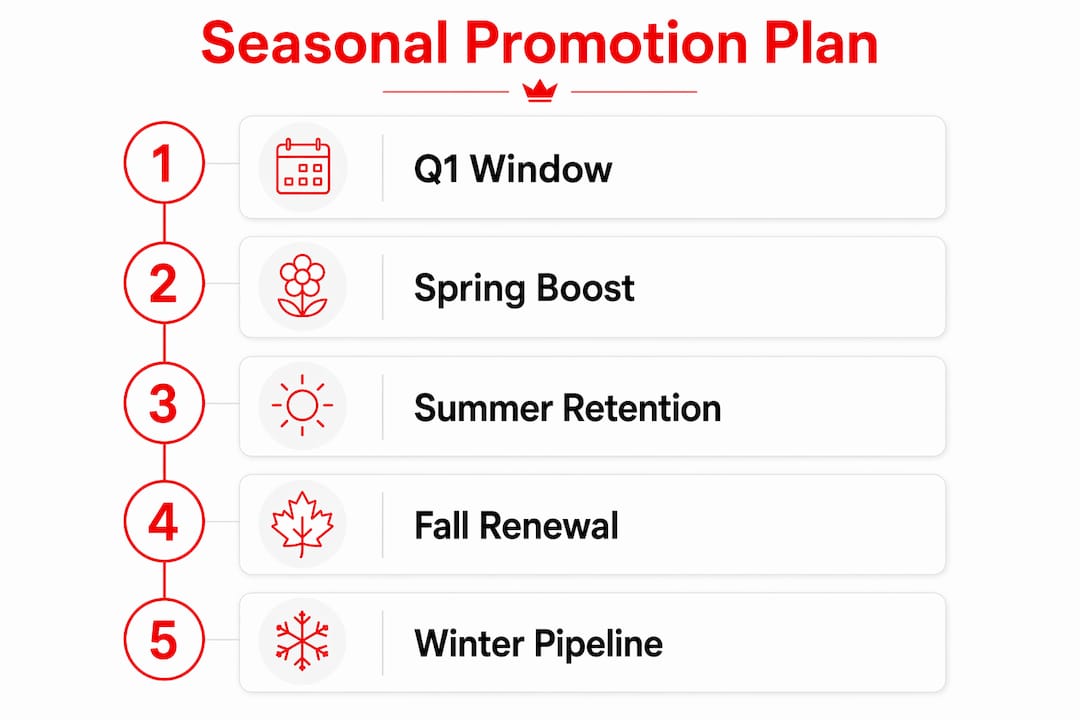
January through march: the Q1 window
January is your highest-intent month. New member surges require a dual focus on converting sign-ups and retaining them through onboarding sequences, milestone check-ins, and early community building. A failure in onboarding leads directly to high churn in february and march.
February shifts the emphasis from acquisition to engagement. Heart health awareness, couples fitness events, and "stick with it" content reinforce the decision to join. March opens the spring window with 30-day challenges, win-back offers for lapsed members, and referral incentives timed to cooperative weather.
April through june: spring and early summer
April works well for member appreciation campaigns and referral pushes. Members who joined in january are now three months in and far more likely to refer friends. May is when summer proximity creates real urgency. "Summer ready" programs, time-bound challenges, and outdoor pop-up events perform well because members are thinking about results, not starting.
June marks the beginning of slower acquisition. Fighting that with aggressive lead-generation campaigns produces diminishing returns. Flex memberships, summer class packs, and shorter-commitment options serve members whose schedules are disrupted by vacations and travel.
July through september: protect and pivot
July and august are retention months. Member appreciation events, outdoor workouts that embrace the season, and attendance challenges keep your existing base engaged. The goal is to enter fall from a position of strength, not to force acquisition during a naturally slower window.
September is your second january. Run a full acquisition campaign with a fall kickoff challenge, a "get ahead of the holidays" message, and a limited enrollment period. Members who join in september tend to be more committed and more likely to stay long-term than january sign-ups.
October through december: the pipeline quarter
October focuses on reducing winter churn through appreciation events and SMS nurture sequences. November and december are not dead months. They are when you plant seeds for january. Pre-sale campaigns, early-bird offers for a january challenge, gift card promotions, and waitlist campaigns build anticipation and fill the pipeline so january hits harder than it ever has.
Key promotion types to rotate across seasons:
- Discounted first-month or first-quarter memberships during high-intent windows
- Structured challenges with entry fees or program bundles (these build urgency without training discount expectations)
- Referral programs with double-sided rewards running year-round
- Free trial or starter passes to lower commitment pressure for new prospects
- Reactivation offers for inactive members, available as a standing option
- Gift card campaigns in november and december
- Loyalty rewards tied to attendance milestones
Evergreen promotions like referral programs, starter passes, and loyalty rewards serve as the foundational infrastructure supporting every seasonal push. They run quietly in the background and maintain steady engagement between your bigger campaign moments.
Structured promotions like programs, bundles, and challenges consistently outperform constant discounts. They create urgency and perceived value without conditioning members to wait for a price cut before committing.
Best practices for planning, scheduling, and executing seasonal promotions
Start production six weeks out
A 6-week lead time for campaign production reduces execution errors and keeps messaging consistent across channels. Gyms that plan campaigns month to month always feel behind. The january surge gets captured with a half-finished email sent on january 3rd. The spring re-engagement window passes because everyone was focused on term renewals. Six weeks gives you time to write copy, design assets, brief staff, schedule digital signage, and test automation sequences before launch.
Use automation and CRM to do the heavy lifting
Centralized CRM and marketing automation platforms enable audience segmentation and personalized content delivery, which significantly increases engagement compared to manual outreach. Automated triggers like welcome sequences, re-engagement emails, and at-risk member alerts handle the follow-up work that most gym teams never have time to do manually. A well-configured CRM moves leads through a pipeline from first contact to signed member without requiring staff to chase every prospect individually.
Segmentation is where most gyms leave money on the table. Your january sign-up needs different messaging than your three-year member who has not checked in for six weeks. Tailor your seasonal promotions to at least three segments: new leads, active members, and lapsed members. Each group has a different motivation and a different barrier.
Limit concurrent promotions to two or three
Running no more than two or three promotions simultaneously prevents member confusion and protects brand value. The typical combination that works: one seasonal offer, one evergreen referral or retention program, and one reactivation campaign. More than that dilutes conversion rates and makes your gym look like it is always running a sale.
Keep your brand identity stable while the hook shifts
Seasonal scheduling adapts the promotional hook each month to align with member mindset, not the core brand message. Your gym's voice, visual identity, and value proposition stay consistent. What changes is the angle: "start fresh" in january, "get ahead of summer" in may, "don't lose your progress" in october. Members trust brands that feel familiar even when the offer is new.
Synchronize digital and physical channels
Digital and physical gym environments must work together to deliver consistent member experiences. A campaign that lives only in email misses the members who walk through your door every day. Your in-gym screens, staff talking points, and social media content should all reinforce the same seasonal message at the same time.
Platforms like Kingdomsignage make this coordination practical. By managing TV displays, workout class screens, and audio from a single dashboard, you can push seasonal promotion content across every room in your gym simultaneously, without juggling multiple tools or relying on staff to remember to swap out printed posters. When a new campaign launches, your digital signage updates across the floor instantly, keeping the message visible to every member who walks in.
Best practices checklist:
- Plan your full 12-month promotional calendar before january 1st
- Set a 6-week production deadline for every major seasonal campaign
- Segment your member list by status: new leads, active members, lapsed members
- Run no more than three concurrent promotions at any time
- Keep your brand voice consistent; change only the seasonal hook
- Brief staff on every campaign before it launches so they can reinforce it in person
- Sync in-gym digital signage with your digital marketing calendar
- Review campaign performance monthly and adjust the next quarter's plan accordingly
Measurement KPIs to track for each seasonal campaign:
- New member sign-ups attributed to the campaign period
- Trial-to-member conversion rate
- Member retention rate in the 60–90 days following a high-acquisition month
- Email open and click-through rates by segment
- Referral program participation rate
- Reactivation rate for lapsed member campaigns
- Class attendance changes during challenge or program periods
Pro Tip: Review your previous year's campaign data before building next year's calendar. The months where you ran no promotion and still saw sign-ups are your hidden high-intent windows. Double down there next cycle.
How Kingdomsignage helps you execute seasonal promotions on the gym floor
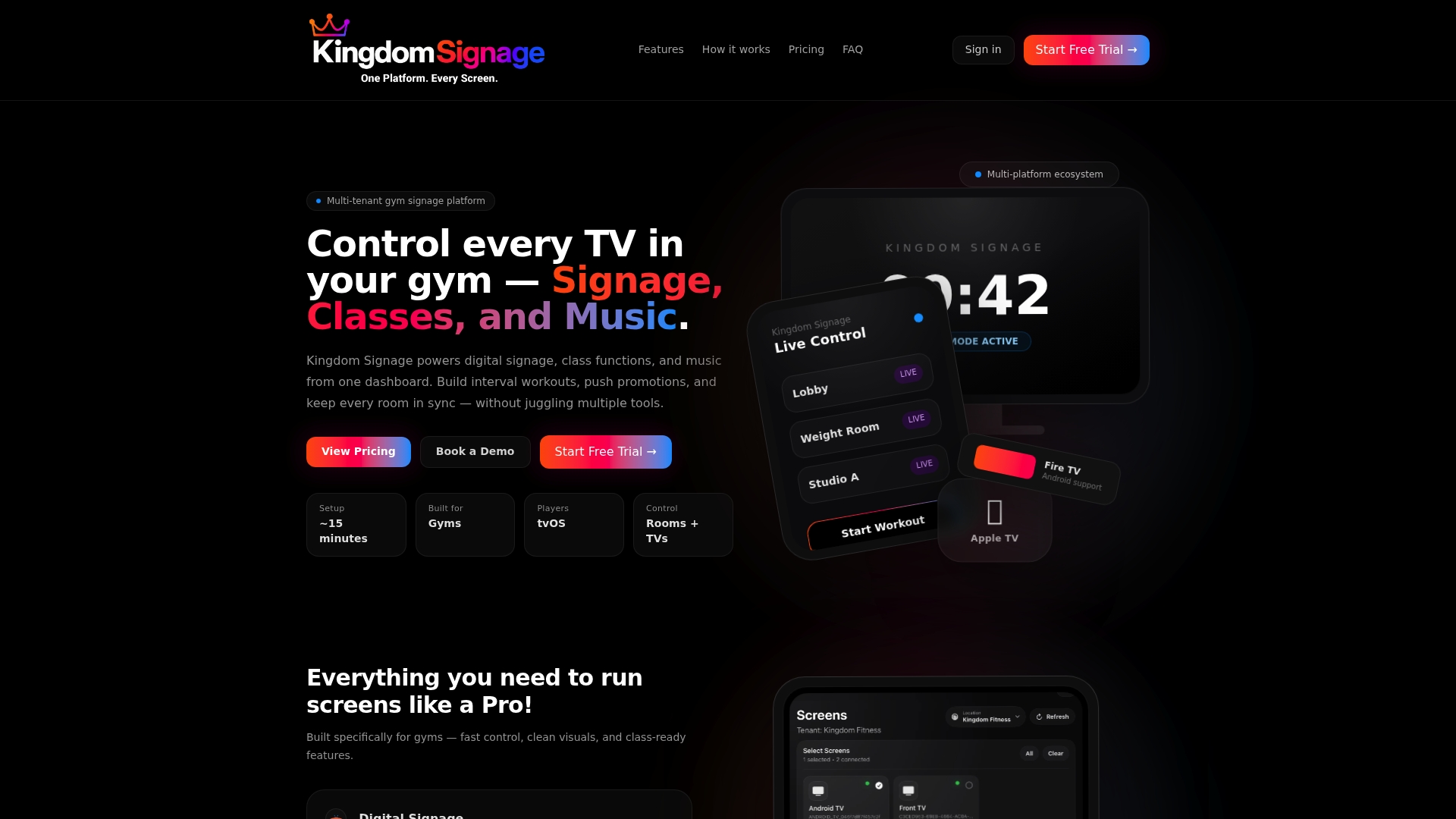
Planning a seasonal calendar is one thing. Getting that message in front of members the moment they walk through your door is another. Kingdomsignage unifies your gym's TV displays, class screens, and audio under one dashboard, so your seasonal promotion content reaches every room without manual updates or disconnected tools.
When your january acquisition campaign goes live, your lobby screen shows the offer, your workout floor TV reinforces it between sets, and your class room display carries the same message before the session starts. That kind of multi-room display coordination turns your physical space into an active marketing channel, not just a place people work out.
Visit Kingdomsignage to see how gym operators are using digital signage to reinforce seasonal campaigns and keep members engaged year-round.
Key Takeaways
Seasonal gym promotion scheduling works because it matches your marketing message to where your members' motivation actually is, month by month, rather than broadcasting the same offer all year.
| Point | Details |
|---|---|
| Plan the full year in advance | Studios with annual promotional calendars run six times more campaigns than those planning month to month. |
| Use a 6-week production lead time | Starting campaign production six weeks before launch reduces errors and keeps messaging consistent across all channels. |
| Limit concurrent promotions | Run no more than two or three offers at once: one seasonal, one evergreen, and one reactivation campaign. |
| Shift the hook, not the brand | Change your seasonal angle each month while keeping your gym's core voice and identity stable to build lasting member trust. |
| Sync digital and physical channels | In-gym screens, staff messaging, and digital campaigns should all reinforce the same seasonal offer at the same time. |