
Gym class promotion screen strategies are the methods gyms use to display class schedules, availability, and promotional content on digital screens to drive attendance and member engagement. The right digital signage strategy turns passive screens into active enrollment tools. Platforms like Kingdomsignage, MediaSignage, and CieloVision each approach this differently, but the core principle is the same: deliver the right message, in the right zone, at the right moment. Gyms that automate and zone their screen content consistently outperform those running static, one-size-fits-all loops.
1. What are the most effective gym class promotion screen layouts?
Screen layout is the foundation of any gym promotional screen strategy. A glanceable schedule layout shows the current class prominently at the top, followed by the next 3–4 sessions with times and instructor names. Members scan screens while moving, so the design must communicate in under three seconds.
Typography standards matter more than most gym managers realize. Minimum 24pt for class names and 18pt for times keeps text readable from 10–15 feet away. That distance covers most lobby and studio entrance viewing scenarios.

Color coding adds a second layer of communication without extra text. Use one color for open classes, another for nearly full, and a third for waitlist only. Members read this system instantly after one or two exposures.
Balancing operational information with promotional content is a common design challenge. A clean split of roughly 70% schedule information and 30% promotional messaging prevents visual clutter. Promotional content placed in a sidebar or lower third stays visible without competing with the schedule.
Pro Tip: Apply peripheral vision principles by placing urgency cues like "2 spots left" at the edges of the screen. Members notice edge movement even when not looking directly at the display.
2. How scheduling and automation improve your screen strategy
Effective digital signage scheduling is a problem of relevance, solved by playlists, dayparting, priority scheduling, and fallback defaults rather than graphic design alone. Gyms that treat scheduling as a content strategy tool, not just a technical task, see stronger engagement across all zones.
Dayparting is the practice of assigning different content to different time blocks. A morning playlist promotes high-energy classes and nutrition supplements. An evening playlist shifts to recovery, stretching sessions, and personal training packages. Dayparting aligns messaging with the member's physical state and mindset at that moment.
Content loop length directly affects how much information a member absorbs. The recommended range for full content loops is 3–10 minutes. Within that loop, individual images should display for 8–15 seconds and videos for 15–60 seconds. Shorter loops with fewer pieces perform better than long loops members never complete.
Key scheduling practices that reduce stale content:
- Set campaign date ranges so seasonal promotions expire automatically
- Assign fallback defaults so screens never go blank when a campaign ends
- Schedule a weekly content review as a minimum refresh cadence
- Integrate your signage CMS with your booking system for live class updates
- Use priority scheduling to override standard playlists for urgent announcements
Automating CMS integration with your gym's booking or calendar system eliminates the manual update problem entirely. When a class fills up or an instructor changes, the screen updates without staff intervention.
3. Which gym zones benefit most from targeted screen content?
Zone-specific content is the single biggest gap between gyms that get results from their screens and those that don't. Each gym screen zone should be treated as a different conversion step with its own playlist and messaging priority.
The reception and lobby area carries the highest dwell time in any gym. Prospects and new members spend the most time here, making it the best zone for membership upgrade offers, class package promotions, and new member conversion messaging. A screen showing live class availability at this point directly reduces the friction between "I'm thinking about it" and "I'll book now."
Studio entrance screens serve a different purpose. Members standing outside a studio are already committed to working out. The right content here shows the upcoming class, the instructor's name, spaces available, and the next three sessions. This is not the place for general promotions. It is the place for class-specific upsells like booking the next session or joining a challenge.
Workout floor screens work best with motivational content and contextually timed upsells. A member on a treadmill at 6 p.m. is a good candidate for a recovery class promotion. A member in the free weights area is a candidate for a personal training package offer.
Pro Tip: Build a content matrix before you build your playlists. Map each zone to a conversion goal, then assign content types to each zone. Reception converts. Studio entrance confirms. Workout floor upsells.
Managing multiple gym screen zones from a single dashboard prevents the common problem of mismatched messaging across the facility.
4. What role does real-time class availability play in promotion?
Real-time availability display is the highest-converting content type on a gym screen. Showing class capacity for the next 60–180 minutes reduces booking friction at the exact moment a member is deciding whether to join a class.
The messaging format matters as much as the data itself. "8 spots open" creates mild urgency without pressure. "Full, waitlist available" keeps the option visible and prevents members from assuming a class is inaccessible. Both messages serve different conversion goals.
| Message Type | Example Text | Best Zone | Conversion Goal |
|---|---|---|---|
| Open availability | "Yoga at 6:30 PM, 8 spots open" | Lobby, reception | Walk-in booking |
| Near capacity | "Spin at 7:00 PM, 2 spots left" | Studio entrance | Immediate sign-up |
| Full with waitlist | "HIIT at 5:45 PM, waitlist open" | Reception, lobby | Waitlist conversion |
| Off-peak promotion | "Pilates at 2:00 PM, 12 spots open" | Workout floor | Off-peak demand fill |
Walk-in conversions increase when members see open spots on a screen before they reach the front desk. The screen does the selling. The staff confirms the booking. That division of labor reduces front desk pressure and speeds up the member experience.
Technical integration requires connecting your booking system's API to your signage CMS. Platforms like Kingdomsignage support real-time schedule syncing so availability data updates automatically without manual input.
5. How to use dayparting for smarter fitness class advertising
Most gyms underperform by running the same promotional content all day without adjusting for member mindset or time of day. Dayparting fixes this by dividing the day into content windows, each with its own playlist and messaging focus.
A practical dayparting structure for a typical gym looks like this:
- Early morning (5:00 AM–9:00 AM): High-energy class promotions, protein and supplement offers, challenge sign-ups
- Midday (9:00 AM–2:00 PM): Off-peak class availability, personal training packages, membership upgrade offers
- Afternoon (2:00 PM–5:00 PM): Class schedule previews for the evening rush, recovery and stretch class promotions
- Evening (5:00 PM–9:00 PM): Real-time availability for peak classes, social proof content, next-day class reminders
- Late evening (9:00 PM–close): Recovery content, nutrition offers, early morning class previews
Each window targets a different member segment with a different intent. A member arriving at 6 a.m. is not the same person as a member arriving at noon. Treating them identically wastes screen time.
Content pieces within each window should stay short. Images display for 8–15 seconds and videos for 15–30 seconds per unit. That pace keeps the loop moving and prevents members from tuning out.
6. Examples of effective gym screen campaigns that work
Concrete campaign examples give gym managers a starting point they can adapt immediately. The most effective campaigns share three traits: a clear time limit, a single offer, and a direct call to action visible from across the room.
Seasonal campaigns perform consistently well because they align with member motivation cycles. A January "New Year Reset" campaign promotes beginner classes and orientation sessions. A September "Fall Back Into It" campaign targets lapsed members with re-engagement offers. Both campaigns benefit from a defined start date, end date, and a dedicated screen playlist.
Event-based push campaigns work on shorter timelines. A new instructor launch, a charity fitness challenge, or a studio opening all justify a two-week screen campaign with a countdown element. Countdown messaging like "3 days left to register" creates urgency without discounting.
Cross-promotions combine class enrollment with ancillary revenue. A personal training package offer displayed alongside a group class schedule targets members already engaged with classes. The screen shows the class they are about to take and the PT offer in the same frame.
Member achievement content, such as milestone callouts or challenge leaderboards, generates social proof on screen without requiring a paid promotion budget. Members who see their name on a screen tell other members.
Pro Tip: Rotate promotional content every 3–10 minutes to prevent message fatigue. A member who visits four times a week will see your loop roughly 16 times per month. Stale content stops registering after the third or fourth exposure.
For more campaign ideas, the guide on gym screens for new service launches covers promotional timing and content structure in detail.
Key takeaways
Gym class promotion screen strategies work best when content is zone-specific, time-aware, and connected to live booking data rather than running as a static loop.
| Point | Details |
|---|---|
| Zone-specific playlists | Assign different content goals to reception, studio entrance, and workout floor screens. |
| Dayparting by member mindset | Match promotional content to the time of day and the member's likely intent at that moment. |
| Real-time availability display | Show spots remaining for the next 60–180 minutes to reduce booking friction and increase walk-ins. |
| Automate CMS and booking sync | Connect your signage platform to your booking system to eliminate manual updates and stale content. |
| Content loop discipline | Keep images at 8–15 seconds and full loops at 3–10 minutes to maintain attention without overload. |
What I've learned from watching gym screens underperform
The most common mistake gym managers make is treating their screens as a notice board. They upload a schedule, maybe a promotion, and leave it running for weeks. The screen becomes invisible to members within days.
The gyms that get real results from their screens treat content as a live operation, not a set-and-forget task. They assign someone ownership of the screen content, set a weekly review cadence, and build playlists that change with the day and the season. That discipline is what separates a screen that drives bookings from one that members walk past without looking.
Automation is the practical answer to the ownership problem. When your signage CMS connects directly to your booking system, the schedule updates itself. Availability changes in real time. Seasonal campaigns expire on their own. The staff burden drops to a weekly creative review rather than daily manual updates.
The second thing I have seen consistently is that zone logic matters more than design quality. A beautifully designed poster running in the wrong zone at the wrong time converts nobody. A plain text "2 spots left in Spin at 7 PM" on the studio entrance screen converts every time. Context beats creative.
Start with two zones and two dayparting windows. Get those working before adding complexity. The gyms that try to build a full content matrix on day one usually abandon it within a month. The ones that start simple and add layers over time build systems that actually run.
— Kingdom
How Kingdomsignage powers your gym's screen strategy
Kingdomsignage is built specifically for gym environments where managing TVs, class screens, and audio from separate tools creates daily friction.
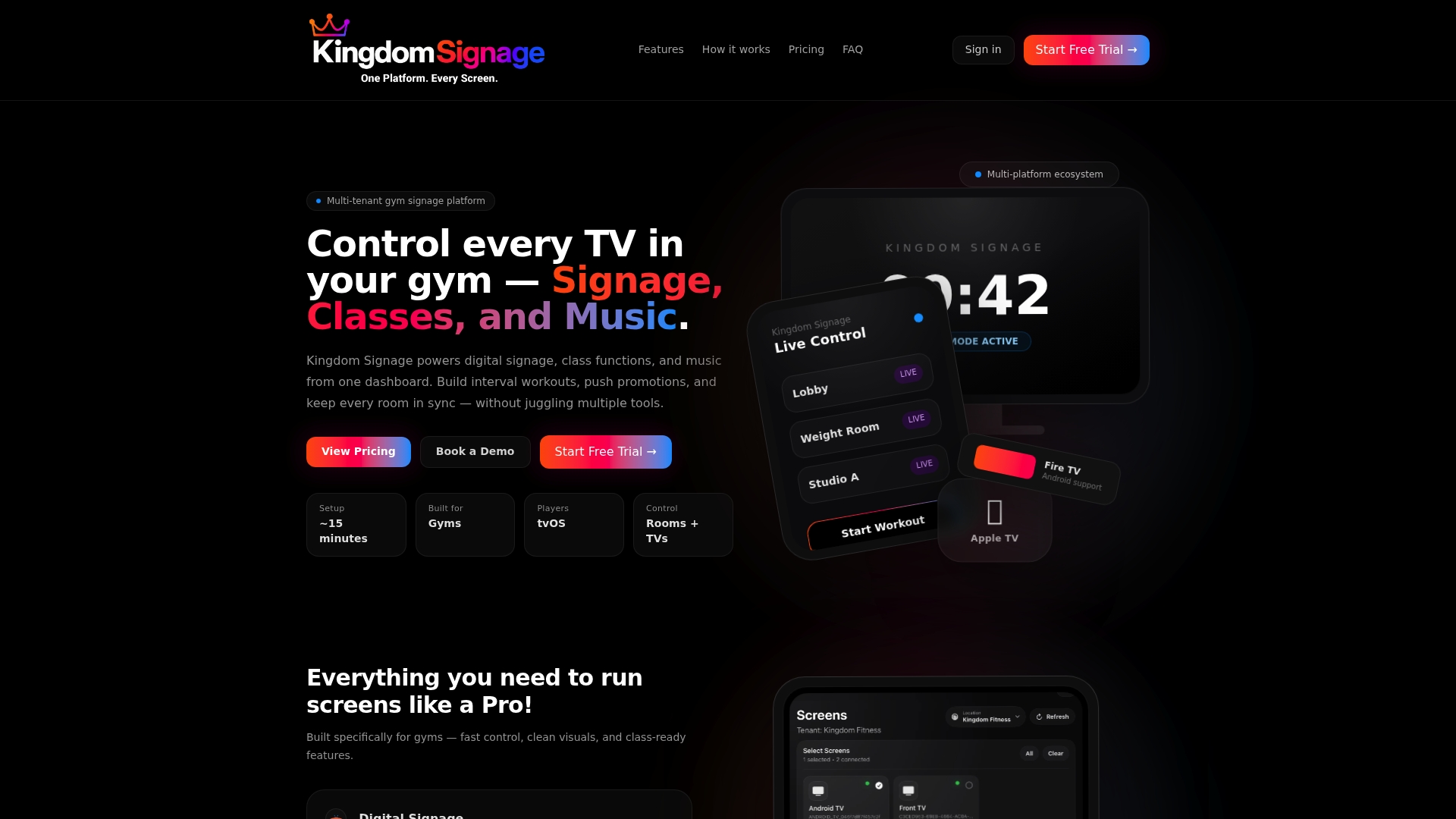
The platform gives gym managers a single dashboard to control every screen zone, sync class schedules in real time, and run dayparted playlists without manual intervention. Kingdomsignage connects directly to booking systems so availability data updates automatically across lobby, studio entrance, and workout floor screens simultaneously. Customizable playlists with fallback defaults mean your screens never go blank between campaigns. For gym operators managing multiple rooms or locations, Kingdomsignage scales without adding complexity. Learn more about the platform's gym digital signage capabilities and how it fits your facility's setup.
FAQ
What are gym class promotion screen strategies?
Gym class promotion screen strategies are the methods used to display class schedules, availability, and promotional content on digital screens to increase attendance and member engagement. They include zone-specific playlists, dayparting, real-time availability feeds, and automated CMS scheduling.
How often should gym promotional screen content be updated?
A weekly content refresh is the recommended minimum cadence. Connecting your signage CMS to your booking system enables automatic real-time updates for class availability and schedule changes.
Which gym zone converts best with digital signage?
The reception and lobby area carries the highest dwell time and is the most effective zone for new member conversion and class enrollment promotions. Studio entrance screens perform best for immediate class sign-ups and upsells.
What is dayparting in gym digital signage?
Dayparting is the practice of scheduling different content playlists for different times of day to match member mindset and intent. Morning content promotes high-energy classes while evening content shifts to recovery and next-day scheduling.
How does real-time availability improve class bookings?
Displaying spots remaining for the next 60–180 minutes reduces booking friction at the moment a member is deciding whether to join a class. Messages like "8 spots open" or "full, waitlist available" drive walk-in conversions without requiring staff interaction.