
Video content is the single most effective tool gym owners have for converting strangers into paying members. The role of video content in gym advertising goes far beyond posting workout clips online. It communicates atmosphere, coaching quality, and real member results in a way no static ad can replicate. Fitness consumers now expect to see a gym before they visit it. Video satisfies that expectation and shortens the decision cycle dramatically.
How does video content drive gym advertising results?
Video ads in the fitness sector generate 59% higher engagement and 25–40% lower cost per lead compared to static image ads. That gap matters because most gym advertising budgets are tight. Getting more leads for less spend is not a minor efficiency gain. It is the difference between a campaign that grows your membership and one that drains your marketing budget with nothing to show.
The trust factor is equally significant. Video compresses trust-building in fitness marketing by showing the gym environment and coaching style in seconds. A prospective member watching a 30-second walkthrough clip learns more about your gym than they would from reading three paragraphs of copy. That visual proof removes the uncertainty that keeps people from booking a trial.

Consumer behavior confirms this pattern. 86% of fitness consumers watch video content before choosing a gym, and 76% say they are more likely to join after watching real member testimonials. Those numbers define the standard expectation in the market. Gyms that do not produce video content are invisible to the majority of their potential members before those members ever walk through the door.
The impact of videos on gym sales also shows up in booking data. Walkthrough videos increase trial bookings by 33%. A trial booking is the highest-value conversion in gym marketing because it puts a prospect inside your facility. Once they are there, your staff and environment close the sale.
What types of video content work best for gym marketing?
Not all video formats serve the same purpose. Matching the right format to the right stage of the member acquisition funnel is what separates effective gym advertising strategies from random content posting.
-
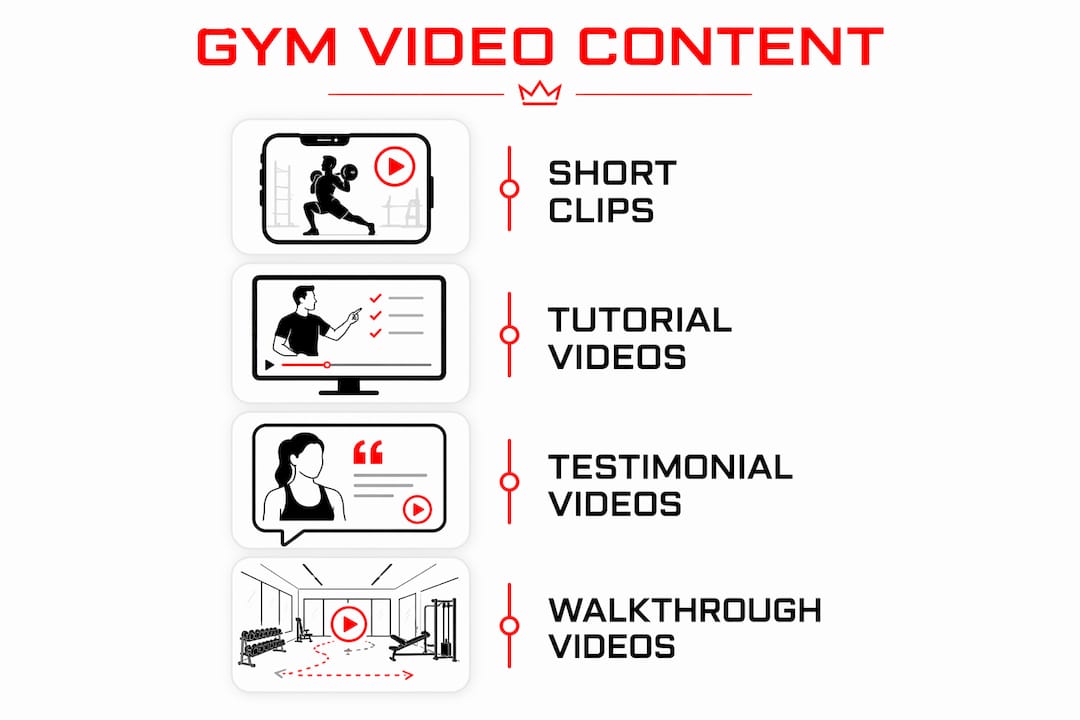
Short-form vertical videos (Reels and TikToks). These are your cold traffic engine. Short-form videos under 30 seconds deliver 3–5x the reach of static posts. Use them to introduce your gym to people who have never heard of you. A fast-paced class clip, a before-and-after transformation, or a 15-second tour of your facility all qualify. Pair these with class promotion screen strategies to reinforce the message inside your gym as well.
-
Member testimonial videos. These are your highest-converting format. Real members speaking about real results carry more weight than any scripted ad. Member testimonials outperform stock footage and cinematic production in trust and conversion metrics. Keep them under 90 seconds and let the member speak naturally.
-
Facility walkthroughs. These directly drive trial bookings. A clean, well-lit tour of your gym floor, locker rooms, and class spaces answers the questions prospects are too shy to ask. Pair walkthroughs with a clear call to action (CTA) for a free trial or discounted first month.
-
Behind-the-scenes and class previews. These build ongoing engagement with warm audiences. Showing a coach preparing a session or members warming up before a class creates familiarity. Familiarity reduces the anxiety that stops people from committing to a new gym.
-
Tutorial and educational videos. These serve your long-term organic search strategy. A well-edited YouTube video on proper squat form or nutrition basics builds searchable authority for your gym's brand. Long-form YouTube videos require careful editing, chapter markers, and graphics to hold watch time, but they compound in value over months.
Pro Tip: Post two short-form videos per week consistently, and add one longer tutorial video per month. Consistency in this posting cadence best supports compounding SEO and engagement growth over time.
How should gyms produce and edit video for maximum impact?
The most common mistake gym owners make is waiting until they can afford a professional video crew. Raw, smartphone-shot video content often outperforms polished studio footage because it reads as authentic. Prospects trust what looks real. A shaky, enthusiastic clip of a packed Saturday morning class converts better than a sterile, perfectly lit promo reel.
That said, authenticity does not mean careless editing. Videos must hook viewers within 3 seconds to prevent drop-off. The first frame cannot be a logo animation or a slow pan of an empty gym floor. It needs to be a dramatic moment: a member hitting a personal record, a coach giving high-energy instruction, or a transformation side-by-side.
Key production principles for using video in fitness promotions:
- Hook first. Open with your most compelling moment, not your gym name.
- Edit for the platform. Instagram Reels rewards fast cuts and trending audio. YouTube rewards longer explanations with clear structure. TikTok rewards personality and humor. Gyms must edit videos specifically for each platform's algorithm and audience expectations.
- Add captions. Most social video plays without sound. Captions keep viewers engaged and improve accessibility.
- End with a CTA. Every video needs a next step: book a free trial, follow the page, or visit the website. A video without a CTA is a missed conversion.
- Send paid traffic to landing pages. Dedicated landing pages triple conversion rates compared to sending ad traffic to a general homepage.
Pro Tip: Film three to five short clips every time you set up your phone to record. Batch filming cuts the time cost of consistent posting and gives you a content buffer for slow weeks.
What legal and privacy rules apply to gym video content?
Filming members without consent is the fastest way to turn a successful video campaign into a legal liability. Privacy laws including GDPR in Europe and CCPA in California require explicit consent from any identifiable person appearing in your content. That applies to background members who did not sign up to be in your ad.
The practical steps for compliance are straightforward:
- Post visible consent signage at gym entrances stating that filming may occur on the premises.
- Collect written consent from any member who appears prominently in your videos.
- Use AI face-blurring tools for background members who did not consent. Automated AI face-blurring saves 6–10 hours per video and keeps your content compliant without reshooting.
- Review platform terms before publishing. Meta, YouTube, and TikTok each have their own content policies on identifiable individuals.
Non-compliance carries real consequences. Fines under GDPR can reach 4% of annual global revenue, and platforms will remove content that violates their privacy policies without warning. Building consent into your filming process from the start costs far less than fixing a violation after the fact.
Facial recognition AI tools are increasingly accurate at anonymizing gym backgrounds while preserving video quality. This technology removes the trade-off between compliance and compelling footage. You can film a packed class, blur the faces of non-consenting members, and still publish content that shows your gym at its most energetic.
Key Takeaways
Video marketing for gyms is the highest-return advertising format available, combining lower cost per lead, higher engagement, and measurable conversion lifts across every stage of the member acquisition funnel.
| Point | Details |
|---|---|
| Video outperforms static ads | Video ads generate 59% higher engagement and 25–40% lower cost per lead in the fitness sector. |
| Testimonials convert best | 76% of fitness consumers are more likely to join after watching real member testimonials. |
| Hook within 3 seconds | The opening frame must show a compelling moment or viewers will scroll past before your message lands. |
| Compliance is non-negotiable | Use AI face-blurring tools and written consent forms to meet GDPR and CCPA requirements. |
| Consistency compounds results | Most gyms see new members citing video as a primary factor 60–90 days after consistent posting begins. |
Video marketing is a long game, and most gyms quit too early
The gyms I see struggle most with video are not the ones producing bad content. They are the ones producing decent content for six weeks, seeing no immediate spike in memberships, and stopping. Most gyms see new members citing video content as a primary factor 60–90 days after consistent posting starts. That is a compounding effect, not a campaign result. If you stop at week six, you never reach the payoff.
The other pattern I notice is an over-reliance on paid video ads without any organic foundation. Paid ads work for cold traffic, but warm prospects want to see a library of content before they commit. Hybrid strategies using paid social video for cold traffic and search-optimized content for warm leads generate up to 3x higher conversion rates than either approach alone. Build both tracks simultaneously.
Video quality standards in fitness marketing are rising fast. A year ago, a basic smartphone walkthrough stood out. Now, the bar is higher because more gyms are producing content. The gyms winning in 2026 are the ones combining authentic footage with intentional editing, platform-specific formatting, and a clear funnel from first view to trial booking. That is not complicated. It is just consistent, deliberate work applied over time.
— Kingdom
How Kingdomsignage amplifies your gym video strategy
Producing great video content is only half the equation. Where and how you display that content inside your gym shapes the member experience just as much as what you post online.
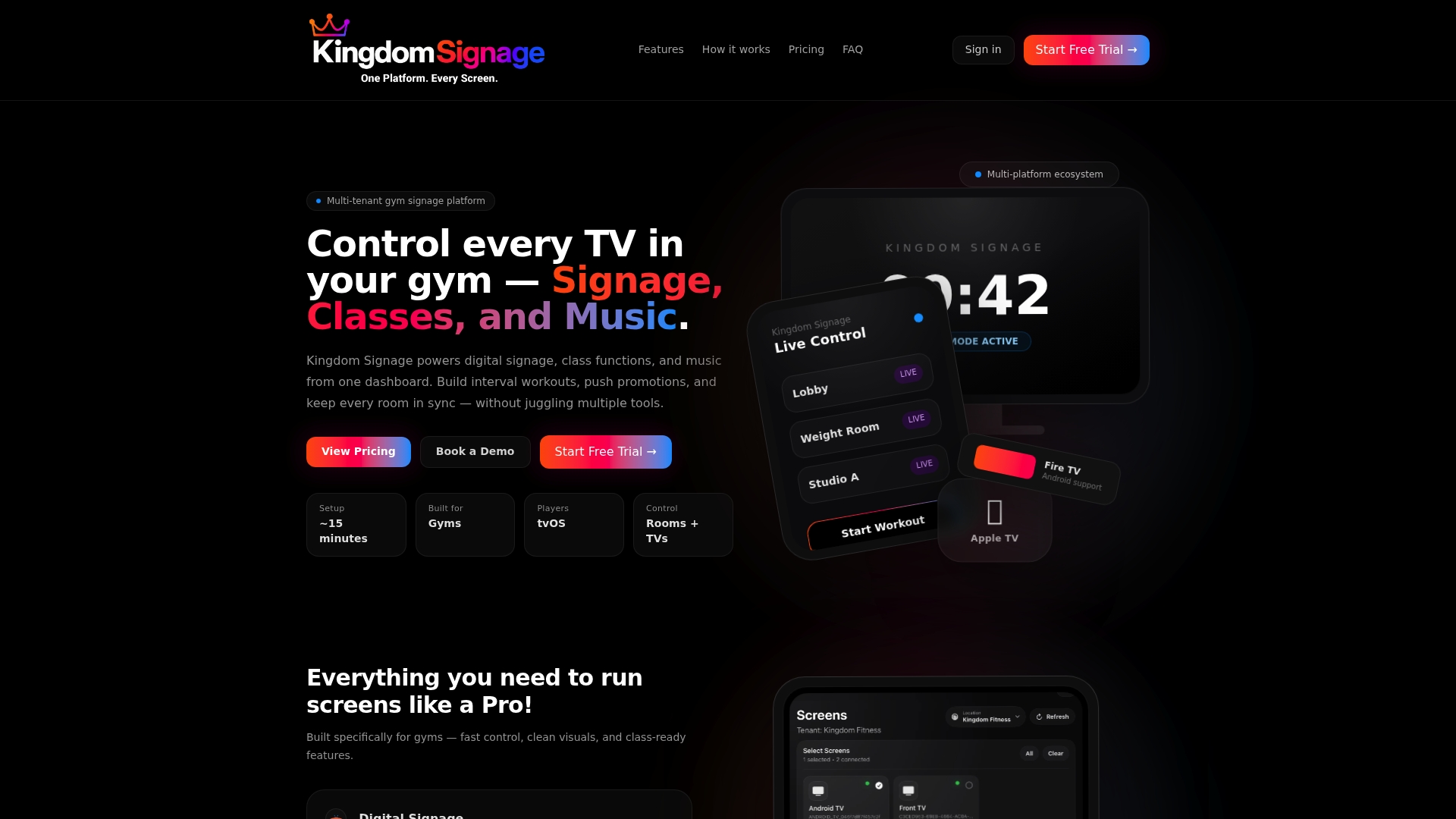
Kingdomsignage gives gym operators a single dashboard to control TVs, class screens, and audio across every room. You can display member testimonials in the lobby, run facility walkthroughs on screens near the front desk, and sync promotional video content with live class schedules without juggling multiple tools. The platform also supports Connected TV campaigns that extend your video reach beyond the gym floor. For gym owners ready to put their video content to work in every corner of their facility, Kingdomsignage is built for exactly that.
FAQ
How does video content increase gym membership sales?
Video builds trust faster than any other format by showing the gym environment, coaching style, and real member results. Walkthrough videos alone increase trial bookings by 33%, and 76% of fitness consumers are more likely to join after watching member testimonials.
What is the best video format for gym advertising?
Short-form vertical videos under 30 seconds deliver the broadest reach for cold audiences, while member testimonial videos convert at the highest rate. Use both formats together for a complete gym advertising strategy.
How often should a gym post video content?
Posting two short-form videos per week combined with one longer tutorial video per month best supports compounding engagement and SEO growth over time.
Do gyms need member consent to film video content?
Yes. Privacy laws including GDPR and CCPA require explicit consent from any identifiable person in your video content. Post visible signage at entrances, collect written consent from featured members, and use AI face-blurring tools for background individuals.
How long does it take for gym video marketing to show results?
Most gyms begin seeing new members cite video content as a primary decision factor 60–90 days after starting consistent posting. Video marketing builds compounding results over time rather than delivering immediate spikes.