
TV screens are a direct revenue tool in fitness facilities, not a background amenity. The role of TV screens in gym revenue spans three measurable channels: member retention, upsell conversion, and class attendance. Well-executed digital signage can increase total gym revenue by 1–5%, with a 15–25% lift on specific upsell categories like personal training. That range is not theoretical. It comes from operator reporting across dozens of facilities. Gym owners and fitness managers who treat screens as passive entertainment are leaving real money on the table.
What are the main revenue mechanisms of TV screens in gyms?
Screens amplify existing revenue streams rather than create new ones from scratch. A screen above a retail shelf does not replace a sales conversation. It primes the member before that conversation happens. The impact on gym profits comes from compounding small behavioral nudges across hundreds of daily interactions.
The four core revenue mechanisms are:
- Class slot fill. Real-time class schedules displayed on floor screens reduce the friction of booking. Members who see an open slot during their workout fill it on the spot. Gym screens that support class enrollment consistently show attendance gains when content is updated in real time.
- Personal training upsells. Targeted PT offers shown to members with zero prior PT engagement produce a 15–25% lift in PT bookings. The trigger is member state: trial days, attendance milestones, or time since last PT session.
- Retail and supplement cross-sells. Screens placed above sales shelves increase average member spend without adding staff. Dwell time in the retail area is the asset. The screen converts that dwell time into a purchase prompt.
- Trial-to-member conversion. Automated welcome sequences and social proof content shown to trial members during their first visits accelerate the decision to commit. This is funnel logic applied to a physical space.
Pro Tip: Schedule PT offer content during peak hours, specifically the 6–9 a.m. and 5–7 p.m. windows, when members are most receptive and staff are most available to follow up.
The Peak Performance Gyms case study makes the financial case concrete. After deploying 162 displays, the chain recorded a 44% increase in class attendance, a 38% growth in PT sessions, and a 37% rise in secondary revenue. The initial investment of $445,600 reached full ROI in two months. That result is exceptional, but it illustrates the ceiling when screens are deployed with a clear content strategy.
How does screen placement affect member engagement and revenue?
Placement determines whether a screen generates revenue or generates noise. A screen that members cannot read from their position on a treadmill does not influence behavior. Fit Viz states that at least one visible workout screen per cardio position is critical for engagement and retention effects. That is a minimum standard, not a best practice.
The operational rules for placement are straightforward:
- Mount at eye level or slightly above for cardio zones. Members on treadmills and bikes have a fixed sightline. Screens mounted too high or at an angle create neck strain and get ignored.
- Place promotional screens at decision points. The area near the front desk, the PT booking station, and the retail shelf are where purchase decisions happen. A screen in the locker room hallway does not drive PT bookings. A screen next to the PT schedule board does.
- Separate motivational content from promotional content. Members in the middle of a workout do not want to see a protein shake ad. Motivational content during training, promotional content during rest, check-in, and checkout is the correct sequence.
- Size screens to the viewing distance. A 40-inch screen is unreadable from 20 feet. The standard rule is 1 inch of screen diagonal per foot of viewing distance. A 20-foot cardio row needs a screen of at least 55 inches.
Pro Tip: Unreadable or poorly placed workout screens actively reduce coaching efficiency and member engagement. Test readability from every major equipment position before finalizing a mount location.
Content design follows the same logic. Effective gym signage targets the right member segment at the right time, not broad broadcasting. A new member in week one needs orientation content. A six-month member needs a PT upsell. A lapsed member needs a re-engagement offer. Screens that show the same loop to every member at every time of day underperform by a wide margin.

How can gym owners measure the revenue impact of TV screens?
Measurement is where most gym operators fail. Screens get installed, content gets loaded, and the assumption is that revenue will follow. Without a measurement framework, you cannot separate the screen's contribution from seasonal trends, staff changes, or pricing shifts.
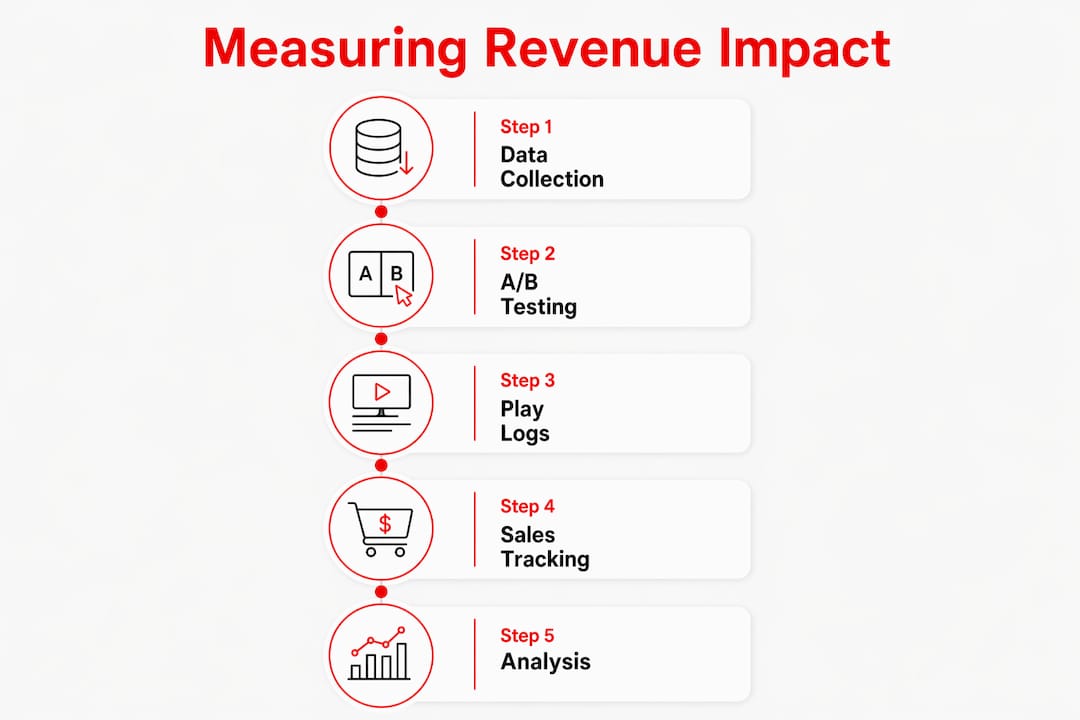
The most credible measurement approach comes from retail. A four-year study across 30 million receipts and 237 campaigns demonstrated measurable behavioral lift from digital signage at the point of purchase. Gyms can apply the same methodology at a smaller scale.
| Measurement method | What it tracks | Practical gym application |
|---|---|---|
| A/B location testing | Revenue difference between screen and no-screen zones | Run screens in one club, hold another as control for 90 days |
| Proof-of-play logs | What content played, where, and for how long | Match content schedule to PT booking spikes |
| Point-of-purchase tracking | Retail sales lift tied to screen proximity | Compare shelf sales before and after screen installation |
| Class attendance tracking | Fill rate changes after schedule display deployment | Track week-over-week class fill rates by room |
Proof-of-play logs deserve special attention. Many gym operators underinvest in this infrastructure. Logs that record what content played, where, and for how long convert screens from cost centers into quantifiable assets. They also open the door to third-party advertising revenue from local brands and fitness-relevant sponsors.
Starting with one high-impact location before scaling reduces risk. Incremental rollout guidance consistently recommends testing in a single high-traffic zone, measuring true revenue impact, and then expanding. This approach also gives you real data to present to ownership or investors when requesting budget for additional screens.
What future trends in gym screen technology can increase revenue?
The next wave of gym screen revenue does not come from more screens. It comes from smarter content delivery and new monetization models.
Programmatic advertising is the most significant shift. DOOH (digital out-of-home) campaigns have shown that audiences are 45% more likely to visit a retail location within 10 days of screen exposure. Gyms with a networked screen infrastructure can sell advertising slots to local health brands, supplement companies, and wellness services. The screen network becomes a revenue line, not just a cost line.
Key trends shaping gym screen revenue in 2026 and beyond:
- AI-driven dynamic content. Content that adjusts based on time of day, current class schedule, and member traffic patterns outperforms static loops. Platforms that integrate with gym management software can trigger PT offers automatically when a member hits a defined attendance threshold.
- Multi-room network management. Managing 10 or 20 screens from a single dashboard eliminates the labor cost of manual content updates. Multi-room gym display management also enables consistent messaging across every zone, which matters for brand trust and promotional timing.
- Integration with membership software. Screens connected to member data can show personalized content at check-in. A member who has not booked a class in three weeks sees a class schedule. A member who just completed their 50th visit sees a loyalty reward offer.
- Third-party advertising networks. Gyms with proof-of-play infrastructure and audience data can join DOOH advertising networks, turning idle screen time into direct ad revenue.
Revenue gains in this category depend on precise timing and targeting. Generic content loops do not produce the same results as content built around peak traffic windows and member behavior triggers.
Key Takeaways
TV screens generate measurable gym revenue only when placement, content targeting, and measurement infrastructure work together as a system.
| Point | Details |
|---|---|
| Revenue lift is real but conditional | Screens produce a 1–5% total revenue lift and up to 25% on PT upsells when content is targeted. |
| Placement determines performance | At least one readable screen per cardio position is the minimum standard for engagement impact. |
| Measurement requires infrastructure | Proof-of-play logs and A/B location tests convert screens from assumptions into quantifiable assets. |
| Start small, then scale | Test one high-traffic zone before deploying facility-wide to reduce risk and build a real ROI case. |
| Future revenue includes advertising | Networked screens with audience data can generate third-party ad revenue beyond member upsells. |
What gym owners consistently get wrong about screen strategy
The most common mistake I see is treating screen installation as the finish line. Gym owners invest in hardware, load a content loop, and then check the box. Six months later, they wonder why PT bookings have not moved.
The screens are not the product. The content strategy is the product. A 162-display network like Peak Performance Gyms deployed did not produce a 38% PT growth because the screens were large. It produced that result because the content was tied to member behavior, scheduled around peak hours, and measured against a baseline.
The second mistake is overloading members with promotional content. A member on a treadmill who sees a supplement ad, a class promo, and a membership upgrade offer in the same 90-second loop tunes out all three. The rule I apply is one message per screen per context. Cardio zone gets motivational content. Front desk area gets class schedules and PT offers. Retail area gets product-specific prompts.
The third mistake is skipping measurement entirely. Without performance metrics for gym screens, you cannot make the case for more investment, you cannot identify what is working, and you cannot sell advertising to third parties. Measurement is not optional. It is the infrastructure that makes everything else defensible.
Gym owners who get this right treat their screen network the way a media company treats its inventory. Every screen, every time slot, and every content piece has a job. When it does not perform, it gets replaced.
— Kingdom
How Kingdomsignage helps gym owners act on screen revenue
Kingdomsignage is built specifically for gym environments, unifying control of TVs, workout class displays, and audio through a single dashboard. Gym managers can push content updates, schedule PT offers by time of day, and sync messaging across every room without juggling multiple tools.
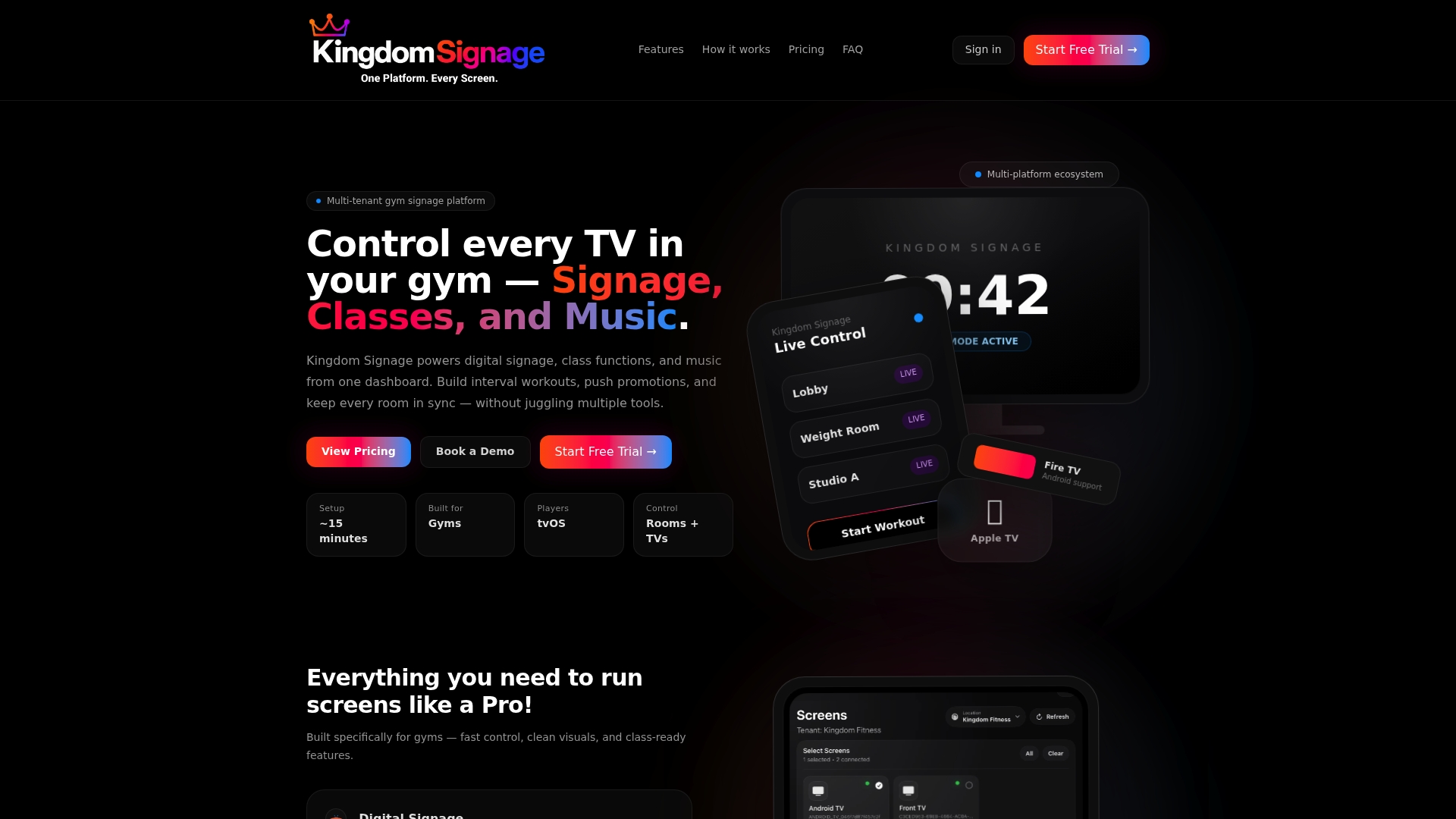
For gym owners ready to move from passive screens to a managed gym signage system, Kingdomsignage provides the infrastructure to schedule, measure, and adjust content across your entire facility. The platform connects directly to your existing TV network and supports the kind of targeted, timed content delivery that produces the revenue lifts outlined in this article. Visit Kingdomsignage to see how the dashboard works for facilities of any size.
FAQ
How much revenue can TV screens add to a gym?
Well-deployed digital signage produces a 1–5% lift in total gym revenue and a 15–25% lift on personal training upsells. Results depend on content targeting, placement, and measurement infrastructure.
Where should gym TV screens be placed for maximum impact?
Screens should be placed at decision points: near the front desk, PT booking areas, and retail shelves. Cardio zones need at least one readable screen per equipment position to drive engagement and retention.
How do you measure the ROI of gym TV screens?
Use A/B location testing, proof-of-play logs, and point-of-purchase tracking to isolate the screen's contribution to revenue. Start with one location and measure for 90 days before scaling.
Can gym screens generate revenue beyond member upsells?
Yes. Gyms with networked screens and proof-of-play infrastructure can sell advertising slots to local health brands and join DOOH advertising networks, turning screen time into a direct revenue line.
How does content targeting affect gym screen performance?
Targeted content tied to member behavior, such as PT offers triggered by attendance milestones, consistently outperforms generic content loops. The 2026 fitness signage playbook identifies member-state triggers as the single highest-impact content tactic.