
Gym promotional content is defined as any media or message a fitness facility uses to attract new members, retain existing ones, or drive specific actions like class sign-ups and product purchases. The most effective gym marketing strategy combines four content categories: direct promotions, educational posts, social proof, and community-driven material. A balanced content mix limits direct promotions to 10–20% of output, with 40% educational, 30% social proof, and 20% personality content. That ratio exists because members tune out gyms that only push discounts. The types of gym promotional content you choose, and how you balance them, determine whether your marketing builds loyalty or gets ignored.
1. What are the main types of gym promotional content?
The four core categories of gym promotional content are direct promotions, educational content, social proof, and community content. Each category serves a different purpose in the member relationship. Direct promotions drive immediate action. Educational content builds trust and organic reach. Social proof converts skeptics. Community content keeps current members emotionally invested.
Most gym owners default to direct promotions because they feel measurable. The problem is that overusing them trains your audience to wait for discounts instead of valuing your services at full price. A content calendar that rotates all four types prevents that pattern and keeps your feed worth following.
2. Direct promotional content: offers, trials, and referral programs
Direct promotional content includes any message with a clear call to action tied to a financial incentive. Free trial passes, limited-time membership discounts, referral bonuses, and seasonal pricing campaigns all fall into this category. These posts work best when they are short, specific, and time-bound. "Join before Friday and get your first month free" outperforms "great deals available now" every time.
- Free trial passes lower the barrier for prospects who are unsure about committing
- Referral incentive programs turn current members into your most credible sales channel
- Seasonal discount campaigns (January, September) align with natural motivation spikes
- Flash sales via SMS reach members who are already warm and likely to act fast
SMS open rates sit at 98%, with 82% of consumers reading messages within five minutes. That speed makes SMS the strongest channel for time-sensitive direct offers. Keep direct promotions to no more than 20% of your total content output to avoid discount fatigue.
Pro Tip: Write every direct promotion as if you have 10 seconds of the reader's attention. One offer, one deadline, one link.
3. How educational content enhances gym promotional efforts
Educational content is the highest-performing category for organic reach and algorithm favor. Platforms like Instagram and TikTok reward content that gets saved and shared, and educational posts are the most shareable and saveable format in fitness marketing. That means every workout tip video or myth-busting post you publish works harder than a discount graphic.
Effective educational formats include:
- Short-form video tutorials showing correct exercise form (ideal for Instagram Reels and TikTok)
- Myth-busting posts that correct common fitness misconceptions and position your staff as experts
- Nutrition tips tied to your members' goals (fat loss, muscle gain, endurance)
- Beginner guides that reduce intimidation for prospects who have never set foot in a gym
TikTok delivers 3.7%–6.2% engagement for gym content, compared to Instagram Reels at 2.2%. That gap is significant for gyms targeting the 18–35 demographic. Publishing the same educational video on both platforms costs nothing extra and doubles your reach.
Pro Tip: Film educational content at your actual gym with your actual trainers. Authenticity outperforms production value every time in fitness content.
4. What is social proof in gym marketing and why does it convert?
Social proof is any content that shows real people getting real results at your gym. It works because prospective members trust other members more than they trust your marketing copy. Testimonials, before-and-after transformations, member milestone posts, and Google review highlights all qualify as social proof content.
- Member spotlight stories give a face and a name to results, making them relatable
- Before-and-after transformation posts are the most persuasive format for conversion-focused campaigns
- Video testimonials carry more weight than written quotes because they are harder to fake
- Micro-influencer partnerships with local fitness enthusiasts extend your reach to warm, local audiences
The ethical standard for transformation content requires explicit written consent from the member. Always get permission before publishing photos or personal details. Gyms that skip this step face both legal exposure and a trust problem if members feel exploited.
Social proof content performs best on Instagram, Facebook, and Google Business Profile. These platforms surface reviews and testimonials to people actively searching for gyms in your area. Posting member success stories consistently gives the algorithm fresh material to show to high-intent prospects.
5. How community content builds gym brand loyalty
Community content is the category most gyms underinvest in, and it is the one most directly tied to retention. When members see themselves and their peers celebrated on your channels, they feel a sense of belonging that no discount can replicate. Digital signage focused on community content increases member belonging and encourages organic sharing and engagement.
Strong community content examples include:
- Behind-the-scenes clips of your trainers preparing for class or setting up equipment
- Staff introduction posts that humanize your team and build personal connections
- Member milestone celebrations (100th workout, first pull-up, one-year anniversary)
- Event recaps from charity fitness challenges, open gym days, or member competitions
Kingdomsignage makes this category easier to execute at scale. The platform lets gym operators push community content to in-gym screens across multiple rooms from a single dashboard. A member who sees their milestone celebrated on the lobby screen during their next visit is far more likely to renew than one who only receives a renewal reminder email.
Pro Tip: Create a simple form or QR code at the front desk where members can nominate each other for milestone recognition. It generates content ideas and builds culture simultaneously.
6. Types of gym promotional display content and digital signage
In-gym digital signage is one of the most underused channels in fitness marketing. Screens placed in lobbies, locker rooms, and workout floors reach members at the exact moment they are most engaged with your brand. Gym digital signage can display class schedules, promotional offers, member spotlights, and motivational content in rotation without requiring manual updates.
The most effective display content types for gym screens include:
- Class schedule announcements that drive enrollment for underbooked sessions
- Limited-time membership offers shown during peak traffic hours
- Member success stories displayed as rotating slides in the lobby
- Trainer profiles and credentials that build confidence in your staff
- Motivational quotes and workout tips that reinforce your gym's identity
Kingdomsignage unifies control of TVs, workout class displays, and audio across every room through one dashboard. That means a promotion running on the lobby screen can be paired with a matching audio message in the weight room without needing separate devices or software. Multi-room display management removes the friction that causes most gyms to abandon their signage strategy after the first month.
7. How to automate gym promotional displays and messaging
Automation is what separates gyms that execute consistently from those that post sporadically. The three main automation tools for gym marketing are social media scheduling platforms, AI-driven SMS systems, and digital signage content management.
Social media scheduling lets you batch-create a month of content in one session and publish it automatically. That consistency signals reliability to both your audience and the algorithm. For email, segmenting campaigns by member visit frequency and membership tier reduces unsubscribe rates and keeps messages relevant. A member who visits five times a week needs different messaging than one who has not checked in for three weeks.
AI-driven SMS conversations based on individual member behavior outperform broadcast blasts in both engagement and trust. An AI agent that texts a lapsed member with a personalized check-in feels like a trainer reaching out, not a mass marketing campaign. That distinction matters because generic broadcast texts actively reduce trust over time.
For in-gym screens, Kingdomsignage automates content rotation so your displays always show current, relevant material without manual intervention. Operators can schedule promotional content to appear during morning rush hours and switch to community content during evening classes, all from the same dashboard.
Key takeaways
The most effective gym marketing strategy uses a structured content mix: 40% educational, 30% social proof, 20% community, and 10–20% direct promotions, delivered across digital signage, SMS, and social media with consistent automation.
| Point | Details |
|---|---|
| Balance your content mix | Limit direct promotions to 10–20% and prioritize educational and social proof content. |
| Use SMS for time-sensitive offers | SMS carries a 98% open rate, making it the fastest channel for urgent promotions. |
| Invest in community content | Member milestone posts and behind-the-scenes content drive retention more than discounts. |
| Automate display content | Digital signage platforms like Kingdomsignage remove manual effort and keep screens current. |
| Segment your messaging | Tailor email and SMS by visit frequency and membership tier to reduce unsubscribes. |
What I have learned about gym content that most marketers get wrong
Most gym marketing advice focuses on what to post. The harder question is what not to post, and how often. I have seen gyms with strong offers and great trainers lose members because their feed became a discount catalog. When every post is a promotion, members stop reading them. Worse, they start expecting a deal before they commit to anything.
The gyms that retain members longest are the ones that make members feel seen. A post celebrating a member's 200th workout does more for retention than a "bring a friend" campaign. That is not a soft, feel-good observation. It is a practical content decision backed by how people actually behave when they feel belonging versus when they feel marketed to.
Authenticity is not a style choice. It is a competitive advantage. A phone-filmed trainer tip from your actual floor beats a polished stock-photo graphic every time, because your members know the difference. The gyms winning on TikTok and Instagram right now are not the ones with the biggest production budgets. They are the ones showing up consistently with real content from real people.
The technology side of this has also shifted. Automating your in-gym screens and SMS campaigns used to require multiple vendors and a lot of manual coordination. Platforms like Kingdomsignage have collapsed that complexity into a single dashboard. The operators who use that kind of tool are not just saving time. They are executing a more consistent content strategy than their competitors, which compounds over months and years.
— Kingdom
How Kingdomsignage helps gyms run better promotional content
Gym owners who want to run consistent, well-timed promotional content across every touchpoint need a system that handles the coordination for them.
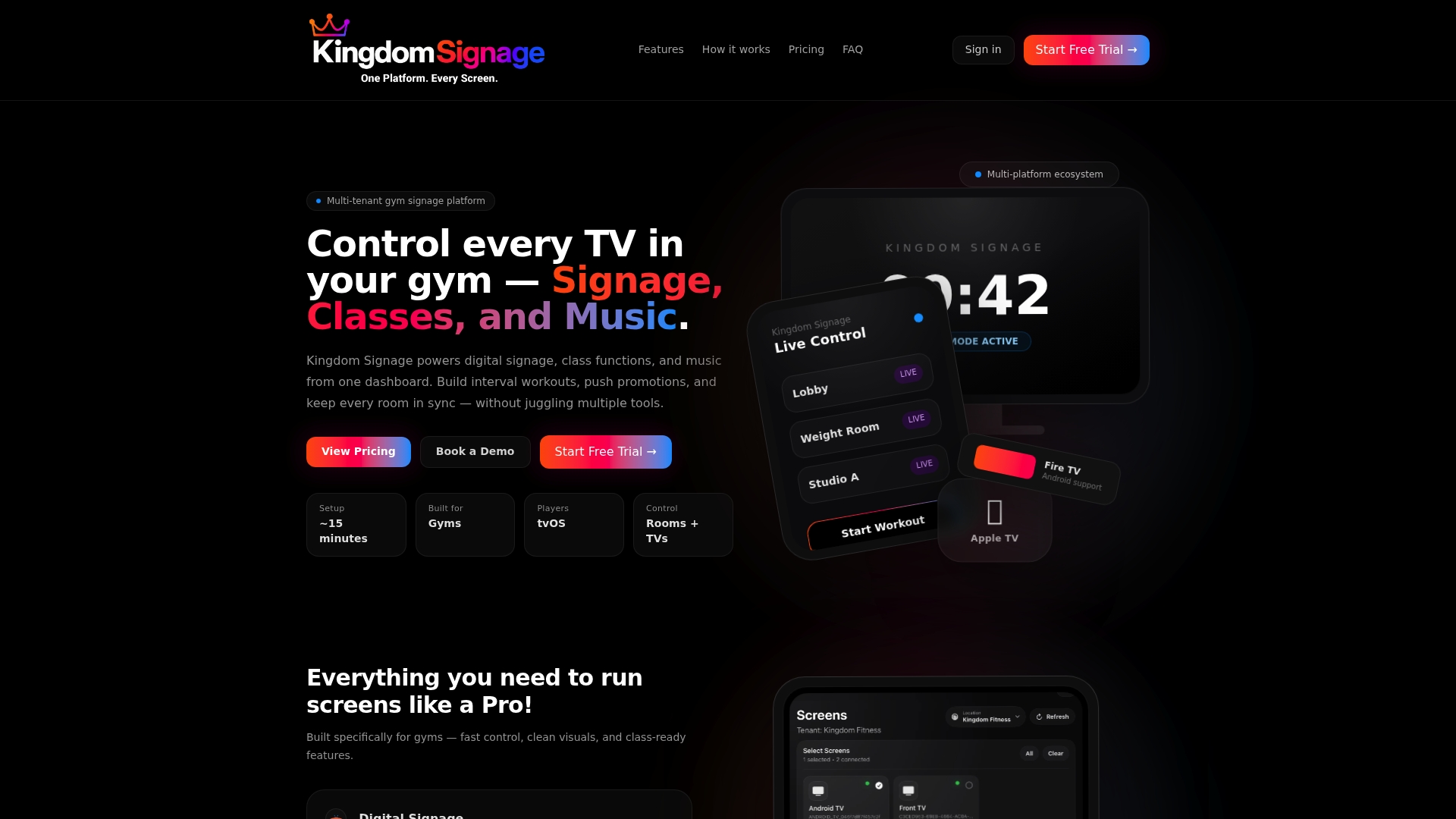
Kingdomsignage gives gym operators a single dashboard to control TVs, class displays, and audio across every room. You can schedule promotional content to run during peak hours, push community spotlights to lobby screens, and sync audio messaging with your visual campaigns, all without juggling multiple tools. The platform is built specifically for gym environments, which means the workflow fits how your facility actually operates. If you are ready to see how gym digital signage can run your promotional content on autopilot, Kingdomsignage is worth a close look.
FAQ
What are the four main types of gym promotional content?
The four main types are direct promotions, educational content, social proof, and community content. Each serves a different role in attracting new members and retaining existing ones.
How much of gym social media content should be direct promotions?
Direct promotions should make up 10–20% of your total content output. The recommended content mix allocates 40% to educational posts, 30% to social proof, and 20% to personality and community content.
What is the best channel for gym promotional offers?
SMS is the most effective channel for time-sensitive gym offers, with a 98% open rate and 82% of messages read within five minutes. Social media and digital signage work best for ongoing brand and community content.
How does gym digital signage support promotional content delivery?
Gym digital signage displays class schedules, member spotlights, and promotional offers on in-facility screens without manual updates. Platforms like Kingdomsignage let operators manage screen content across multiple rooms from one dashboard.
Why does educational content perform better than promotional posts on social media?
Educational content gets saved and shared more than any other format, which signals high value to social media algorithms. TikTok delivers 3.7%–6.2% engagement for gym fitness content, compared to 2.2% for Instagram Reels, with educational formats driving the strongest results.