
Digital signage for personal training promotion is defined as the use of commercial-grade display screens to deliver targeted, dynamic content that drives PT bookings inside a gym facility. Gym owners who use screens to promote personal training gym screens report a 28% increase in PT sales compared to static methods. That number reflects a fundamental shift: screens are not electronic posters. They are your most consistent, always-on sales tool. Kingdomsignage builds platforms specifically for this environment, unifying screen control, audio, and content scheduling into one dashboard so gym operators can run targeted promotions without juggling multiple tools.
How to promote personal training gym screens effectively
The right technology stack is the foundation of every successful gym signage campaign. Without it, even great content fails to reach the right member at the right moment.
Choosing the right hardware
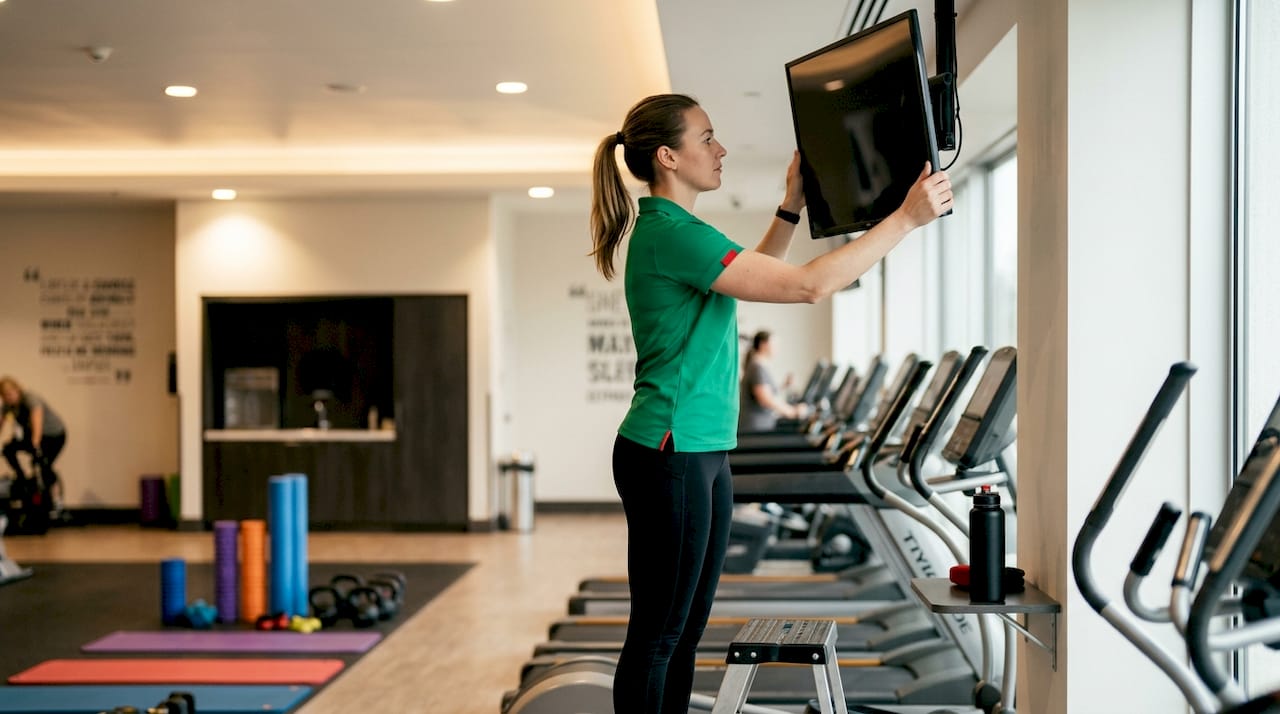
Commercial-grade screens rated for 24/7 operation are non-negotiable for gym environments. Consumer televisions overheat, lose brightness, and fail within months under continuous gym use. The Samsung QMR Series is a widely used benchmark for commercial fitness installations, offering high brightness, portrait and landscape orientation, and built-in media player support.
Screen placement matters as much as screen quality. Entry areas, free-weight floors, and cardio rows each serve different member mindsets. A screen near the entrance captures attention during check-in. A screen beside the cardio equipment holds attention during low-intensity work. Matching screen location to member activity state is the first step toward effective fitness screen advertising.
Software and integration requirements
A cloud-based Content Management System (CMS) gives you remote control over every screen in your facility. You can update a promotion, swap a trainer photo, or change a class schedule from your phone without setting foot on the floor. The CMS must integrate with your gym's CRM and booking system to enable automated, data-triggered content.
CRM and booking system integration allows the screen to display a PT trial offer the moment a qualifying member checks in. That automation removes the need for staff to manually pitch every eligible member. Network stability is equally critical. Hardwired ethernet connections outperform Wi-Fi in gym environments where thick concrete walls and high device density cause signal drops. Power over Ethernet (PoE) simplifies installation by running power and data through a single cable.
Essential features: basic vs. full setup
| Feature | Basic setup | Full setup |
|---|---|---|
| Screen type | Consumer TV | Commercial-grade, 24/7 rated |
| Content management | USB or manual upload | Cloud-based CMS with remote access |
| CRM integration | None | Automated, trigger-based content |
| AI targeting | Not available | Member activity-based PT offers |
| Network connection | Wi-Fi | Hardwired ethernet or PoE |
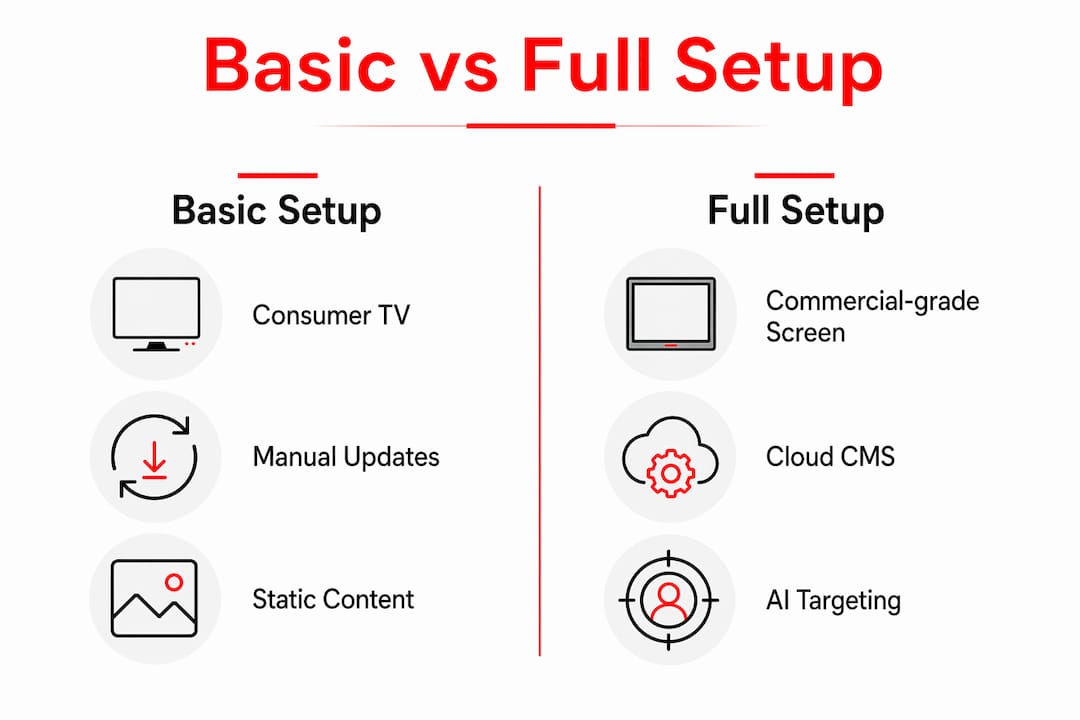
The gap between a basic setup and a full setup is not cosmetic. It is the difference between a screen that shows a static poster and one that delivers a personalized PT offer to the right member at the right time.
What content strategy drives personal training bookings?
Content design determines whether your screens build trust or create noise. The 80/20 content rule is the standard that separates high-performing gym signage from screens members learn to ignore. Eighty percent of your content should deliver fitness value, community recognition, or motivation. Twenty percent should carry direct promotional messaging.
That ratio is not arbitrary. Members who see constant advertising develop screen blindness fast. When 80% of what they see is genuinely useful, the 20% that promotes a PT package lands with far more credibility.
Content types by gym zone
Different areas of your gym call for different content. A member grinding through a deadlift set is not in the right headset for a soft-sell consultation offer. A member cooling down on a stationary bike is far more receptive.
- Free-weight floor: Technique tips, form cues, and trainer spotlights build authority without interrupting focus.
- Cardio area: Member success stories, leaderboard rankings, and 30-day challenge progress keep members motivated during longer sessions.
- Reception and lobby: PT trial offers, class schedules, and new member welcome messages work well here because members are stationary and mentally available.
- Recovery and stretching zones: Calm content such as nutrition tips, recovery advice, and upcoming workshop announcements match the lower-energy environment.
- Group class studios: Class countdowns, instructor bios, and post-class PT upsell prompts fit naturally into the pre and post-class window.
Scheduling PT ads during peak hours and using passive content during low-traffic periods is the practice that top operators follow. Peak hours concentrate your highest-value audience. Off-peak hours are better used for brand building and community content.
Pro Tip: Build a digital content calendar that maps content type to time of day and gym zone. A Monday morning free-weight crowd needs different messaging than a Saturday afternoon cardio group.
Community-driven content such as real-time leaderboards, member stories, and fitness challenges increases engagement and validates PT investments. Members who see peers succeeding with a trainer are far more likely to book a consultation than members who only see promotional graphics.
How does AI targeting improve personal training promotions on screens?
AI targeting is the practice of using member data to trigger specific content for specific members at the moment they are most likely to act. Operators who use AI-driven triggering to show PT offers when qualifying members check in see a 15–25% lift in booking rates compared to generic ads. That lift comes from relevance. A member who has attended 20 classes but never booked a trainer is a high-probability PT prospect. Showing that member a targeted trial offer at check-in is far more effective than broadcasting the same offer to everyone.
Setting up AI targeting step by step
- Define your qualifying criteria. Common triggers include members active for 90 or more days, members who have attended 20 or more classes, and members with no prior PT booking on record.
- Connect your CRM to your CMS. The CRM holds member history. The CMS controls screen content. The connection between them allows automatic content triggers based on member data.
- Build targeted content assets. Create specific PT offer graphics for each qualifying segment. A long-term member needs a different message than a new member who just hit their first milestone.
- Set trigger rules in your CMS. Program the system to display the targeted PT offer on lobby or entry screens when a qualifying member's check-in is detected.
- Monitor and adjust. Track which triggers generate consultation bookings and refine your qualifying criteria over time based on actual conversion data.
Pro Tip: Do not run AI-targeted PT offers exclusively. Balancing targeted content with general community content prevents members who do not qualify from feeling excluded or confused by messaging that does not apply to them.
Screens outperform staff verbal recommendations for personal training promotion because members perceive them as less intrusive and more consistent. A trainer who pitches every member risks feeling pushy. A screen that shows a relevant offer at the right moment feels like useful information.
What mistakes hurt gym screen promotions for personal training?
The most common mistake gym operators make is running promotional content 24/7. Members stop seeing screens that never change or never offer anything beyond advertising. The result is the opposite of what you want: your most visible marketing channel becomes invisible.
Running PT promotions on screens around the clock does not increase bookings. It trains members to ignore your screens entirely. Reserve direct calls-to-action for peak hours and let the rest of your content earn member attention first.
The second most common problem is network instability. A screen that goes black during peak hours is worse than no screen at all. It signals disorganization to members and wastes the prime promotional window you planned for.
Common pitfalls and how to fix them:
- Pitfall: Promotional content 24/7. Fix: Apply the 80/20 rule and schedule PT offers only during peak traffic windows.
- Pitfall: Consumer-grade screens failing. Fix: Replace with commercial-grade displays rated for continuous operation.
- Pitfall: Wi-Fi dropouts causing black screens. Fix: Install hardwired ethernet or PoE connections at each screen location.
- Pitfall: Generic ads shown to all members. Fix: Integrate CRM data to trigger targeted content for qualifying members only.
- Pitfall: No content variety across zones. Fix: Use multi-room display management to assign different content playlists to each area.
- Pitfall: Outdated content left running. Fix: Use a cloud-based CMS to update content remotely and set expiration dates on time-sensitive promotions.
The modern fitness market demands transparency. Successful screens feature live data and social validation to satisfy members who want proof before they invest in a trainer. Leaderboards, member milestone announcements, and real transformation stories are not feel-good extras. They are conversion tools.
Key Takeaways
Gym screens that promote personal training effectively combine commercial hardware, CRM-integrated targeting, and an 80/20 content mix to drive consistent PT bookings without alienating members.
| Point | Details |
|---|---|
| Use commercial-grade hardware | Consumer TVs fail under 24/7 gym use; commercial screens maintain reliability and brightness. |
| Apply the 80/20 content rule | Eighty percent value content builds trust so the 20% promotional content actually converts. |
| Integrate CRM for AI targeting | Trigger PT offers for qualifying members at check-in to achieve a 15–25% booking lift. |
| Schedule by peak hours and zone | Run direct PT calls-to-action during high-traffic windows and passive content during off-peak periods. |
| Avoid 24/7 promotional loops | Constant advertising trains members to ignore screens; content variety keeps attention active. |
Screens as salespeople: what the data confirms
Gym operators often treat digital signage as a cheaper version of print advertising. That framing undersells the medium and leads to poor content decisions. A screen that shows a static PT package price is a poster. A screen that recognizes a member's check-in history and surfaces a personalized trial offer is a salesperson who never calls in sick.
What I find most underused is the social proof layer. Leaderboards and member spotlights do two things simultaneously: they reward existing members and they show prospects what results look like in your specific gym. That combination is more persuasive than any discount graphic. Gyms that run member milestone announcements alongside PT offers consistently see stronger consultation conversion than gyms running promotions alone.
The 80/20 rule also does something that most operators miss. It reframes the screen as a community resource rather than an advertising board. Members who trust your screens for useful content are far more likely to act on the 20% that asks them to book a session. The trust built by 80% of the content is what makes the promotional 20% work. Skipping that trust-building phase is the single biggest reason gym signage campaigns underperform.
— Kingdom
How Kingdomsignage helps gyms run smarter PT promotions
Kingdomsignage is built specifically for gym environments where managing screens, audio, and class content across multiple rooms creates real operational friction. The platform unifies TV control, music, and promotional content delivery through a single dashboard, so you are not switching between tools to update a PT offer or change the lobby screen during a busy morning shift.
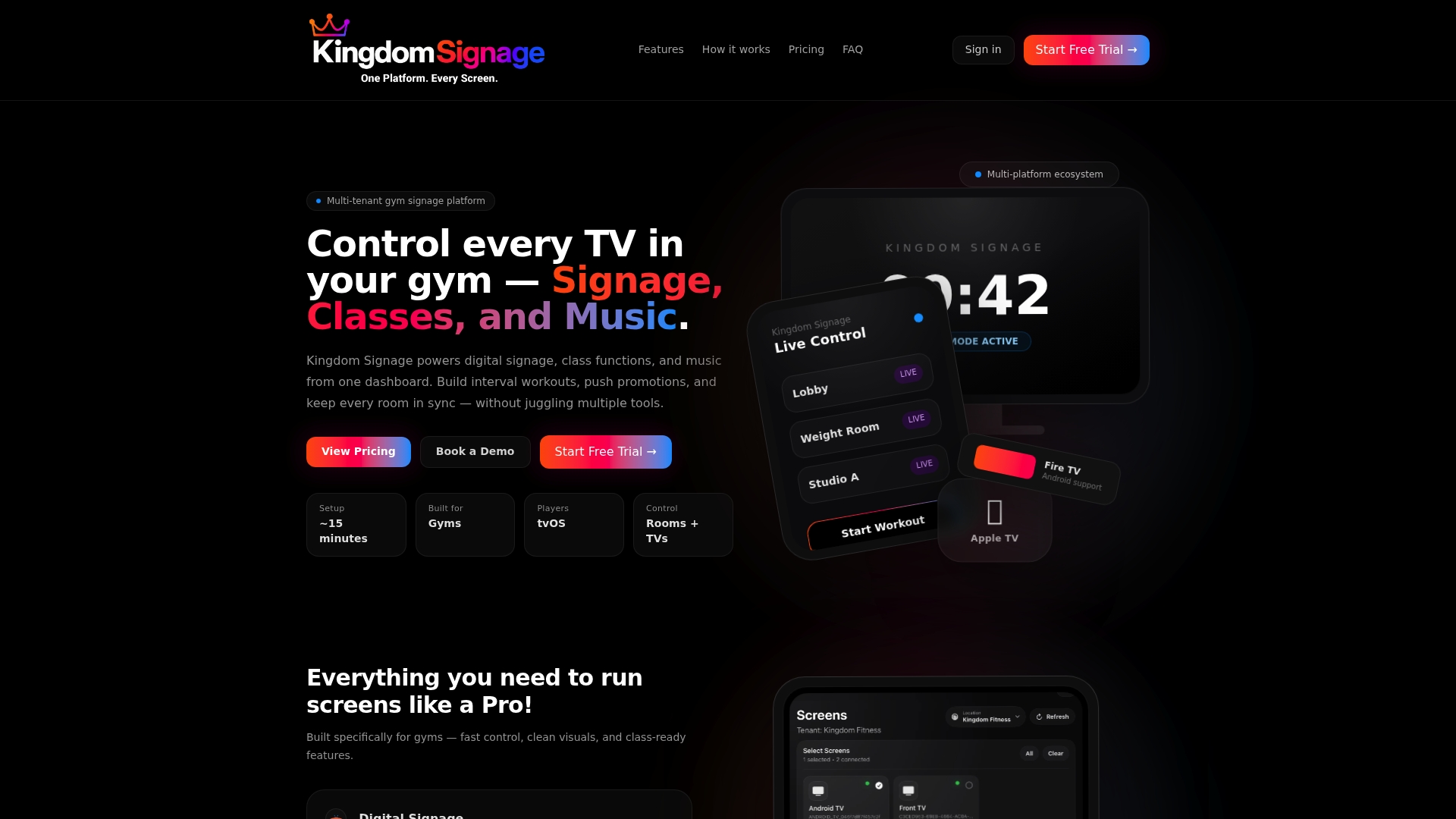
Kingdomsignage integrates with gym management systems to support the kind of targeted, data-driven content scheduling that drives PT bookings. Real-time updates, zone-based content control, and audio-visual sync across rooms give gym operators the control they need without the complexity. If you are ready to turn your screens into a consistent personal training sales channel, Kingdomsignage gym signage solutions are built to get you there.
FAQ
How much can gym screens increase personal training sales?
Dynamic digital signage can increase PT sales by 28% compared to static promotional methods. AI-targeted content shown to qualifying members at check-in lifts consultation bookings by 15–25%.
What is the 80/20 rule for gym screen content?
The 80/20 rule means 80% of your screen content should deliver fitness value or community recognition, and 20% should carry direct promotional messaging. This ratio prevents advertising fatigue and keeps members engaged with your screens.
Do gym screens work better than staff for promoting personal training?
Screens are perceived as less intrusive than verbal staff recommendations and are available consistently throughout operating hours. Members respond more positively to screen-based PT offers because they feel informational rather than pressured.
What hardware do I need for gym digital signage?
Commercial-grade screens rated for 24/7 operation are required for reliable gym signage. Pair them with a cloud-based CMS and a hardwired ethernet connection to avoid the reliability issues that consumer televisions and Wi-Fi setups create.
How do I set up AI targeting for personal training promotions?
Connect your gym CRM to your CMS, define qualifying member criteria such as 90 or more days active with no prior PT booking, and program trigger rules that display targeted PT offers when those members check in. Monitor booking conversion data and refine your criteria over time.