
Yes, you can run a high-performing gym referral program on digital displays starting this week. The fastest first step: pair the give a month / get a month two-sided incentive, recommended by Treetop Growth Strategy, with auto-updated leaderboards on your floor TVs and a scan-to-share QR code at every entry point.
Before you launch, confirm these are in place:
- A unique referral link or code per member (generated by your gym management software)
- A payment-verified conversion trigger (reward fires only after the referred member's first payment clears)
- At least one screen in the lobby running a live leaderboard and CTA
- A short, mobile-optimized landing page that auto-fills the referrer's info
Your ops team's 24–72 hour checklist: (1) configure referral tracking in your CRM and test the webhook that fires on first payment, and (2) upload a leaderboard template to your signage platform and schedule it to rotate every 90 seconds with your existing content.
Table of Contents
- Why does combining digital displays and audio lift referral volume?
- How do you design the referral program rules and incentives?
- What should you show on screens and play over speakers?
- How do you wire the system: integrations, automation, and schedule control?
- What KPIs should you track for referral performance?
- What does a 30/60/90-day rollout look like?
- What mistakes kill referral program momentum?
- Key Takeaways
- The part most operators underestimate
- Kingdomsignage gives you one dashboard for all of this
- Useful sources for implementation and policy details
Why does combining digital displays and audio lift referral volume?
Screens and speakers work together because they hit members at the exact moment motivation peaks — right after a great class, when endorphins are high and social identity is front of mind. A static poster in the locker room asks members to remember something later. A leaderboard on the lobby TV, paired with an audio chime calling out the week's top referrer, creates a public recognition moment that drives significantly more referrals than monetary incentives alone, according to ClubIntel engagement data cited in industry summaries.
"Pairing CTAs with social proof like Wall of Fame photos or leaderboards humanizes the studio and increases interaction — signage becomes a hook, not just a notice board." — Zenoti fitness studio growth research
Identity reinforcement is the mechanism. When a member sees their name on a screen, they are not just receiving a reward — they are being publicly recognized as someone who builds the community. That social currency sustains participation longer than a discount ever will. A practical screen layout to hand your designer: a 70% zone for the leaderboard and Wall of Fame photos, a 20% CTA strip with the QR code and reward summary, and a 10% ticker for the current month's top referrer name.
How do you design the referral program rules and incentives?
The structure that converts best is two-sided: both the referring member and the new member get one free month credited to their accounts. This 'give a month / get a month' model, recommended by Treetop Growth Strategy, consistently outperforms one-sided offers because both parties feel the program is working for them, not just the gym.
Eligibility and conversion rules to lock in before launch:
- Referrer must be an active, paid member in good standing at the time of conversion
- Reward triggers only after the referred member completes their first full payment (no free-trial conversions)
- One reward per unique referred member (no double-dipping on the same person)
- Referred member must not have been a member in the past 12 months
Anti-fraud controls:
- Require a unique referral link or code at signup — no name-drop-only tracking for digital programs
- Flag any account that generates more than five referrals in 30 days for manual review
- Disable self-referral at the platform level (most CRMs support this natively)
- Set a 48-hour hold before reward application to allow payment verification
Pro Tip: Create a "Super Referrer" tier: members who send five or more paid referrals in a calendar quarter earn a bonus reward (a free personal training session or branded gear). Announce the tier on your leaderboard screen to give high-performers a visible goal.
IHRSA benchmark data shows that if a referrer does not receive their reward within 48 hours of conversion, referral motivation drops by 64%. Automate fulfillment — do not rely on a staff member to apply credits manually.
What should you show on screens and play over speakers?
The highest-performing content mix runs four elements in rotation: a live leaderboard, a reward CTA, a QR code, and a short social-proof line ("47 members referred a friend this month"). That combination gives members a reason to stop, read, and act — not just glance and walk past.
Screen templates by location:
- Lobby TV: Full leaderboard with top 10 referrers by name, current month's reward offer, and a large QR code. Rotate with class schedule every 90 seconds.
- Classroom TV: Simpler — one slide post-class showing "Loved today's session? Share it." with the QR code and a two-line reward summary. Display for 60 seconds after class ends.
- Stairwell or locker screens: Wall of Fame format — member photo (with consent), first name, and referral count. No QR needed here; this is pure identity reinforcement.
Audio script for post-class announcements (30 seconds):
"Before you head out — quick shoutout to [Name], this week's top referrer. If you know someone who would love this class, scan the QR code on the lobby screen. You both get rewarded. Details at the front desk."
"Each additional step in the referral flow significantly reduces completion — QR codes that land on a mobile-optimized page with the referrer's info pre-filled keep the action under 30 seconds." — US Tech Automations UX research
Pro Tip: Place QR codes at eye level (between 4.5 and 5.5 feet from the floor), use a minimum 2-inch print size, and always include a short URL below the code for members who prefer to type. For accessibility, add a one-line text description: "Scan to refer a friend and earn a free month."
For consistent branding across all screens, follow your gym's brand consistency guidelines so referral content never looks like an afterthought next to your class schedule.

How do you wire the system: integrations, automation, and schedule control?
The minimum technical stack to automate reliably: a referral engine or gym CRM with unique link generation, a payment gateway with webhook support, and a signage platform like Kingdomsignage that accepts API-triggered content updates and controls audio across zones.
Integration checklist:
- Generate a unique referral URL per member in your CRM (most platforms including Mindbody support this natively)
- Configure a webhook on the payment gateway: fires on first successful payment by a referred member
- Map the webhook payload to your reward fulfillment API endpoint (credit one month to referrer's account)
- Push a content update trigger to Kingdomsignage to refresh the leaderboard in real time
- Optionally, trigger an audio chime or announcement in the relevant zone via the multi-room sync controller
For multi-room audio sync, choose hardware that supports NTP time sync so leaderboard updates and audio chimes fire simultaneously across zones — Kingdomsignage handles this centrally.
| Automation trigger | Action | System responsible |
|---|---|---|
| Member hits 10th class | Send referral SMS with unique link | CRM / automation middleware |
| Referred member completes first payment | Apply reward credit to referrer | Payment gateway webhook → CRM API |
| Reward applied | Update leaderboard on all screens | Signage platform API |
| Weekly Monday AM | Rotate leaderboard to new week | Scheduled signage rule |
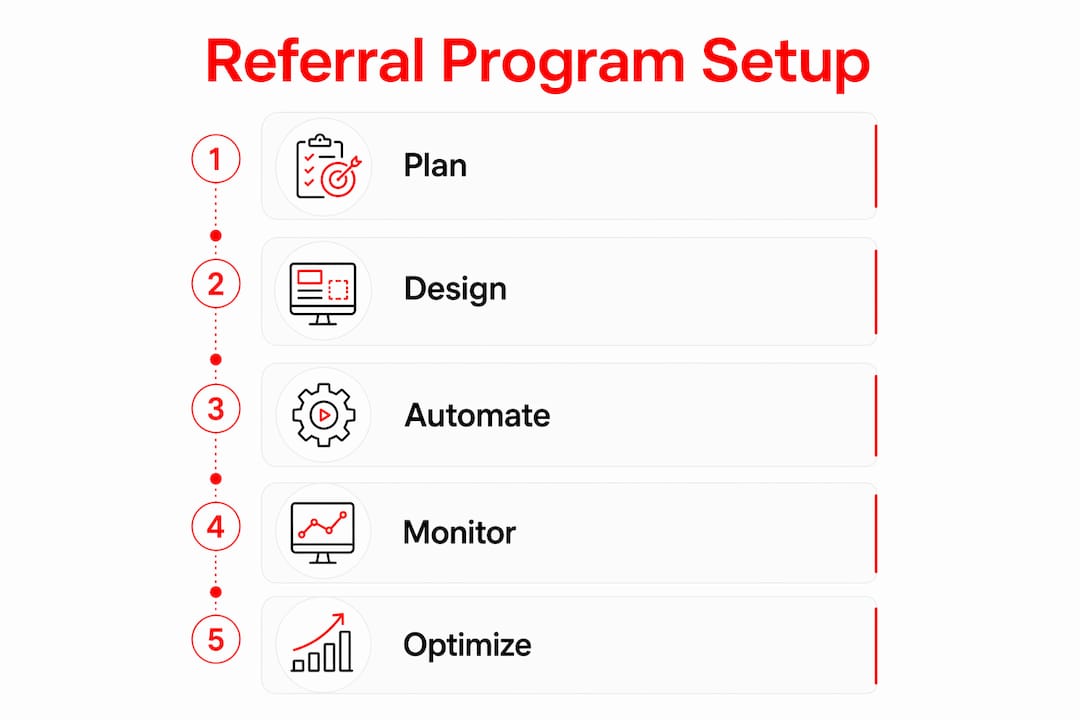
Pro Tip: Build a retry rule: if the webhook fails to reach the signage API, queue a retry at 5 and 15 minutes. Most middleware tools (Zapier, Make) support this natively. Log every failed trigger so you can audit reward gaps at month-end.
What KPIs should you track for referral performance?
Prioritize three metrics above all others: referral rate (percentage of active members who referred at least one person), referred-to-paid conversion rate, and cost per referred member. Together they tell you whether the program is growing, converting, and staying cheaper than paid acquisition.
- Referral rate: (Members who made a referral ÷ total active members) × 100. A common target is for a moderate share of members to refer at least once per year, per Optimized Growth benchmarks.
- Referred-to-paid conversion: (Referred signups who completed first payment ÷ total referred leads) × 100. A healthy conversion rate is generally above average, supporting effective program results.
- Cost per referred member: Total reward cost ÷ number of paid referred members. Gyms using native referral modules report substantially lower costs per referred member compared to paid ads.
- Retention lift: Track 90-day retention for referred members versus non-referred. Referred members typically stay longer, which lowers your long-term CAC.
Two A/B tests worth running in month two: (1) test a 7-day vs. 14-day referral prompt window after a member's milestone event, and (2) test leaderboard-only screens versus leaderboard-plus-Wall-of-Fame to see which drives more scans.
What does a 30/60/90-day rollout look like?
| Phase | Focus | Key milestones |
|---|---|---|
| Days 1–30 | MVP launch | CRM links live, webhook tested, lobby screen running leaderboard, staff briefed |
| Days 30 and beyond | Automation optimization | Retry logic active, A/B tests running, audio scripts deployed, first reward cycle complete |
| — | Growth scaling | Super Referrer tier live, Wall of Fame added, KPI dashboard reviewed, content refreshed |
Estimated costs:
- Signage hardware (if not already installed): $300–$800 per screen
- Signage software subscription: varies by platform and screen count
- Referral software integration or middleware setup: $200–$600 one-time
- Staff training time: 2–3 hours total across the team
Role checklist:
- Ops manager: CRM configuration, webhook setup, reward policy sign-off
- Front desk lead: Staff briefing, QR card distribution, pending referral queue review
- Instructor team: Post-class verbal asks, milestone shoutouts
- Signage admin: Template uploads, schedule rules, weekly leaderboard refresh
Use a gym signage upgrade checklist to confirm hardware and software compatibility before day one.
What mistakes kill referral program momentum?
Top five red flags:
- Rewards applied manually (delays kill motivation — automate or the program stalls)
- A single CTA screen with no leaderboard (no social proof = no urgency)
- Referral links that expire before the referred member signs up
- No staff training (instructors who do not know the program cannot promote it)
- Content that has not changed in 30 days (members stop reading static screens)
Quick fixes:
- Automate reward fulfillment via webhook — remove the manual step entirely
- Add a leaderboard to every lobby screen within the first week
- Set referral link expiry to 90 days minimum
- Run a 20-minute staff briefing before launch and a 10-minute refresh at 30 days
- Schedule a content refresh every two weeks in your signage platform
On fraud: if you see a spike in referrals from one account, check whether the referred members have completed payments before any reward applies. The payment-verified trigger is your primary fraud control. For multi-channel promotion, embed the referral ask in post-class emails and SMS alongside your screens — passive decay happens when the program lives only on one channel.
Accessibility matters too: every QR code screen should include a text alternative URL, font sizes on leaderboards should be readable from 10 feet (minimum 48pt), and audio announcements should be captioned on classroom screens where possible.
Key Takeaways
A gym referral program on digital displays works when automation handles reward fulfillment, screens provide real-time social proof, and staff embed the ask into daily operations.
| Point | Details |
|---|---|
| Two-sided incentive wins | Give a month / get a month outperforms one-sided offers; both parties must feel rewarded. |
| Automate reward fulfillment | Delays beyond 48 hours drop referral motivation by 64%; webhook-triggered credits are non-negotiable. |
| Leaderboards drive significantly more referrals | Public recognition on screens outperforms monetary incentives alone, per ClubIntel data. |
| $42 vs. $156 acquisition cost | Native referral modules average $42 per referred member versus $156 for paid ads. |
| Kingdomsignage for real-time updates | Kingdomsignage syncs leaderboard updates and audio chimes across all gym zones from one dashboard. |
The part most operators underestimate
The technology is the easy part. The programs that actually sustain themselves share one habit: someone on the team owns the weekly leaderboard ceremony. Not a software alert — a person who walks the floor on Monday morning, calls out the top referrer by name at the front desk, and makes it feel like a real moment.
Ops teams that embed the referral ask into shift huddles ("Who are you going to ask today?") and post-class routines see consistent participation. Those that rely on screens alone watch engagement plateau after week three. The screen is a prompt; the instructor is the closer.
Realistic expectations: most gyms see their first meaningful referral wave in weeks three through five, after the leaderboard has enough names to feel competitive. Staff training takes two sessions — one before launch, one after the first reward cycle when questions surface. Member response is almost always warmer than operators expect, because the program rewards loyalty rather than just asking for it.
The role of displays in gym atmosphere matters here too. Screens that reinforce community identity — not just promotions — make the referral ask feel natural rather than transactional.
Kingdomsignage gives you one dashboard for all of this
Running a referral program across multiple screens and audio zones without a central controller means logging into three different tools every time you update a leaderboard. Kingdomsignage solves that with a single dashboard that syncs TVs, classroom displays, and zone audio simultaneously.
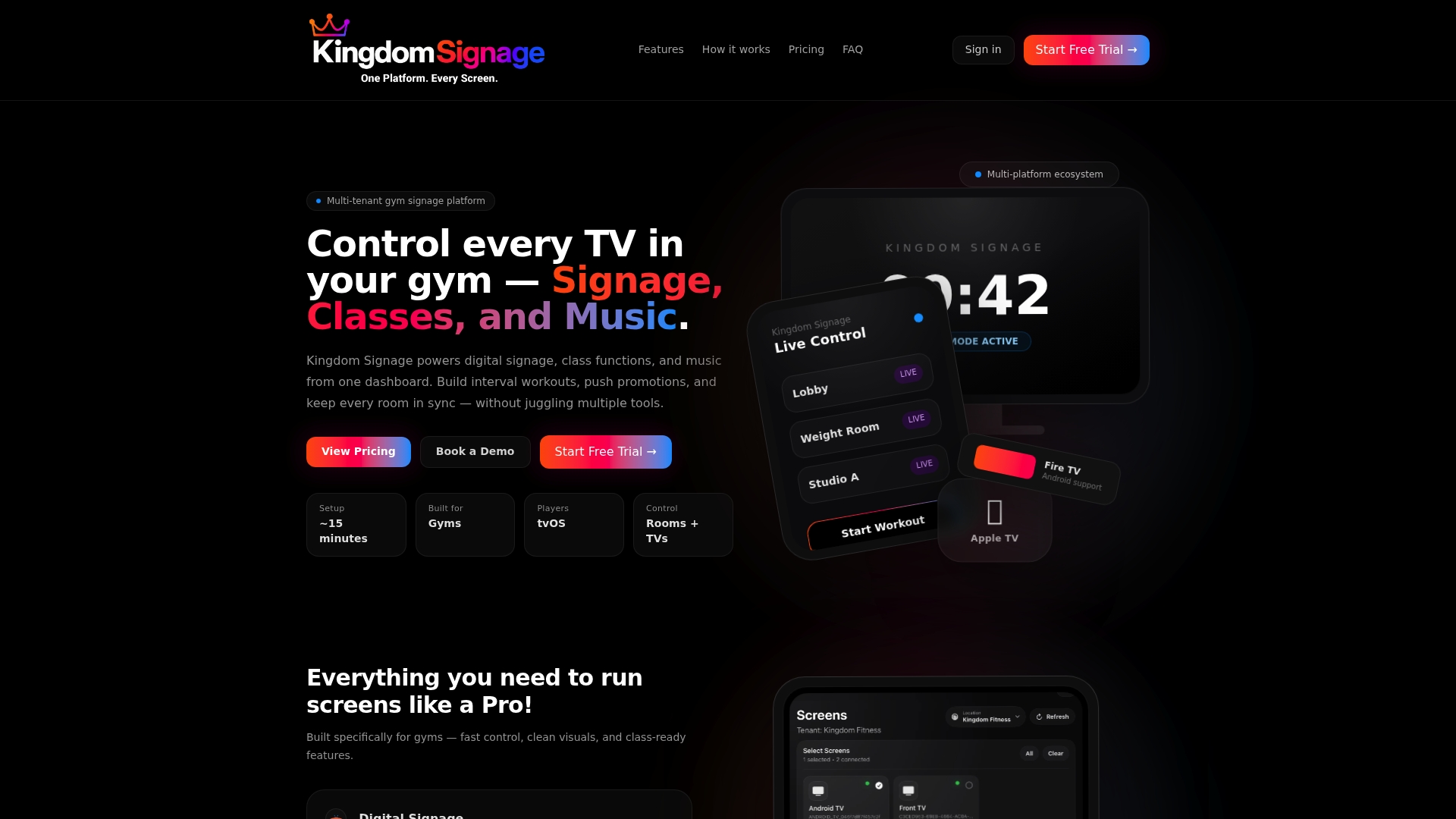
Kingdomsignage maps directly to the automation flow in this guide: when your CRM fires a reward webhook, Kingdomsignage picks up the trigger and refreshes the leaderboard across every screen in real time, no manual upload required. QR code templates, Wall of Fame layouts, and scheduled audio announcements are all managed from the same interface. For gyms running multiple rooms, NTP-synced audio means the chime and the screen update land at the same moment, everywhere.
If you are ready to connect your referral software to your displays and audio, visit Kingdomsignage to see how the platform fits your current gym management setup.
Useful sources for implementation and policy details
- Treetop Growth Strategy — Gym Referral Program: Templates for two-sided incentive structures and identity reinforcement tactics; the source for the give a month / get a month recommendation.
- US Tech Automations — Gym Referral Automation: Automation flow blueprints, webhook trigger maps, the 48-hour reward fulfillment benchmark, and the $42 vs. $156 acquisition cost comparison.
- Zenoti — Fitness Studio Referral Growth: Research on social proof, Wall of Fame hooks, and leaderboard effectiveness for fitness studios.
- Mindbody — Fitness Referral Program Guide: Operator frameworks for multi-channel promotion and embedding referral asks into daily operations.
- Optimized Growth — Gym Referral Program Templates: Word-for-word scripts, tracking benchmarks (15–20% annual referral rate target), and two-sided reward policy templates.
- Kingdomsignage — Gym Control and Digital Signage: Product documentation for multi-room sync, API-triggered leaderboard updates, and scheduled audio management.
Save the automation checklist from the technical implementation section and share it with your CRM vendor and signage admin before kickoff — it will cut your setup time significantly.