
To play music legally in a U.S. gym, you need public performance permission. That means securing blanket licenses from the relevant performance rights organizations, ASCAP, BMI, SESAC, and GMR, or subscribing to a licensed commercial music service that already bundles that coverage. There's no third option. Whatever route you pick, "we'll just use Spotify" isn't one of them.
TL;DR:
- Licensing costs depend heavily on the gym's square footage, number of locations, zones, class frequency, and capacity, not flat rates.
- Most gyms need to secure licenses from multiple PROs, with each location requiring separate coverage calculations and renewals.
- Streaming services built for gyms cover performance rights but often exclude content distribution, sync, and master licensing for videos or apps.
- Playing unlicensed music, including personal streaming accounts, can lead to costly legal damages and enforcement actions.
- Using centralized, zone-controlled playback systems helps ensure compliance, reduces liability, and simplifies license management across multiple rooms.
Table of Contents
- What is gym music licensing and which PROs issue it?
- How does licensing differ for classes, background music, and video?
- How do you get your gym properly licensed?
- What determines how much gym music licensing costs?
- Are bundled commercial music services worth it?
- What happens if a gym gets caught playing unlicensed music?
- Managing music access across staff and rooms
- Your gym music licensing action checklist
- Do gyms outside the U.S. face the same licensing rules?
- Beyond performance rights: sync, master, and app licensing
- How are streaming platforms changing gym music compliance?
- A gym owner's honest take on licensing and control
- A simpler way to keep licensed music running everywhere
- Where to confirm current rates and licensing details
- Sources
What is gym music licensing and which PROs issue it?
A public performance license is permission to play copyrighted music where the public can hear it, and a gym floor, a group class, and even a hallway speaker all count. In the United States, that permission comes from the performance rights organization (PRO) representing the songwriter, not the streaming app you use to play the song.
The two rights bundled inside most licensing conversations get confused constantly: the composition (the underlying song and lyrics) and the master recording (the specific produced track). A PRO license covers the composition side. It says nothing about the recording itself, which matters more once you get into video or app content.
Four PROs collectively represent nearly every commercially released song in the U.S.:
- ASCAP represents hundreds of thousands of songwriters and composers and offers a dedicated fitness-club blanket license.
- BMI covers a separate, overlapping catalog and issues its own business licensing agreements.
- SESAC represents a smaller, invitation-only roster that still includes chart-relevant writers.
- GMR (Global Music Rights) is the newest and smallest, but it holds catalogs from major artists gyms love to play.
Because a songwriter can only belong to one PRO at a time, and your workout playlist spans dozens of writers, most gyms end up needing coverage from more than one PRO to legally play a typical mix.
How does licensing differ for classes, background music, and video?
Not every speaker in your building carries the same legal risk. The license you need depends entirely on how the music travels once it leaves the source.
- Background or premises music playing over gym-floor speakers or in a lobby is generally covered by a standard PRO blanket license, priced against your space and audience.
- Instructor-led classes (spin, HIIT, yoga) often trigger a separate class-based fee tier, since PROs treat structured group participation as higher-value use than ambient background sound.
- Recorded or distributed content, like an on-demand workout video, a livestream, or an app feature, needs synchronization and master-use licenses on top of performance rights, because you're now reproducing and distributing a fixed recording, not just performing it live in a room.
That third category catches a lot of owners off guard. A PRO blanket license that fully covers your studio floor covers exactly none of that same song once it's baked into a video you post online.
How do you get your gym properly licensed?
Getting licensed is mostly a matter of sequencing, not difficulty. Skipping steps is what gets gyms in trouble.
- Audit every music source. Walk the building and list every zone, speaker, TV, and class type that plays music, plus who controls each one.
- Choose your path. Contact ASCAP, BMI, SESAC, and GMR individually for direct blanket licenses, or subscribe to a licensed commercial music service that bundles PRO coverage into one bill.
- Provide your facility details. PROs typically ask for square footage, speaker or zone count, class frequency, and number of locations to calculate your rate.
- Sign, file, and calendar renewals. Keep signed agreements, payment records, and renewal dates in one place, ideally with whoever manages your AV systems.
Pro Tip: Set a recurring calendar reminder 60 days before each license renewal date. PROs don't send friendly nudges, and a lapsed license looks identical to never having one if a dispute arises.
If you operate multiple locations, note that each location generally needs its own coverage calculation. A four-location chain isn't one license times four; it's four separate facility profiles feeding into whatever contract structure you negotiate.
What determines how much gym music licensing costs?
PRO fees aren't flat rates pulled from a chart. ASCAP's fitness materials lay out the objective factors that go into a quote, and the same general inputs show up across BMI and SESAC pricing conversations too.
- Square footage of the space where music plays
- Number of locations if you operate a multi-site business
- Occupancy or capacity of the facility
- Number of zones or speaker groups running independent audio
- Class frequency, since instructor-led sessions are often priced separately from ambient background music
Vendors have started publishing tools that translate these inputs into instant estimates rather than making owners wait on a callback. Dynamic Media's calculator, for instance, lets you plug in background versus class use, square footage, and session counts to get a ballpark figure before you ever talk to a rep.
Trade groups sometimes soften the bill. Checking your IHRSA membership benefits before you sign anything is worth the ten minutes; some licensing vendors extend member pricing that isn't advertised on the public rate sheet.
Are bundled commercial music services worth it?
Running four separate PRO relationships, four renewal dates, and four sets of paperwork is a real operational drag, which is why a large share of gyms opt into a single commercial music service instead of negotiating with ASCAP, BMI, SESAC, and GMR one at a time.
These services typically license the composition side across all major PROs and hand you a curated, gym-appropriate catalog to play through their app or hardware. What they usually don't cover: sync and master rights for content you record and distribute yourself, and sometimes instructor-led class tiers, depending on the provider's fine print.
Before signing, vet any provider against a short list:
- Confirm in writing which PROs are actually covered, not just implied.
- Ask whether multi-zone and multi-room playback is included or billed separately.
- Check if group fitness classes fall under the base plan or a premium add-on.
- Get clarity on whether reporting and audit documentation come standard.
The trade-off is straightforward: less paperwork, but less control over catalog depth and edge cases like your own recorded content.
What happens if a gym gets caught playing unlicensed music?
PROs may monitor gyms for music licensing compliance and send inquiries if they suspect unlicensed use, potentially leading to enforcement actions.
- Statutory damages for proven infringement can run from hundreds to tens of thousands of dollars per work, and each unlicensed song may be considered separately in any legal action.
- Willful infringement, meaning you knew and kept playing music anyway, pushes damages toward the higher end of that range.
- A personal Spotify or Apple Music account playing over gym speakers violates that service's own terms regardless of whether a PRO ever notices.
Pro Tip: If you receive a licensing inquiry letter, don't ignore it and don't argue with the field rep. Document what's playing where, pause anything unlicensed immediately, and get a licensed service or direct PRO agreement signed before responding.
Managing music access across staff and rooms
Most compliance failures aren't about ignorance of the law. They're about a front-desk employee plugging in a personal phone because the "real" system glitched, or a substitute instructor bringing their own playlist for spin class. Centralizing playback removes that temptation entirely.
A platform like Kingdom Signage locks playlists to licensed sources at the zone level, so no individual device becomes the weak link.
- Schedule-linked playlists automatically swap tracks by class type, so instructors don't need personal accounts.
- Per-room volume and playback controls give staff room-level authority without app-level access to swap sources.
- Playback logs create a timestamped record, which is exactly what you want on hand if a PRO ever asks what played and when.
- Instructor handoff settings prevent a substitute from defaulting to their own phone mid-class.
Read more on managing playlists across multiple rooms for a deeper operational breakdown.
Your gym music licensing action checklist
Treat this as your remediation list if you're not sure where you stand today.
- Walk every zone and confirm nothing is playing through a personal streaming account or TV cable box audio.
- List every music source, room, and class type in one document.
- Pull your current vendor contract, if one exists, and confirm which PROs and use cases it actually covers.
- Contact ASCAP, BMI, SESAC, and GMR directly, or a licensed commercial vendor, and get quotes in writing.
- File signed agreements and renewal dates somewhere your operations team checks regularly.
For setup specifics once you've picked a system, this room-specific playlist guide walks through assigning licensed content per space.
Do gyms outside the U.S. face the same licensing rules?
No, and this trips up chains expanding internationally more than almost anything else in the licensing conversation. U.S. copyright law and the ASCAP/BMI/SESAC/GMR framework apply only within U.S. borders. Every other country runs its own collective rights management system, and the differences aren't cosmetic.
The United Kingdom uses PRS for Music for composition rights and PPL for recording rights, and a gym there needs a combined license from both. Canada operates through SOCAN. Australia and New Zealand run licensing through APRA AMCOS. Most of the European Union routes performance royalties through national collecting societies, GEMA in Germany, SACEM in France, SIAE in Italy, and those societies have reciprocal agreements with each other but not with U.S. PROs.
That reciprocity matters more than owners expect. A song by a U.S. songwriter played in a German gym still generates a royalty obligation, just paid to GEMA under a deal GEMA has with the U.S. PRO representing that writer, not to ASCAP or BMI directly. If your gym has locations in more than one country, you're managing separate licensing relationships per jurisdiction, not one global umbrella agreement.
A few countries carve out narrow exceptions for genuinely incidental music, background sound so minor it isn't considered a meaningful public performance, but "background music" in a gym setting almost never qualifies. If you're opening a location abroad, budget time to research that country's collecting society before assuming your U.S. licensing structure travels with you. It doesn't.
Beyond performance rights: sync, master, and app licensing
A public performance license, no matter which PRO issues it, only ever covers one thing: someone in your building hearing a song play live. The moment you record, distribute, or embed that same song into a product, you've stepped into an entirely different licensing category.
Synchronization (sync) licenses grant permission to pair a specific composition with visual content, video, an app interface, a promotional reel. If you're filming an on-demand class for your app or a YouTube channel, you need sync rights from the publisher who controls that composition, separate from anything your PRO blanket covers.
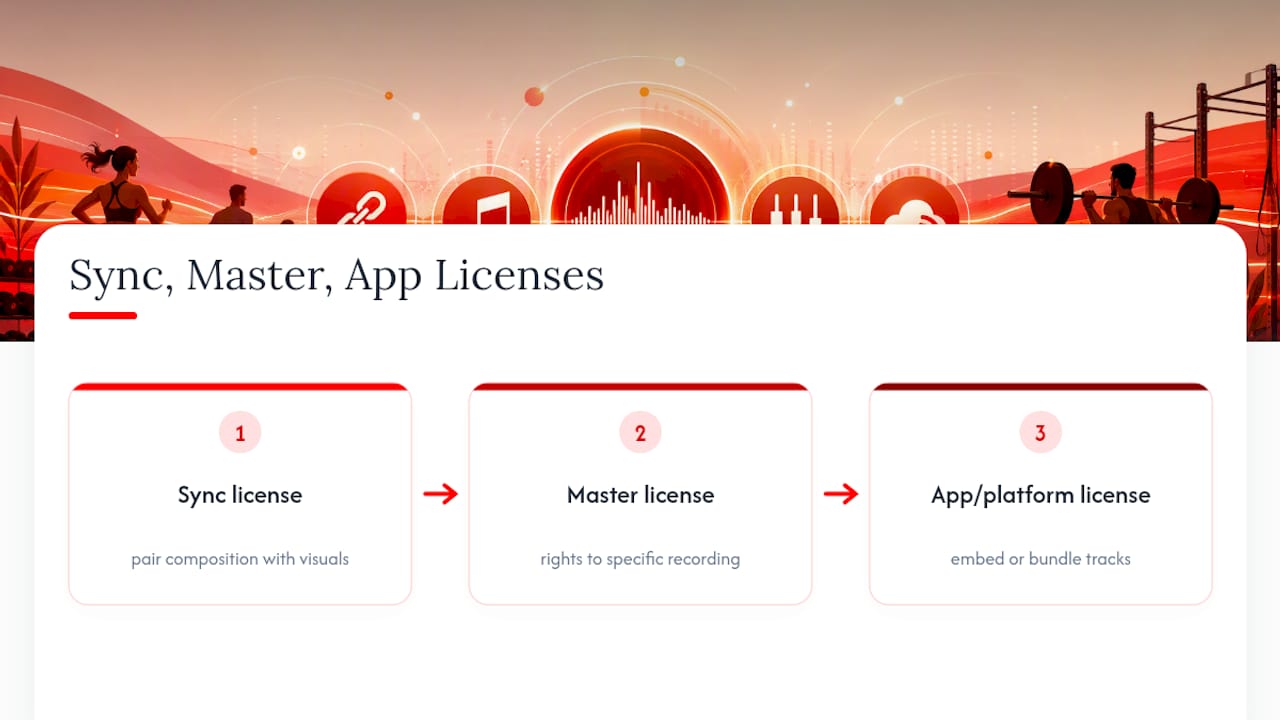
Master-use licenses cover the actual recorded performance, the specific mixed and mastered audio file, and come from whoever owns that recording, usually a record label. Sync and master licenses are typically negotiated together since you need both the song and that specific recording of it for video content.
App and platform licensing adds another layer if you're building a branded fitness app with embedded workout audio. Streaming a licensed track through a live class is different, legally, from bundling that track into downloadable or on-demand app content that lives on a member's phone indefinitely.
The practical takeaway: if your gym's music stays live and in-room, PRO blanket licenses probably cover you. The instant you record it, post it, or bake it into an app, assume you need additional clearances and budget accordingly. Guides on syncing music and visuals for fitness classes cover this handoff in more depth.
How are streaming platforms changing gym music compliance?
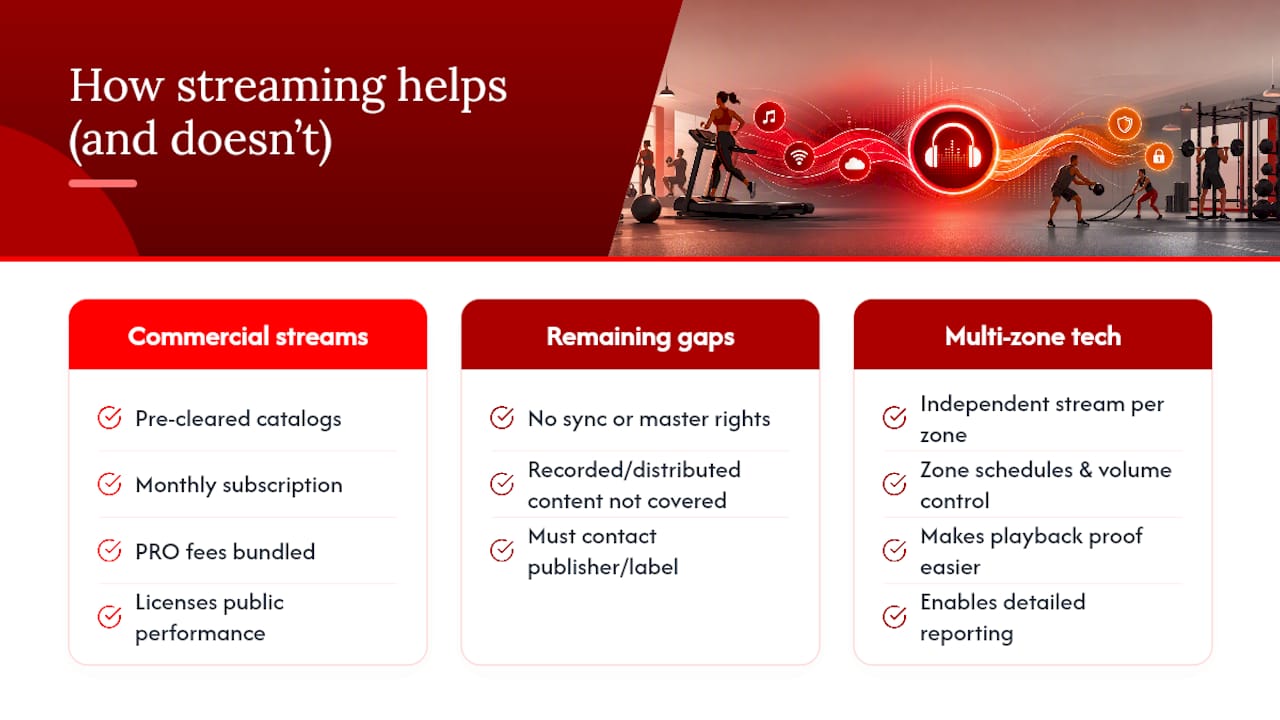
The music licensing landscape has shifted meaningfully as commercial-use streaming platforms built specifically for businesses have matured. These aren't consumer apps with a "business" label slapped on; they're catalogs pre-cleared for public performance, sold as monthly subscriptions that fold PRO fees into one bill.
That shift solves the biggest historical headache: juggling four separate PRO relationships and four separate invoices. It doesn't solve everything. Most commercial streaming subscriptions still license composition and recording rights for live, in-room play only. They generally don't extend to sync or master rights for content you record and distribute, so a gym building out video content still needs a separate conversation with a publisher or label.
Multi-zone technology has moved just as fast. Where older commercial audio setups piped one feed to every room, current systems let a gym run distinct, independently licensed streams per zone, weight room, studio, locker room, each on its own schedule and volume. That granularity actually helps compliance, because it makes it easier to prove exactly what played where, which matters if a PRO ever asks. Technical breakdowns like this multi-zone audio delivery guide show how that zone-level separation works in practice.
The direction is clear enough: expect commercial streaming providers to keep expanding fitness-specific catalogs and reporting tools, and expect PROs to keep refining audit methods that lean on that same reporting data. Staying licensed in 2026 increasingly means staying inside a documented, zone-aware system, not hoping nobody notices a personal playlist.
A gym owner's honest take on licensing and control
Legal compliance and member experience aren't competing priorities. They're the same job. A gym that pays for proper licensing but lets any employee plug in a personal phone hasn't actually solved its risk; it's just moved the risk from "we never paid" to "we paid, but can't prove what played."
Zone-level scheduling and locked playback do more than protect you from a PRO letter. They remove the daily judgment calls that create liability in the first place, the substitute instructor, the glitchy speaker, the well-meaning employee reaching for their own account. Systems that make the right choice the automatic choice beat policies nobody reads.
If your current setup depends on staff remembering the rules, it's worth rethinking before a renewal date sneaks past you.
— Kingdom
A simpler way to keep licensed music running everywhere
Getting licensed is only half the job. The other half is making sure that license actually gets honored in every room, every shift, every day, without relying on staff memory. Kingdom Signage gives gyms one dashboard to control which playlists play in which room, on what schedule, at what volume, so a licensed source stays the only source your team can reach for.
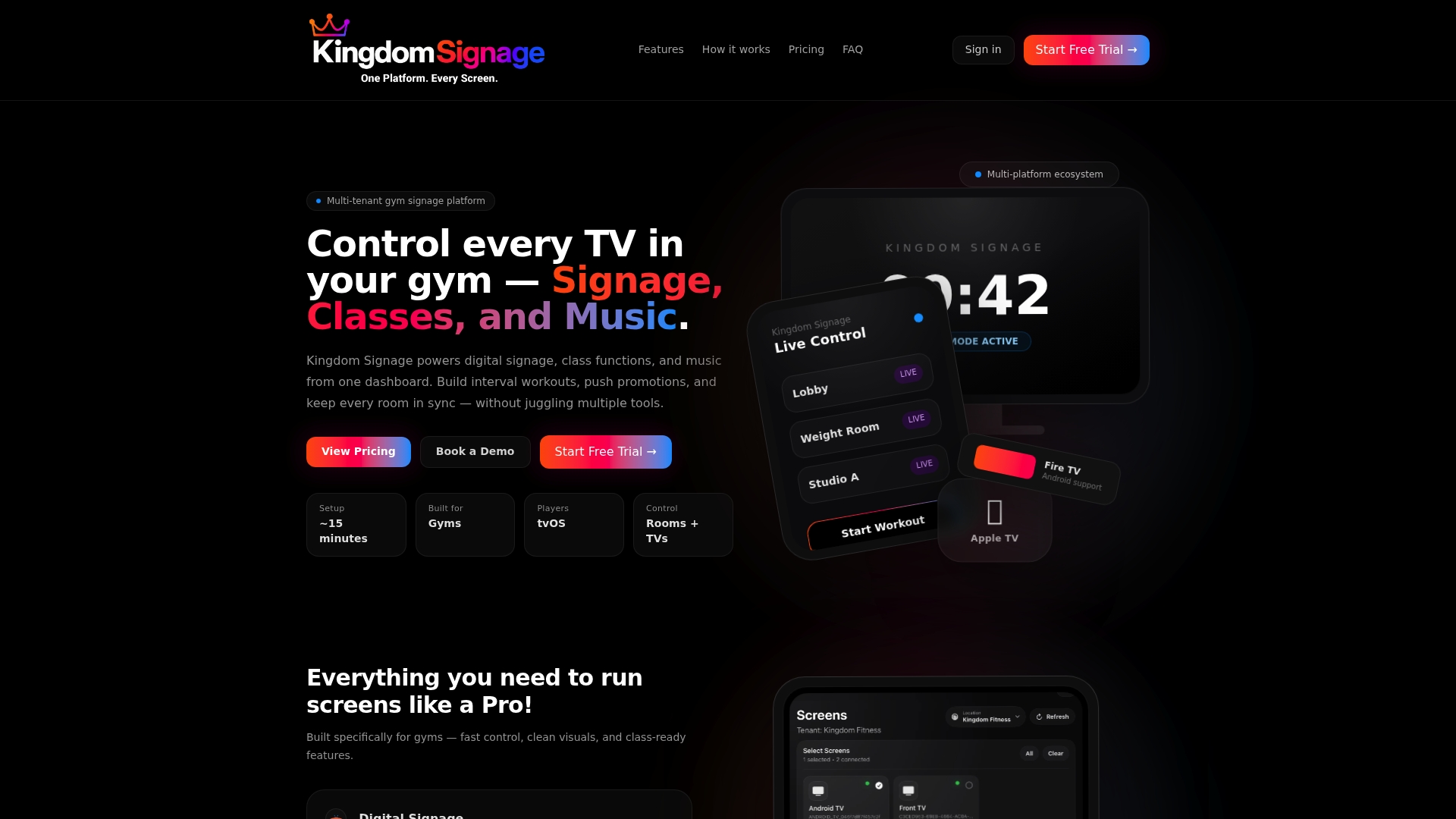
It syncs class schedules, TV signage, and room-based audio together, which means an instructor handoff doesn't require plugging in a personal device, and a front-desk swap doesn't require touching a music app at all. Kingdom Signage doesn't issue PRO licenses itself; you still need your ASCAP, BMI, SESAC, and GMR coverage or a licensed commercial music subscription in place. What it does is make that licensed setup the only one your staff can actually use across every room and every location. If you're ready to see how zone-level control looks in your facility, book a demo of Kingdom Signage and walk through your specific room layout.
Where to confirm current rates and licensing details
Verify fee structures and contact paths directly: ASCAP's fitness club brochure covers fee factors, BMI Licensing handles business inquiries, and Dynamic Media's calculator estimates costs by use case. For facility upkeep context, see this commercial sauna maintenance guide.
Sources
- What Gym & Studio Owners Need To Know About Music Licensing - Athletech News
- ASCAP Fitness Clubs Brochure
- Gym Music Licensing Cost Calculator | Dynamic Media
- BMI Licensing