
Audit logs for digital-signage screens are chronological records of what played, when it played, and who changed the playlist or schedule that controlled it. For gym operators running TVs across multiple rooms, these logs mean you can confirm a sponsor's ad actually aired, catch a frozen screen before a member complains, and prove delivery without a site visit. Platforms built for fitness venues, including Kingdom Signage, build this logging into the dashboard rather than treating it as an add-on.
TL;DR:
- Before signing, request a sample proof of play export showing device IDs, content IDs, timestamps, and offline events restored after reconnection.
- During weekly 15 to 30 minute checks, compare shared content timestamps across every room; device status events can identify offline screens or reboots.
- Keep routine troubleshooting logs for 90 days, extend retention up to a year for sponsor reporting, and restrict access through staff roles.
- Preserve immutable timestamps and playlist versions, rotate API keys, and use encrypted connections when transferring log data.
- Standard signage logs record content, devices, and staff playlist edits, not member identities or workout history; limit access to employee change records.
Table of Contents
- What data fields and record types make up screen audit logs
- How audit logs support gym workflows: promotions, class media, and troubleshooting
- Concrete feature checklist: APIs, exports, retention, identity, and integrity
- Step-by-step practical setup and verification routine for multi-room gyms
- Maintenance and security best practices around audit logs and scheduling
- Privacy considerations related to user activity tracking in audit logs
- Detailed auditing of multi-room synchronized playback events and their logs
- Security measures and encryption for audit logs to prevent tampering or unauthorized access
- Integrating audit logs with third-party gym management or security systems
- Common operator gaps and quick wins
- How Kingdom Signage helps: unified logging, verification, and multi-room control
- FAQ
- Sources
- Select API docs and internal resources for deeper reading
What data fields and record types make up screen audit logs
A usable audit log is not just a timestamp. It is a bundle of linked records that let you reconstruct exactly what happened on a given screen at a given moment.
- Playback records: content ID, playlist ID, device ID, start and end timestamps, and duration played.
- Schedule and playlist changes: before and after states of a playlist, plus the user ID that made the edit.
- Device status events: online and offline transitions, reboots, and app crashes, each tied to the playback gap it caused.
- Proof-of-play entries: client-side recordings of what played, buffered locally when a device loses connection and submitted once it reconnects.
That last point matters for gyms with spotty back-office Wi-Fi or screens tucked behind equipment. The Proof of Play API documentation from signageOS describes a recordItemPlayed() function that logs each playback event in real time and resubmits buffered records once a device comes back online, so a brief network drop never erases evidence that content aired.
How audit logs support gym workflows: promotions, class media, and troubleshooting
Logs only matter when they answer a question you actually have. For gym operators, those questions tend to repeat across locations and across months.
- Proving ads ran: a sponsor or supplement brand paying for screen time wants confirmation their creative played the agreed number of times, not a verbal assurance.
- Confirming class media played: instructors need the workout timer, demo video, and synced room music to fire together, every session, without manual checks.
- Faster troubleshooting: a log that shows a device went offline at 6:40 AM tells you it is a connectivity issue, not a content error, before you dispatch anyone.
- Franchise consistency: a regional manager comparing five locations can pull the same report format from each and spot the one studio falling behind.
Front-desk displays and lobby promotions are a common place this shows up first, since front desk signage often carries both member announcements and paid placements that someone, somewhere, will ask you to verify.
Concrete feature checklist: APIs, exports, retention, identity, and integrity
Whether you are evaluating a new signage platform or auditing the one you already run, the same handful of features separate a usable logging system from a decorative one.
- Real-time proof-of-play with timestamps and device IDs attached to every playback event.
- Offline buffering with automatic retry, so a disconnected screen does not simply lose its history.
- Per-device REST API access, so you or your IT team can pull playback history for one screen without exporting everything.
- Dashboard filters that let non-technical staff search by location, device, or date range.
- Export options in CSV or JSON, with scheduling-history diffs that show exactly what changed between versions.
- Retention policy controls, so you decide how long records are kept rather than losing them to a default setting.
- Immutable timestamps and content metadata, including version history for any asset that gets updated.
- Role-based user change logs, tying every playlist edit to a specific login.
A typical REST proof-of-play entry includes the device identifier, a content or item ID, a play-start timestamp, duration, and a status flag. The signageOS proof-of-play documentation notes that specific type values, such as PoP.ItemPlayed, are used when retrieving these records, which makes it possible to filter a feed down to just the events you need.
Pro Tip: Ask any signage vendor for a sample proof-of-play export before you sign a contract. If they cannot produce one in the sales call, assume the feature does not exist in production yet.
Step-by-step practical setup and verification routine for multi-room gyms
Setting up logging is only half the job. The habit of actually checking it is what prevents a dead screen from running for three weeks before anyone notices.
- Confirm proof-of-play is active on every device, then set your retention window and export schedule once, so you are not repeating the setup per location.
- Automate spot checks: scheduled queries against the PoP feed, periodic device pings, or remote screenshots catch drift between what should play and what did.
- Run a short site check, roughly 15 to 30 minutes, per location, walking through each room's playlist and confirming audio sync, following a routine like the one in Kingdom's guide to testing gym screen content.
- Document a runbook: who checks what, how often, and who gets escalated to when a screen fails for more than a defined window.
- Tie log entries to incidents or partner reports, so a sponsor dispute or a member complaint has a paper trail attached to it automatically.
A 15 to 30 minute weekly check per location, matched against the proof-of-play feed from the signageOS API, is enough to catch most stale-content and sync failures before a member or sponsor notices them.
Maintenance and security best practices around audit logs and scheduling
Logs are only trustworthy if the system producing them is maintained with the same discipline as the rest of your gym's technology stack.
- Set a retention window that matches your needs, commonly 90 days for routine troubleshooting and up to a year for sponsor or franchise reporting.
- Use role-based access control and rotate API keys periodically, so a departing employee's old credentials cannot alter history.
- Schedule power and content windows deliberately, since a screen that only runs during open hours has a smaller failure surface and a shorter list of things that can go wrong overnight, a point covered in Kingdom's guide to screen power scheduling.
- Require a short change comment on every playlist edit and link it to a ticket number when the edit was made in response to an incident.
Screen uptime itself is worth tracking as its own metric alongside playback logs, since downtime directly affects the member experience your screens are meant to support, as outlined in Kingdom's piece on gym screen uptime and retention.
Privacy considerations related to user activity tracking in audit logs
Audit logs for signage are about content and devices, not members. The data they capture, playback timestamps, device status, and staff login activity for playlist changes, does not include biometric data, member identities, or workout history, so the privacy questions here are narrower than they might first appear.
The main consideration is staff-level: a change log that records who edited a playlist is, functionally, an activity record of your own employees. Treat it the way you would treat any internal system log. Limit access to the dashboard to staff who need it, document who holds admin rights, and avoid exposing raw change logs outside your management team. If a franchise location shares screens with a partner business, such as a juice bar or a retail counter, clarify in writing who owns the logging data for shared devices before a dispute arises.
Because these are operational logs rather than personal data about gym members, most studios will not trigger consumer privacy obligations through signage logging alone. If your gym separately collects member data through check-in kiosks, apps, or loyalty programs, that data sits under different rules entirely and should be governed by its own policy, reviewed with your legal counsel for your specific setup.
Detailed auditing of multi-room synchronized playback events and their logs
A single-screen gym can get away with checking one feed. A multi-room facility, where the strength class, the cardio floor, and the lobby all need to be in sync for a themed promotion or a brand takeover, needs a different level of scrutiny.
The core challenge is that synchronized playback across rooms produces one log per device, not one log per event. If three screens are supposed to start the same promotional loop at 6:00 PM, you need to compare three separate proof-of-play entries, each with its own device ID and timestamp, to confirm they actually lined up. A gap of even a few seconds between rooms can be invisible to members but obvious to a sponsor reviewing footage.
Build your verification routine around this reality. Pull the proof-of-play feed filtered by the shared content ID across all devices in a sync group, then check that start timestamps cluster within your acceptable window rather than assuming a single "sent" confirmation means every room received and played the content. When a sync failure does happen, the device status events, offline, rebooting, app crash, usually explain which room broke the pattern and why. This is where a platform built specifically for multi-room gym layouts earns its keep: dashboards built for generic signage networks often treat each screen as independent and make cross-room comparison a manual export job rather than a built-in view.

Security measures and encryption for audit logs to prevent tampering or unauthorized access
A playback log is only useful as proof if nobody can quietly edit it after the fact. That means audit log security deserves the same attention as any other business record you might need to defend in a dispute.
At minimum, timestamps and device identifiers should be immutable once written, meaning the system appends new records rather than allowing edits to historical ones. Playlist and schedule changes should be versioned, with the "before" state preserved alongside the "after" state, rather than overwritten. Access to the logs and to the admin functions that could alter them should run through role-based permissions, so a front-desk staff account cannot touch logging settings that only a manager or franchise technology lead should control.
Transport of this data, from the device to the dashboard and from the dashboard to any export, should run over encrypted connections, which is standard practice for cloud-connected signage platforms and worth confirming with any vendor during setup. Rotating API keys periodically closes off a common path for unauthorized access: a key issued to a contractor or a former employee that never gets revoked. Combined with a documented retention policy, these measures turn a log from a casual record into something you could hand to an auditor, a franchise office, or an advertising partner with confidence. The booking and scheduling world faces a similar tamper-risk problem, and Riddlio's piece on tiered retention for audit logs walks through how retention structure itself reduces the window in which a record could be altered unnoticed.

Integrating audit logs with third-party gym management or security systems
Signage logs rarely live in isolation for long. Most gyms eventually want to connect what a screen did with what happened elsewhere in the business, whether that is a membership system, a security camera feed, or a facility maintenance schedule.
The practical integration points are usually straightforward. Exported CSV or JSON playback reports can be matched against class schedules in your gym management software to confirm a workout video played at the moment a class was supposed to start, not just at some point during the hour. Device status events, particularly reboots or offline periods, are worth cross-referencing against your facility's power and network monitoring, especially if you already track screen power scheduling as part of routine maintenance. For security purposes, a device that goes offline unexpectedly outside scheduled downtime is a signal worth flagging to whoever manages physical security for the location, since it can indicate anything from a power outage to tampering with the hardware itself.
Full two-way integration, where a membership system automatically triggers a signage change, is less common and depends heavily on what your management software supports. A more realistic near-term goal for most operators is treating the exported log as a shared reference point: one file that your front-desk software, your maintenance log, and your sponsor reporting can all point back to, instead of three separate systems that never talk to each other.
Common operator gaps and quick wins
The gap I see most often is not a lack of ambition, it is a lack of per-device detail. Operators turn on signage, assume it works, and only discover a missing offline buffer or an absent change log when a sponsor asks for proof they cannot produce. Three fixes close most of that gap fast: confirm proof-of-play is actually recording per device, run a 15 to 30 minute site check per location on a fixed schedule, and set up exports with alerts before you need them, not after.
— Kingdom
How Kingdom Signage helps: unified logging, verification, and multi-room control
We built Kingdom Signage around the exact workflow this guide describes: per-device proof-of-play, playlist change history, and exportable reports, all inside one dashboard rather than scattered across device firmware and separate apps.
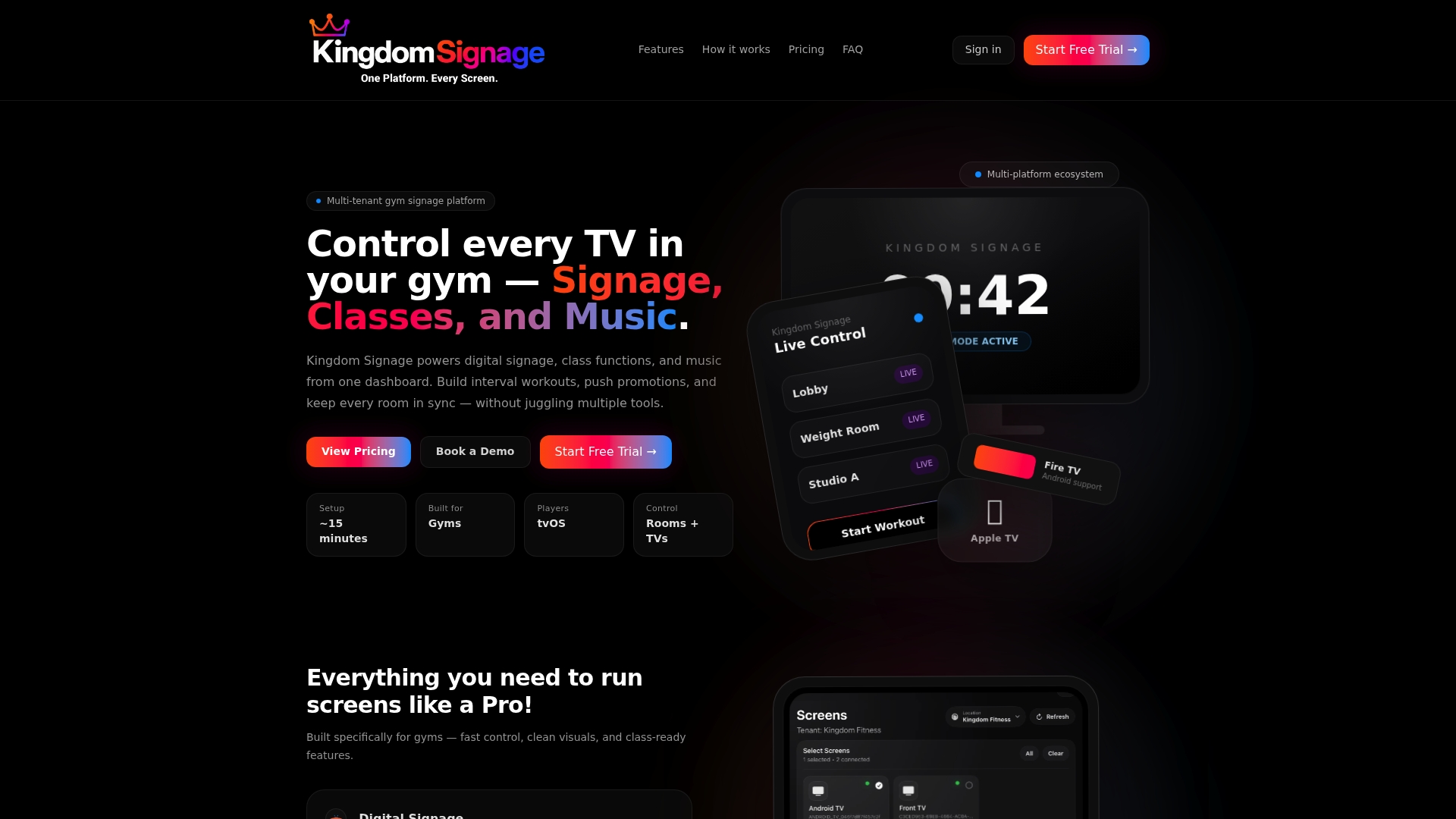
- We unify TV screens, class media, and room-based music across multiple locations from a single login.
- We give you playback history and dashboard filters, so a site check takes minutes instead of a trip to each room.
- We support exports that can be used directly, without a manual report-building step.
If you are managing screens across more than one room or more than one location, schedule a demo of Kingdom Signage and see how verification fits into a routine you already run.
FAQ
What is a proof-of-play log in digital signage?
A proof-of-play log is a record of exactly when a piece of content started and stopped playing on a specific device. The signageOS proof-of-play API documents this as a recordItemPlayed() event that reports in real time and buffers locally if the device is offline.
How often should a gym check its screen audit logs?
A short routine of 15 to 30 minutes per location, run weekly, catches most stale content and sync problems before members or sponsors notice, following a checklist like the one in Kingdom's site-check guide. Franchise operators with multiple locations often run this on a rotating schedule across sites.
Do audit logs for screens track gym members?
No, standard screen audit logs track content, devices, and staff changes to playlists, not individual gym members. Member-facing privacy obligations typically apply to separate systems like check-in kiosks or membership apps, not to signage playback records.
What should I ask a signage vendor about audit logs before signing up?
Ask for a sample proof-of-play export, confirmation of offline buffering, and details on retention and role-based access controls. Our platform includes playback history, exportable reports, and multi-room logging as part of its gym-focused dashboard.
How do audit logs help with multi-room synchronized playback?
Comparing proof-of-play timestamps across every device in a sync group shows whether rooms actually started shared content together rather than assuming a single confirmation covers all screens. Device status events in the same log, such as reboots or offline periods, typically explain which room broke the sync and why.